It was very appreciated since the Pharaohs and Babylonians, but the first certain citations of its virtues date back to Greek and Roman times. For Hippocrates, doctor, geographer and aphorist, considered the father of scientific medicine, he was precious for dissolving mucus in respiratory diseases, Aulus Cornelius Celsus, the great Roman scholar author of the treatise De Medicina, which expanded the Hippocratic categories of surgery, dietetics and pharmaceuticals and Galen of Pergamum who defined the theory of the four bodily humors destined to influence the history of medicine for centuries, they recognized exceptional virtues against intestinal pain, jaundice and poisoningthe. For Pliny he cured indigestion, caused sweet sleep, freshness to the face and attenuated the wrinkles of age. He didn't even shy away from her flavor and charm Charlemagne, who recommended cultivating it and had it planted in the imperial gardens of Aachen. Thanks to its therapeutic properties and use as a flavoring of foods, wines and drinks, it has had an important economic value and widespread diffusion in the past.
As we understand, it is an ancient and prestigious history of the green anise, a herbaceous plant of oriental origin, which incredibly owes its name to the Greek term anisos meaning “not equal”, with reference to the dreaded plant of hemlock, similar but different in color and size. A plant that does not exceed 50 centimeters in height characterized by small white flowers gathered in umbels that appear at the end of June. Fortunately, to avoid dangers due to its resemblance to the dangerous hemlock, today anise is cultivated throughout the Mediterranean basin.
A concentrate of properties useful in respiratory and digestive disorders, of antioxidants (vitamin A, vitamin C and manganese)
Centuries later, the intuitions and deductions of Hippocrates, Celsus and Galen have found ample confirmation in modern medical research. In fact, on the Humanitas website, regarding the properties of anise we read: Anise seeds are used in various traditional medicines to treat respiratory (asthma, bronchitis and cough) and digestive (flatulence, bloating, colic, nausea and indigestion) disorders. To its essential oils have been attributed antiseptic, antispasmodic, carminative, expectorant, digestive, stomachic, stimulant and tonic properties. It also appears that dill exerts an action similar to that of estrogen. From a nutritional point of view it is one good source of antioxidants (vitamin A, vitamin C and manganese) and molecules necessary for the proper functioning of the metabolism (group B vitamins), to keep bones and teeth healthy (calcium, phosphorus and magnesium), to promote good cardiovascular health (potassium and mono- and polyunsaturated fats) and to produce red blood cells (copper and iron).
To say Anice in Italy is to say Castignano, a small town of 2.500 inhabitants in the province of Ascoli Piceno in the Marche region, included in the Tronto mountain community, which has the pride of having given history its oldest Italic inscription found so far, the so-called stele of Carignano, a sandstone stone, about one meter high, dated around the XNUMXth century BC, which bears a boustrophedic inscription, written from left to right and then from right to left, on the sacredness of territorial limits.
But Castignano is surrounded by suggestive steep gullies, with its pyramid shape, which enjoys a magnificent panorama that ranges from the Conero to the Sibillini, the Gran Sasso, the Maiella, up to the sea. it is also known for cultivate one of the best qualities of green anise in Italy, a practice that dates back to the 1700s in the Marche region. In this area, in particular on the clayey and well-drained soils of the Castignano and Offida gullies, the sunny exposure and the fresh air currents that are created allow over the decades to select a particular ecotype of green anise, richer in aroma and sweetness, thanks to the extraordinary concentration of anethole (the aromatic compound of anise and fennel) equal to 94%.
The industrial adventure of Anisetta Meletti
In the Marche anise was consumed and marketed as early as the 700th century and its cultivation is widespread, especially in the Piceno area. In this area, particularly on the clayey and well-drained soils of the Castignano and Offida gullies, the sunny exposure and the fresh air currents that are created allow select a particular ecotype of green anise, richer in aroma and sweetness, thanks to the extraordinary concentration of anethole (the aromatic compound of anise and fennel) equal to 94%. It was precisely in Castignano that he left in 1870 the industrial adventure of Silvio Meletti who took advantage of the local tradition of anise distillation (a widespread activity in local families) to create the recipe for Anisetta Meletti, the liqueur which met with great success on the national and international market. A production that represented the main commercial outlet for green anise from Castignano until 1948. Subsequently, however, the ups and downs of the company and the progressive replacement of this ingredient with another variety of anise led to the decline of cultivation in Castignano. Despite her history and the fact that she has been the protagonist of famous books and films. The best-known reference to Anisetta Meletti is found in Carlo Emilio Gadda's novel Quer pasticciaccio ugly de via Merulana in which it appears as an expensive drink and is presented as a "classic". In literature, anisette is also mentioned in the novel L'Assommoir by Émile Zola when Gervaise enters the Assommoir tavern and also drinks this liqueur ("The anisette spoiled her stomach"). Anisette is also mentioned in cinematographic literature : the character Johnny Ola, played by Dominic Chianese, in the film The Godfather, in the scene in which he goes to visit Michael Corleone (Al Pacino), at the Godfather's family residence, accepts a glass of anisette for a drink. And other quotes can be found in two films Casino by Martin Scorsese, where Joe Pesci annoyedly narrated the sweet idleness of the mafia bosses while they sipped anisette, and in Goodfellas where it is mentioned again by Joe Pesci during the first four-way date as his favorite liqueur after lunch. Worth mentioning again is the film Yuppies – The successful young people, a 4 film directed by Carlo Vanzina, as the favorite liqueur of Cinzia De Ponti, lover of Guido Nicheli.
Not just liquor. Castignano Anise was also traditionally used to make sugared almonds and sweet donuts, for the dough of which flour, sugar, oil and white wine are used. Classic use in herbal tea, as a decoction and the transformation into anise milk, which is obtained by crushing the seeds and leaving them to infuse for 5 minutes in boiling milk.
To keep alive a historical tradition that risked becoming just a memory Slow Food has started a project to safeguard green anise thanks to the recovery of the seed from the last remaining farmers in the Castignano countryside. Today this seed is part of the regional biodiversity register of the Marche and its conservation is entrusted to the producers involved in the Slow Food Presidium, who have the role of custodian farmers. Among other things, the flowering, harvesting and drying of the plants (in August) are also important tourist attractions in the area.
Finally, a curiosity, in 1687 the Venetians conquered Mistrà (not far from ancient Sparta) and discovered ouzo, the traditional Greek anise liqueur. They renamed it with the name of the city and imported it home. From a typical product of the Serenissima, mistrà later became the symbolic liqueur of the Marche.
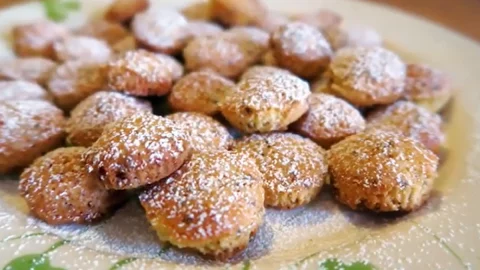
The recipe for Castignano green anise biscuits
Ingredients (for approximately 400 g of biscuits)
60 g of butter at room temperature
125 g sugar
2 eggs
1 teaspoon of baking powder
15 g of green anise
150 g flour
1 cup of anisette
Preparation
Beat the butter and sugar with an electric whisk until creamy.
At this point add the two egg yolks, the yeast, the anise and the flour, continuing to mix. Finally, add the whipped egg whites.
Transfer the mixture obtained into a piping bag and pour small pieces obtained into a bowl containing anisette and water. Place each piece in the baking cups and sprinkle with sugar.
Bake in a hot oven at 170° for about 15 minutes, until they are coloured.