— l'Adret — exposed to the sun, where temperature variations are marked, is not simply agriculture: it is the testimony of an act of profound cultural fidelity to the history of man and that of the mountains. On these rugged terrains, viticulture is truly heroic, and here a family-run winery, Rosset Terroir, has succeeded in transforming the limitations imposed by nature into strengths recognized by the international winemaking scene in just a few years.
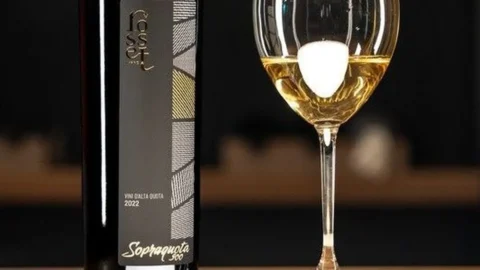
The history of the Rosset Terroir winery, spanning a quarter of a century, demonstrates a profound belief in wines that speak of altitude. Even the names of the labels—like Sopraquota 900, Pinot Noir 850, Syrah 870, Chardonnay 770—aren't just numbers, but coordinates of a precise identity. They indicate the altitude of the vineyard of origin, underscoring how the location isn't just a backdrop, but a protagonist. It is precisely on these rugged slopes, at over 900 meters above sea level, that the Rosset Terroir is born. Above 900 2022 quotaPetite Arvin, which achieved 98 points, among the highest scores awarded to an Italian white in the latest vintage, from James Suckling, one of the most authoritative international wine experts and European editor-in-chief of Wine Spectator, who every year publishes eagerly awaited dossiers on the most important European wines.
Harvested by hand in October, Sopraquota 900 is then divided into four batches and aged partly in amphorae, partly in Tuscan jars, partly in barriques, and the remainder in steel to achieve a pleasing balance between flavor and minerality. On the nose, Sopraquota 900 2022 opens with a refined and elegant bouquet, dominated by aromas of white flowers and orange blossom, combined with citrus notes of grapefruit and lime zest, enriched with delicate hints of tropical fruit.
Pedological conditions, combined with the altitude and optimal exposure, contribute to the production of vertical and territorial wines, with marked qualities of freshness and longevity.
A fine and intense aromatic complexity, supported by the typical freshness of altitude, deep moraine soils (up to 150 cm), sandy-loam or sandy-loam in texture, with a marked presence of gravel and pebbles and a high percentage of sand (over 50%), which ensure excellent drainage and good root aeration. The silt content also ensures adequate water retention, promoting a balanced vegetative-productive cycle even under stressful conditions. These soil conditions, combined with the altitude and optimal exposure, contribute to the production of precise, vertical, and territorial wines, with marked freshness and longevity.
Distillers for generations, deeply rooted in the mountains and artisanal know-how, the Rosset Levi family decided in the early 2000s to plant the first rows of vines in the municipality of Saint-Christophe, just outside Aosta, transforming their expertise in aromas and botanicals into a new form of expression: wine.
The first varieties planted were Chardonnay, Syrah, and the native Cornalin. Within a few years, the company grew, expanding its vineyards and selecting new, particularly suitable plots, including Moscato Bianco di Chambave, Pinot Gris, and new Syrah parcels.
The turning point came in 2017, when Rosset Terroir moved beyond 900 metres above sea level, in the municipality of Villeneuve, starting the cultivation of the traditional Petite Arvine grape variety.
The story began in 2001, with the planting of the first three hectares of vineyards in the municipality of Saint-Christophe, just outside Aosta. The first varieties planted were Chardonnay, Syrah, and the native Cornalin. Within a few years, the winery grew, expanding its vineyard area and selecting new, particularly suitable plots, including Moscato Bianco di Chambave, Pinot Gris, and new Syrah parcels. The turning point came in 2017, when Rosset Terroir expanded to over 900 meters above sea level, in the municipality of Villeneuve. On particularly steep slopes, in a context of heroic viticulture, the traditional Petite Arvine grape was cultivated, which gives rise to the winery's flagship wine: Sopraquota 900.
Today, Rosset Terroir boasts approximately 13 hectares of vineyards and an annual production of approximately 50.000 bottles, 30% of which is exported, from Switzerland to Japan, via France, Belgium, the United States, and Indonesia, demonstrating a new focus on the mountains. Alongside wine production, the love and attention to the mountains is also expressed in the cultivation of raspberries, saffron, and génépy, giving rise to a line of artisanal spirits, an expression of integrated, sustainable Alpine agriculture, respectful of the seasons and biodiversity.