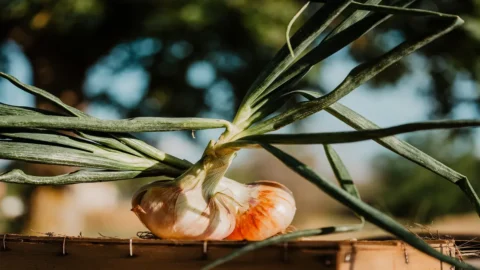
It's delicious raw as a salad, and cooked in frittatas, as a pasta sauce, stuffed in the oven, or sweet and sour. It's incredibly versatile in the kitchen, prized not only for the sweetness and flavor of its bulb but also for the flavor of its green stem, excellent for frittatas. And, last but not least, it can be cooked... without moving to tears.
The Castrovillari white onion, the pride of the Pollino town, was once cultivated by almost everyone, especially in the more fertile lands near waterways. It was among the vegetables that for centuries ensured the local population's subsistence, so precious that it was used as a bargaining chip with Lucanian shepherds in exchange for their cheeses. However, with the gradual abandonment of the countryside, it fell into oblivion. Fortunately, some growers, out of tradition and the memory of their ancestors' work in the fields, preserved and passed down the seed. Then came the recognition of the municipal denomination, and more importantly, it became a full member of the Slow Food Presidia, and the white onion regained popularity among local producers. "Today, the total area under onion cultivation is nearly twenty hectares, partly managed by the six producers who belong to the Slow Food Presidium," says Vincenzo Alvaro, Slow Food coordinator for the Presidium. "The group is made up primarily of young people who, united by the desire to care for the Castrovillari onion, have become involved with Slow Food."
A light-colored bulb, sweet in flavor, and easily digestible even when eaten raw, the Castrovillari white onion has thus been added to the already rich basket of onions—with it, there are now 18 throughout Italy, from north to south—found and protected by the Chiocciola association.
"It's very good, even sweeter than the red Tropea onion," continues Alvaro. An onion "that doesn't make you cry, because it has very low pyruvic acid levels," adds Carlo Pontevolpe, coordinator of the six producers who belong to the Presidium.
The production regulations adopted by the Presidium producers establish agricultural techniques and practices to be followed in the field and prohibit the use of chemical fertilizers. The onion ripens between May and June, when the outer skins turn light pink and the bulbs can weigh up to a kilo. However, it's not uncommon to harvest fresh spring onions between late winter and early spring. In this case, Alvaro explains, "the green stem emerging from the ground is also edible, and traditionally used in omelettes." Production remains very small, however, and the annual harvest does not exceed 100 quintals. In the kitchen, the onion has many uses: a key ingredient in bread cooked with broth, mashed beans, extra virgin olive oil, salt, and cheese, the Castrovillari onion can also be used in vegetable carbonara, legume soup, or in the preparation of "eggs in purgatory," made by soaking eggs in tomato and onion sauce, perhaps sprinkled with crusco peppers. Pontevolpe adds, "Farmers once carried it with them on days spent in the fields and during the transhumance in the mountains, because it boasts a very high concentration of water, sugars, and mineral salts." Castrovillari onions can also be found in oil, preserved or as a pâté, and even dehydrated (for topping pizzas and focaccia).
Traditional recipes
We've already mentioned its versatility in the kitchen, so here are some of the most popular traditional Calabrian recipes.
White Onion Salad: Thinly slice the onion and season with olive oil, vinegar, salt, and pepper. Add fresh parsley and serve as a side dish or appetizer.
Onion Frittata: Sauté the onion in a pan with olive oil until soft. Add beaten eggs, salt, and pepper, and continue cooking until golden brown.
Onion Sauce: Sauté onion, garlic, and olive oil, adding peeled tomatoes. Simmer for a delicious sauce to serve with pasta.
Stuffed Onion: The center of the onion is hollowed out and filled with ground meat, breadcrumbs, eggs, and cheese. Bake until golden brown.
Sweet and Sour Onion: Sauté onion with sugar, vinegar, and raisins. The result is a sweet and sour onion, perfect for accompanying cheese or meat.