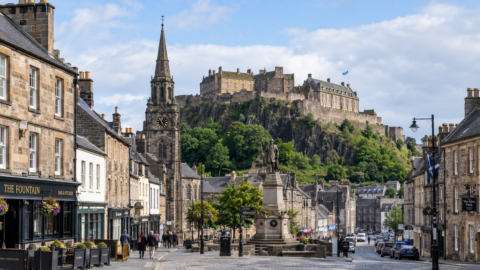
In the Middle Ages it was called the village of bells, in fact here the bells destined for the churches of the whole region and beyond took shape from the fusion of copper, tin and bronze. An activity in decline today, undermined by modern digital technology that re-proposes their sound from the bell towers without the help of man. If the bells always remain a glory of the town, the small town of Tortorici with 6000 inhabitants, in the province of Messina, has over time also linked its name to a thriving production of quality hazelnuts, thanks to the presence of numerous woods rich in hazelnut groves. scattered throughout the 72 villages, to the point that in addition to the nickname of "city of bells" it has also earned that of "City of hazelnuts".
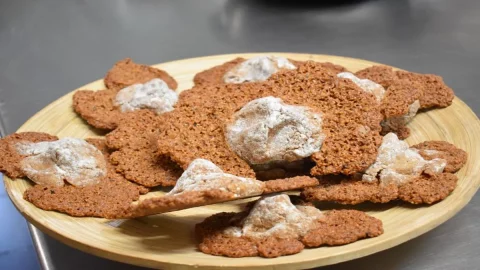
And the hazelnut is the basis for the preparation of a typical specialty of Tortorici much appreciated for its taste and simplicity of flavor: the Royal Pasta which due to its originality obtained last year to become part of the Slow Food Presidia .
The recipe that dates back to 1600 is simple but insidious, the secret of the central swelling that must reproduce Mount San Pietro
It is a dessert, a simple recipe for the preparation of which only three ingredients are needed: water, sugar and chopped hazelnuts, obtained from the fruits of plants that strictly come from the Nebrodi park, an area of great biodiversity, where still numerous local ecotypes of hazelnuts ('carrello', 'ghirara', 'crucia' and other ecotypes generically referred to as 'minnulara'). The hazelnuts are toasted, then crushed and mixed with sugar and water. The dough rests for a few hours and then pinecone-shaped loaves are formed which are placed in a pan to rest for two, three days, depending on the weight. Baking takes place in the oven where, having reached about 160°/170°, the sugar melts, emptying the shape inside and creating the characteristic central swelling. The caramelization temperature gives a more or less dark color to the paste.
«It is a preparation with very ancient origins, of which we have evidence as early as the end of the seventeenth century» says Lidia Calà Scarcione, pastry chef and contact person for the two producers who are currently members of the Presidium. History takes us back to the time when, in Tortorici, there was the convent of the Poor Clare nuns: as in many other cases, the dessert was born from the tradition of the convents, where the nuns lived, prayed and used to prepare sweets and biscuits. "But then, with the laws of 1866 and 1867, the newborn Kingdom of Italy confiscated ecclesiastical assets - adds Vincenzo Pruiti, Slow Food contact person of the Tortorici Royal Pasta Presidium - and so the convent of the town was also closed" . The nuns, effectively displaced, were welcomed into the homes of the wealthiest families of Tortorici, bringing with them and handing down orally the secrets of preparing the cake.
The Slow Food presidium that safeguards a tradition that dates back to the convents of the Poor Clares confiscated by the Kingdom of Italy
Yes, because despite having very few ingredients, the preparation hides some pitfalls: the particularity of the dessert lies in the fact that it has a flat and irregular shape, with a fundamental swelling in the central part. «According to some, it is a tribute to the mountain, Monte San Pietro, which overlooks the town. For others, however, it would look like a crown, and in fact it was customary to offer pasta to the rulers» continues Calà Scarcione. But, beyond the legend, the fact remains that that swelling occurs during cooking: «In the oven, sweets explode – continues the producers' contact person -. There is no precise recipe, much depends on how the toasted hazelnuts are chopped: according to their fineness, the chopped hazelnuts absorb more or less water; therefore, you have to adjust with experience and dexterity». Once the mixture of water, sugar and chopped hazelnuts is prepared, with the help of a little flour, it is formed into spheres and left to rest on a wooden cutting board for two or three days, depending on the climate and temperature. At that point, they are baked and the marzipan is expected to burst, melting the sugar and generating the characteristic shape of the cake.
The hazelnut economy after last century's phylloxera which decimated the vineyards, a heritage of biodiversity
«Sicily is not only almonds and sweets based on almond paste – continues Pruiti -. Here in the province of Messina there is a long tradition linked to hazelnut groves and hazelnut-based products are second to none other than the exceptional almonds». The presence of the hazelnut, continues the Slow Food representative, has been witnessed in these parts since the sixteenth century: «The area in which we live is mountainous and this plant lends itself well to this type of soil, because it has dense but superficial roots. In addition to the morphology of the area, there is also a historical reason which caused hazel groves to spread further at the beginning of the last century: the arrival of phylloxera which decimated the vineyards. Desperate, many peasants chose to plant hazelnuts». Thus, within the Nebrodi Natural Park, numerous local ecotypes of hazelnuts are still preserved today: a heritage of biodiversity that makes the fortune of the place and of those who know how to exploit the fruit of these plants in pastry-making. «Hazelnuts are the fruit of our territory – concludes Lidia Calà Scarcione – and the marzipan of Tortorici, from this point of view, is emblematic of this corner of Sicily». A heritage that is however in danger: «I note a progressive abandonment of the hazelnut groves, which were once the main source of livelihood for the inhabitants of the area. Today the plants are abandoned because the land here is not flat; therefore, cultivating them is tiring and not very convenient: there is no possibility of mechanizing the work or of having particularly large plots. But abandonment is not without consequences: it means that the forests "get lowered"; in other words, vegetation is reconquering areas that were once cultivated».
It may seem paradoxical, in an era marked by soil consumption, wild urbanization and the anthropization of natural habitats – reads a Slow Food note – to lament the advance of the woods. Yet, although seemingly counterintuitive, the phenomenon is problematic. For centuries, in fact, agriculture was the tool with which man entered into relationship with nature, even domesticating it and making it productive, always respecting an implicit pact: working the land to reap its fruits, but protecting the balance and the regeneration capacity of the soil. But there can be no balance and regeneration either in abandonment or in overexploitation, two widespread trends that today we must reverse globally. Here, then, is the value of a Slow Food Presidium and its producers.
If you pass Per Tortorici it is worth stopping not only to stock up on Pasta Reale, but also to attend the long festival in honor of S. Sebastiano which begins on January XNUMXst with the ringing of the bell and the exposure of the Saint to the city.
The first event is the Bula which falls on the Saturday closest to the holiday. On the Sunday before the Festival, in the morning, upon returning from the procession of S. Antonio Abate, the devotees begin the Laurel Parade along the streets of the city up to the Church of S. Maria Assunta. During the long procession towards the Mother Church, players of bagpipes, accordion and tambourines accompany the devotees.
The "naked" penitential men for the feast of San Sebastiano, the complex relationship of the city of Tortorici with the rivers
The real party is celebrated every year on January 20; devotees who have a vow to fulfill go "naked" to the Saint: the men, as a penitential sign, dress in white with shirt and trousers, a handkerchief folded in the shape of a triangle around their waist and bare feet; the women, also barefoot, wear white shirts and skirts, with a handkerchief covering their heads. They precede and follow the Saint in the procession or in the begging. The religious rite is celebrated in the Church of S. Maria Assunta, with the participation of the local authorities and renewing a centuries-old tradition that takes the name of the Senate: the Jurors in the 600s, the Senators in the 700s and the Mayors from the 800th century onwards, preceded by the dealers, they go to the Church, handing over the keys to the city as a sign of homage to the Saint. At noon the procession begins through the streets of the city. The artistic "Vara" is worn only by the nudes, and represents a privilege but also a penitential obligation. The first stage of the procession is in the Calagni river where the devotees make the vara stop invoking grace: this rite represents the complex relationship of the city of Tortorici with the rivers, which have always supplied water for food needs, for the irrigation of fields, to make mills work, but which often, however, with floods or deluges, have destroyed or damaged the territory. The saint is invoked to avert damage. After stopping in the Calagni river, the «questua» begins, the Saint is taken through the streets of the city returning to the Church of S. Nicolò where he remains until the eighth grade.
On the Sunday following 20 January, the "octave" takes place: the statue of the saint is carried in procession again, until it arrives in the Mother Church. Right here, the following day, "u pirdunu" (in Italian, forgiveness) is celebrated, in which Saint Sebastian is asked for forgiveness for the sins committed on the feast day.