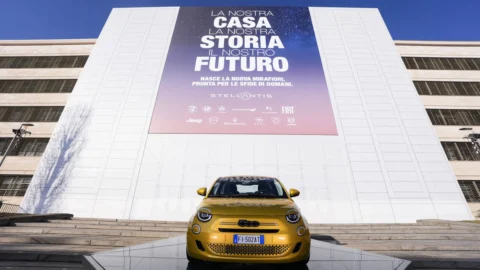
These days you can see them at the cinema, on TV and on social media the first commercials of new Fiat 500 Hybrid, entrance in production at Mirafiori and that we will soon see roaming our streets. They are commercials full of nostalgia in which two Fiat Nuova 500 Hybrids, one blue and the other yellow, the colours of the city of Turin, are inserted, in old black and white archive footage, on the assembly lines of the old Fiat 500, the one in Valletta, to underline the continuity between the past and the present, to the tune of “Ritornerai” by Bruno Lauzi, or the one in which the new 500 drives around the streets of monumental Turin at night with “Nessuno” sung by Mina in the background, or, better yet, the Baby Gate of the 1950s.
In the company plans the new car has the task of relaunching Mirafiori, the Great Factory, grey and industrious, around which the entire city has orbited for decades: economic, political, social and, why not, even sporting.
The golden years of “La Mirafiori”
“La Mirafiori”, as he loved to sayLawyer, was, in the years of greatest development, the largest automobile plant in Europe, with over 70.000 employees and a daily production of over 4.000 vehicles, nearly a million a year. Modeled after American plants, particularly Ford's Baton Rouge plant, the Mirafiori plant was conceived at a time when global industrial development was based on mass production and the mass market, and thus on the need for plants large enough to maximize economies of scale.
The concentration of car production in a single factory in the 1950s and 1960s and the urbanisation of tens of thousands of farmers from the south who were transformed into workers were indicators of the driving force that pervaded those years. Turin, transformed into a factory town, but they were also the causes of the subsequent social tensions which were revealed in the following years.
These are the years in which the Big Factory is identified with its products, the “500” and the “600”, but these are also the years in which, with the Fiat Student School, industrial culture, until then the prerogative of a restricted managerial and entrepreneurial elite, also becomes the heritage of a large section of the company population, made up of executives, technicians and professional workers.
Not only that, but the Fiat School graduates young people who will become famous car designers and stylists or entrepreneurs who, in the following decades, will form the backbone of the automotive supply chain not only of Fiat but also of the European automotive industry.
Crisis, workers' struggles and the end of the golden age
Starting from the “hot autumn” of 1969, Mirafiori, with over ten million hours of strike, however, takes on a totally different image in public opinion, becoming the symbol of trade union struggles and permanent conflict. The seventies mark a deep crisis for Mirafiori. On the one hand, the car market is heavily hit by the first oil shock of 1973 and will remain stagnant for the next few years, on the other hand, with theworsening of trade union struggles and the multiplication of strikes, the production process becomes unmanageable. Added to this is the Red Brigades terrorism, which made Mirafiori its favorite target with over forty attacks, some of them fatal, on its managers, bosses and executives.
With a rate of daily absenteeism of over 20 percent and a lack of productivity of around 30 percentage points, every year at Mirafiori thousands of new hires are made in a continuous race to fill the efficiency losses and the high turnover rate; and when the Italian market shows scant signs of recovery, as in thesummer of 1977, the union is blocking the company's request for seven Saturdays of overtime on the “127” lines, which the company is making up for by importing the “127 Rustica” from Brazil (!).
The turning point came in the autumn of 1980 with the "march of the forty thousand" and the defeat of the opposing union after the total production halt for 35 days. Furthermore, on the industrial level, with the development of the plants in Cassino, Termini Imerese, Termoli and Sulmona, Mirafiori had lost its role as the central production hub of the Fiat system in the previous decade, going from a production of one million cars per year to less than half.
From Ghidella to Marchionne: Rebirths and New Declines
Will Victor Ghidella, the new head of Fiat Auto, once the governability of the management of the Big Factory has been restored, to relaunch its production with three models which allowed Fiat to become the European market leader in 1986 with an 18% share, surpassing Volkswagen, as well as being the leading foreign importer on the French market against German manufacturers, and the leading importer in Germany against French manufacturers.
They were called success Fiat Uno with 3300 cars produced daily (the best-selling car in Europe in its market segment), Launch Thema e Fiat Croma, with assembly lines churning out over 500 a day (a production at the time greater than that of the Mercedes plant in Stuttgart and that of BMW in Munich).
After Ghidella's exit from the company At the end of the 1980s, the reasons for which have never been fully clarified, Fiat, partly due to the loss of competitiveness and attractiveness of its product, declined in market share in Italy and Europe, going from the European market leader to a 7% share, not only behind the German and French manufacturers, but also behind the European subsidiaries of the American and Japanese companies. These were the years in which volumes were generated by the Punto. in the new Melfi plant with 2000 cars a day for 6 days a week, while the Fiat Multipla, the Alfa 166 and the Lancia Thesis are produced in Mirafiori.
Fiat overcomes the crisis of the early 2000s with the arrival of Sergio Marchionne, which focuses on development through investments and launch of new models, particularly at Mirafiori. Production at the Grande Fabbrica, with the redundancy fund eliminated, will once again reach 1000 cars per day and over 200.000 per year with the launches of the Grande Punto, the Alfa MiTo, the Fiat Idea, and the Lancia Musa. Overtime on Saturdays will also return.
Sergio Marchionne goes further on Mirafiori, howeverOn the one hand, he is the creator of a new industrial vision of the factory, in which heavy and repetitive work is performed by robots, noise is almost totally absent, spaces are large and bright, ergonomics, with the ErgoUAS system, is the cornerstone of work organization. With the WCM methodology (World Class Manufacturing) the new industrial vision dismantled traditional hierarchical structures and organizational complexity, replacing them with an organization that distributed decision-making power horizontally to all collaborators (workers, technicians, managers) deemed most suitable to exercise it at the various levels.
La new organization of the work left as a legacy by Sergio Marchionne was however drastically eliminated, because it was deemed too expensive, by the French management appointed to lead Stellantis, the company born from the merger of Fiat, Chrysler and PSA in 2021.
The another legacy Sergio Marchionne's legacy at Mirafiori is the redefinition of the plant's production structure from a "generalist" plant, producing cars from various ranges, to an "exclusive producer of premium cars" such as Maserati, with an annual production of over 50.000 units, primarily for the American market.
Also in this case, Carlos Tavares, the French manager (although of Portuguese nationality) of Stellantis was unable to manage and develop the "Luxury Boutique" in Mirafiori, causing Maserati production to collapse, and focusing on the electric Fiat 500 which in the last two years, however, has remained well below the installed production capacity of over 80000 cars per year, also due to the lack of appeal of the electric market in our country.
In the meantime, recourse has been made to a wide range of social safety nets, from redundancy payments to solidarity contracts, from early retirement to incentivized exits, reducing the overall workforce, workers, employees, technicians and professionals, to less than 12000 people in the entire district.
The long-awaited relaunch with the new 500 Hybrid
Now the new one Fiat's New 500 Hybrid is expected to relaunch Mirafiori. With an expected annual production of 100–150.000 vehicles across two shifts starting early next year, the first 5000 already produced in recent weeks. A positive signal was given by the new CEO of Stellantis, Antonio Filosa, with the announcement of the hiring of 400 young workers, who will receive training to acquire the knowledge and skills necessary for their successful placement on high-tech production lines.
The last hiring of young people at Mirafiori took place in 2008 with the launch of the Grande Punto.