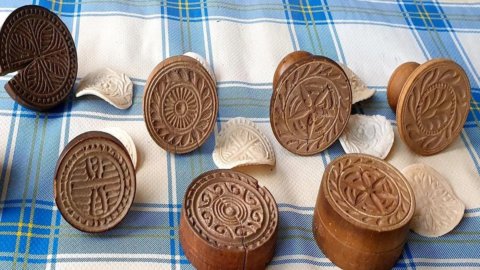
In the popular culture of Eastern Liguria it is known as the "coin in the pot", a type of fresh pasta from very simple recipe: flour 0, eggs, water and a pinch of salt. The peculiarity lies in the shape and in the way in which it is obtained: the dough is rolled out and cut out with special cylindrical molds built by hand by local craftsmen thanks to which "discs" are obtained which bear the engraved design on the wood itself. A procedure that recalls the one used to mint coins.
But Croxetto is much more than a pasta, albeit a very particular one due to its shape, it is lidentity of a gastronomic culture strictly limited to the Varese Ligure area, in the province of La Spezia, which has been handed down for centuries.
Around Liguria – and also in the French region of Provence there are different types of pasta called crosetti, curzetti or cruxetti. But it is only in the extreme Levant of Liguria, between Chiavari, Lavagna, Sestri Levante and Varese Ligure, that croxetti are firmly linked to the history and gastronomic culture of a territory. A culture which, precisely because it is closely linked to the craftsmanship of the local engravers who have handed down this particular technique from father to son, and due to the events of life and of the various generational formations, risked extinction. Danger escaped fortunately with the entry of Slow Food which included the Croxetti among the principals to be protected and promoted.
Though the origin of this fresh pasta is not easily datable, there is no doubt that the first records must be sought several centuries ago, perhaps even in the late Middle Ages.
«The very fact that the name croxetto - says Edmondo Colliva, Slow Food representative of the Presidium, passionate and lively lover of local gastronomic traditions - keeps the x is proof of how ancient the tradition is. This letter of the alphabet, which in the Ligurian dialect is pronounced as a sweet g, was, in fact, very widespread at the time of the Serenissima of Genoa. And the name itself could derive from crosetto, the term used to indicate the coins minted at the time of the Republic of Genoa and on which a cross was often depicted”.
Dish symbolizing great occasions, cAs has been said, however, the croxetto does not represent only a culinary tradition: in fact, in these areas of eastern Liguria, for centuries the custom has been handed down that the father of the groom would pay homage to the future daughter-in-law with a tray of croxetti accompanied by the relative wooden mould. The designs of the molds were simple, geometric shapes, or at most it could have been a design requested by the family that commissioned its construction.
«Even today, there is no family in Varese Ligure that does not bring this pasta to the table at least once a year, for an important occasion» says Colliva. Yet there is a risk that this typicality will be lost: although widespread, the habit of preparing croxetti remains, in fact, mostly «family, private»
So one long history that starts from the historical period occupied by the Maritime Republic of Genoa (1200-1815) this period in which the same as well as fulfilling all the tasks and issues relating to the management of the important territory - recalls Colliva - also did all that set of practical actions that need and compete for a real state such as it was, one of these was to coin money.
The fact that the cross was shown on almost all the coins certainly contributed to the denomination of the homemade pasta we are now talking about. But why get to coin at home with this typical methodology of the Mints, the thing derives from the fact that, even if they were under the dominion of the Serenissima, the various podesterias, especially those more isolated in the interior, they also minted their own local coins so on the wave of this practice we think this one was inserted by osmosis or better still "Frenzy of Minting". It was the pasta for special occasions and parties.
But Croxetto, in addition to family traditions, also had moments of great aristocratic glory. How did it happen when Elisabetta Farnese princess of Parma and Piacenza, passing through Varese Ligure on his relocation trip to Spain to marry King Philip V, stayed at the local noble family, the Cesenas, who cooked in his honour, the dish reserved for important days or holidays, the Croxettis.
They can be found with different dimensions (65/55 mm) and designs, simple or elaborate as noble family crests, depending on who had commissioned the "minting" but all aimed at leaving a fleeting mark on the pasta which was made useless with its consumption , to reappear as if by magic the next party. More than linked to a specific place, during the research study on the history of the particular fresh pasta - says Colliva, who is a mine of information - we found that the presence and tradition of the Croxetti concerns, yes, the whole east, but preserved intact in the name and in the formula of the ingredients only and particularly in the hinterland less subject to contact and contamination due to the presence of different peoples, this is the case of the Val di Vara and specifically of Varese Ligure. With regard to the manufacturing of the wooden mint, there are two types of different diameters and invoices, on the Tigullio area the smallest 55 mm. and less cared for as a chisel, while in the Varese Ligure area with a greater diameter of 65 mm. with more refined chisel carving and above all functional for the purpose in its use, making it possible to work the dough better or at least to detach it easily from the lower and upper mold, thanks to a circular diamond processing near the edge of the circle .
RECIPE
The recipe for preparing Ligurian croxetti for 4 people
Ingredients for the dough:
6 ounces of flour, 2 eggs, a knob of butter, a handful of Parmesan, a glass of water, salt.
Ingredients for the pine nut sauce:
150 g of pine nuts, half a clove of garlic, a little marjoram, enough oil, a little milk (to soften) and a knob of butter.
Preparation:
On a pastry board, make a mound of flour, add all the ingredients, knead until you obtain a homogeneous paste, roll it out, mash it well with the croxetto to cut the medallion and at the same time engrave the design well. Let rest. To prepare the sauce, chop the pine nuts with half a clove of garlic and a handful of marjoram. Add the oil, a little milk and the butter. Boil the pasta for about 5 minutes, strain and season with chopped pine nuts.
THE CONDIMENTS
At the beginning the condiments were very simple almost basic, borrowed from the medieval dominations of the Serenissima in the East so we practically find the use of garlic combined with other ingredients such as oilseeds, walnuts and pine nuts in addition to the obvious aromatic herbs or aromas as in primis marjoram and in any case always In combination with olive oil and cheese, which in the period of the Republic of Genoa consisted almost exclusively of Sardinian and Corsican pecorino, only at the end of the eighteenth century and the beginning of the nineteenth century does the use of Parmigiano Reggiano, butter (for creaming) and basil. With the increase in livestock farming, especially in the hinterland, we have a transition to the use of meat in sauces. The first and best known of these is that of veal or beef in the thigh or in the culatta called "Tuccu", even if there were other variables with white meat poultry.