Giorgia Meloni's speech in Parliament, delivered while the world is in flames and threatening to explode, was a nervous provincial rally, halfway between a cloying list of the things wonderfully accomplished in four years of government and a stubborn polemical resentment toward the left. But Schlein and Conte also used the same tone. Not a shred of strategic analysis of what is happening, not a hint of self-criticism in support of a change of tone on issues and interlocutors, not a single proposal.
The above is an excerpt from Enrico Cisnetto's weekly newsletter. To these considerations, one might add the spectacle of Meloni's subdued posture ("her soft braids spread across her heaving chest") and Schlein's arrogant demeanor, which prompted her to hurl at the government the accusation leveled by Antonio Gramsci against the special tribunal that had convicted him ("it will be up to us communists to save the country you have brought to ruin").
Even political controversy, however, should have rules: criticism should stick to the facts and not be expressed through generic accusations unrelated to the current situation in the country. Even if it's true that "after four years, no Italian citizen can say they're better off than when the Meloni government took office," it's equally true that no Italian citizen, for decades, has had to deal with a "piecemeal" world war and its inevitable consequences. Furthermore, the Democratic Party secretary's other accusation, echoed during the debate by other opposition members, is untrue. "This government had a historic opportunity and squandered it: you had the numbers to do everything, and you did nothing."
The task of a government and a majority in a country like Italy, burdened by enormous public debt and forced by the pandemic emergency to break the rules of balanced public finances, is to "do," or act correctly, even when it takes on the task of reorganizing public finances, a difficult but necessary operation within the framework of rules defined at the European level.
It's worth noting that the government has resisted the temptation to dismantle the pension system, refraining from adopting the measures that the ruling political forces had advocated for years. These measures are now being advocated by the left. Balancing public finances is not a luxury, a whim, or an option, but a prerequisite for a country's political and economic stability. In this area, the Italian government has achieved positive results, recognized as such internationally, at the same time as it faced a serious energy, raw materials, and international trade crisis. What is the treatment advocated by the left in these cases?
The suspension of the Stability Pact to tap into resources that, in reality, aren't there because they're borrowed and borne by future generations. Added to this is the usual "whataboutism" when the question of armed defense arises. "Your Italy is based on poor and precarious work," Schlein added. "It will be up to us to approve the minimum wage, fight precarious employment and forced part-time work, implement equal leave, address job security, and pass a law on delivery riders." These accusations also fail to take into account a changing reality reaffirmed by the OECD at the very same time as the parliamentary debate: Italy's economic performance "has improved over the last decade" and "per capita GDP is growing." Rising employment has driven this improvement. Unemployment has fallen to historic levels, and more women and older adults have entered the workforce. Investment has increased.
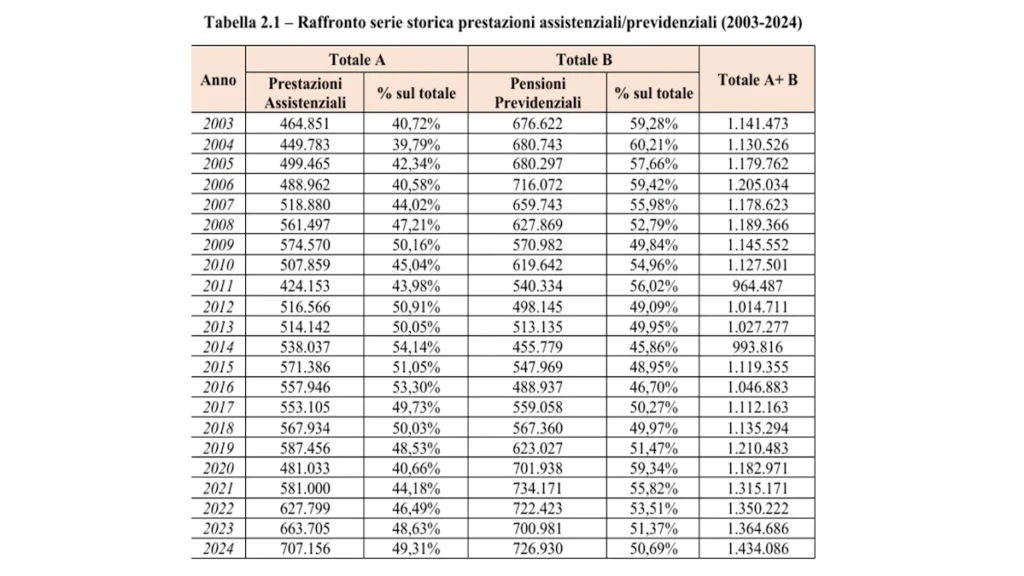
Although labor productivity "improved" at the end of the first decade of the 2000s, "it has since weakened, as strong employment growth generated by labor-intensive service sectors has outpaced overall production growth." Then there is Istat—cited by Meloni—whose figures certify that compared to the beginning of the legislature, there are almost 1,2 million more permanent workers and over 550 fewer precarious workers." These data are denied by the left with arguments worthy of the sports bar, the most common of which is to attribute the increase in employment to the fact that—due to the Fornero law—workers can no longer retire, a refrain that is contradicted by official statistics, as the following table demonstrates.
Certainly, compared to other countries—the government also acknowledges this—there are many shortcomings to overcome in terms of employment and wages. "There is much to be done, for example, regarding women's employment." In recent years, the Prime Minister emphasized, the female employment rate has increased by two percentage points since Italy took office, and we have surpassed the ten million female workers mark. But Italy still lags behind in Europe. Supporting the growth of female employment remains our priority.
The inflationary surge between 2022 and 2023, combined with the delay in contract renewals, has destabilized wage levels in another context. But a recovery is underway: "Italian wages," Meloni continued, "have started to grow again, allowing Italian families to regain, albeit slowly, the purchasing power lost in previous years. As in 2024, in 2025 too, contractual wages grew faster than inflation, and household disposable income increased, albeit not enough for us. And, as Istat noted a few days ago, in 2025, the number of people at risk of poverty or social exclusion decreased, albeit slightly."
Truth be told, just as it's incorrect to blame the government for low wages, it's equally incorrect for the government to attempt to take credit for improvements, which largely stem from the dynamics of productive forces. Recall when Trump's tariffs were blamed for the impending catastrophe with widespread layoffs. Yet, our exports increased by 7%. The social partners and the industrial relations system are responsible for low wages, while they largely deserve credit for their improvement. "It's inappropriate," the Bank of Italy argues, "to assign the public budget the task of recovering workers' lost purchasing power, especially when companies' profitability allows this to happen through bargaining."
Governments can intervene on the fiscal and parafiscal fronts. It is worth recognizing the significant commitment of public budgets to addressing this situation through fiscal measures and transfers. The UPB points out that the various changes to personal income tax (IRPEF) over the past six years (on the structure of tax rates, the breakdown of income brackets, social security contributions, deductions for earned income, and those for expenses incurred by higher-income taxpayers), including the transfer to personal income tax of income support measures for employees introduced to address the inflationary crisis of 2022-23, have increased the progressivity of the tax, resulting in a redistributive effect favoring lower incomes—from 10 to 32 euros—who have recovered the entire fiscal drag at the expense of medium-high income taxpayers, with clear differences in treatment across taxpayer categories, especially for employees.
The UPB also emphasizes that, over the same period, families with incomes below 35 euros achieved net benefits of €18,6 billion over the three-year period, excluding personal income tax (IRPEF). Regarding productivity wages, a favorable tax regime has been in place for at least 15 years, set to even be reduced to 1% in the 2026 budget. We can say that the tax system—despite all the limitations noted—has played its part in protecting incomes. Issues remain the exclusive responsibility of the social partners through national and decentralized bargaining: at the very least, the review of the mechanisms governing the relationship between wages and the cost of living (at least to understand the inflation differential that affects the shopping basket, compared to general indices) and the procedures for contract renewals upon their expiration, revisiting previously negotiated methods that were abandoned following the deterioration of industrial relations. The enabling law for fair wages (the government's alternative to the legal minimum wage), approved in September 2025, addressed the complex issues of bargaining and wages.
In this regard, the government is lacking in drafting legislative decrees. However, it appears that in the May 1st decree, the government intends to resolve the issue of contracts that apply to all members of a given category, and that the criterion should be the most widely used contracts. The opposition accuses the government of favoring pirate contracts and demands that reference be made to contracts signed by the "comparatively most representative" trade unions. In reality, as often happens, this is a false problem, because the set of most widely used contracts and the contracts signed by CGIL, CISL, and UIL coincide for 96% of private sector workers.
But, in conclusion, a different line of reasoning is needed. In an international situation like the one we're experiencing, to be adequate, political leadership must have the ability of salmon to swim against the current. The Prime Minister is accused of being too subservient to Trump. Frankly, it's hard to see what advantage Italy would gain from dissociating itself, with harsher words, from the US and Israel. We're at war, but we pretend not to have noticed. But if this is the reality, it's not very wise to close the US umbrella.
We do not want to take part in the war against the theocratic regime, but we are subjected to Iran's initiatives (the closure of the Strait of Hormuz and the destruction of important facilities in Arab states, not involved in the conflict at all, the mobilization of Hezbollah and the Houthis), from which it has become clear that the regime considers the entire West and its allies, whether de jure or de facto, as enemies, regardless of their armed participation. And it aims to create a global crisis that will ultimately have repercussions on the Great and Little Satan. We could call ours a crisis by proxy. The government has adopted some measures regarding fuel prices that the opposition considers insufficient.
In reality, they are useless and counterproductive because the price depends on a supply that has become insufficient compared to demand. And things will get worse if the Strait of Hormuz remains essentially blocked and European countries' refusal to participate in clearing operations is confirmed, even if they appear to be the only solution to avoid the crisis. If this were to happen, the problem would not be to control prices, but to reduce consumption, assuming that opportunism does not prevail in making ourselves available to Russian products and their trade. Meanwhile, the French, Swiss, and Slovenians cross the border and come to fill up their tanks here because they spend less.