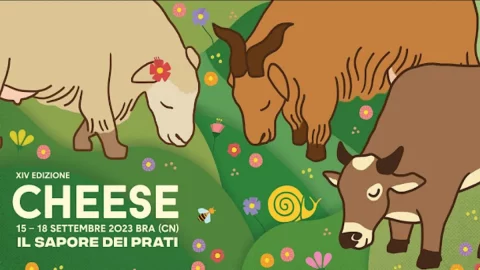
Everyone to the cheese boarding: by 15 18 to September Will be held at Bra the 14rd edition of Cheese, the largest international event dedicated to raw milk cheeses. Among Italian and international market exhibitors, affineurs and selectors, Slow Food Presidia and Ark of Taste products, the event organized by Slow Food and the City of Bra enlivens the streets of the Piedmontese town with the most original forms of milk. Between debuts e great returns, here is a list of the most curious specimens to taste in Bra.
The art of refinement made in Cuneo: Borgo Affinatori
Great debut in via degli Affinatori for the small artisan reality created by Barbara Cecchellero e Lorenzo Borgo, former students of the University of Gastronomic Sciences of Pollenzo (Cuneo). In 2018, after a training course that led them to explore the art of cheese maturation in France and Australia, Barbara and Lorenzo returned to the historic center of Asti to give life to the project Borgo Affinatori. Behind there is not only passion, but also the aim of enhancing the production of local farmers: only the best wheels allow you to make the most of, thanks to the work in the cellar, the qualities of the cheese that Barbara and Lorenzo want to achieve. This is why they pay great attention to seasonality: in the summer months they travel in search of the best mountain pastures, while in winter the utmost care is taken with which they choose raw milk products. Thus, the refinement takes on a unique importance: it allows the aromas, the taste, the texture to develop while respecting the intrinsic characteristics of the raw material.
Among toma cheeses, mountain pastures and washed rinds, at Cheese they offer some of their own creative experiments with pomace, leaves, spices and cocoa. All rigorously handmade, with the care and respect that the raw material deserves.
Slow Food Presidia that resist
In the crowded Piedmontese street, theaxridda of Escalaplano. In this town of just over 2.000 souls, the shepherd Rino Franci keeps a pecorino cheese special. It is a raw sheep's milk cheese, exclusively of the Sardinian breed, which since ancient times has been completely covered in clay, in Sardinian dialect, precisely, axridda, cavata not far from the town. An ancient tradition that the Slow Food Presidium intends to protect and promote.
But it is not the only example of those who continue to fight to preserve historical dairy products. In Nottinghamshire, a county of England in the East Midlands region, Joe Schneider has been producing the Stichelton, blue cow cheese with a typical elongated shape. Joe is the only producer who makes it following the traditional technique and using only raw milk from his farm. And for this very reason it cannot be part of the PDO and cannot call the cheese by the name it deserves: since 1996 the production disciplinary of Stilton in fact provides for the mandatory pasteurization of milk, and all six DOP certified dairies, which produce over one million wheels a year, use a heat treatment that kills the original bacterial flora, depriving the cheese of its aromatic richness and identity. Slow Food has decided to support it with a Presidium and to open a debate and a campaign on the need to process raw milk.
Also on board is the afuega l'pitu made with raw milk
THEREfuega 'l pitu – one of over 6000 products in the Ark of Taste – is one of the oldest cow's milk cheeses in Spain. In 1981, Spanish law forbade raw milk production, a decision that caused the almost total disappearance of this typical Asturian cheese. It survived only in the city of Pravia, where a small-scale producer, Pascual Cabaño, resumed production inspired by his grandmother, who often prepared l'pitu afuega as a dessert. In the local language, afuega l'pitu means "choke the chicken, or choke the neck", it is linked to the consistency of its paste and the fact that it sticks a little in the throat. According to legend, if the chicken struggled to swallow it, it would be the right time to enjoy it. The seasoning can last up to 16 months, but it is also customary to consume it fresh, as soon as it is produced – in this case it is called barreña or cuajada – with the addition of honey or sugar, or even strawberries.
The delicate undergrowth of French brie and the pungent surprise of cow moss
From France, in the small village of La Boissière-Ecole, the Ferme de la Tremblaye has been producing cow and goat cheeses according to the agroecological model since 1967. In the Cheese market it presents soft cheeses with a flowery rind such as the Brie and jovencau, which are characterized by the typical hints of undergrowth, and blue cheeses, some of which benefit from the Fromage Fermier appellation.
On the Italian market, among the blue cheeses, the bluish color and the intense and pungent flavor of the so-called Cow moss, among the most appreciated of the Rabbia Dairy, today led by Francesco and Giorgio Rabbia. The company, founded in 1890, makes the most of the biodiversity of the area, from the herbs of the pastures located at the foot of Monviso to the scents of Valle Grana, where the cheeses are left to mature. But it also preserves the ancient techniques of the dairy tradition: the cheeses, rigorously made with raw milk, are still produced using copper boilers and hand-wrapped with linen cloths, which allow for a unique imprint to be outlined with each process.