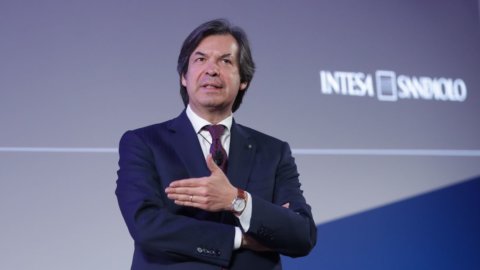
Sustainability and the circular economy not only as a moral duty, but as new paradigm for growth. Intesa Sanpaolo, the leading Italian bank by number of customers (12 million), is taking on the new global challenge and not just in words: in Milan, the institution led by Carlo Messina presented the report on its activity on the social inclusion, access to credit, environmental protection and culture. "Being one of the most solid and profitable banks in Europe gives us the great opportunity to provide tools that restore confidence to those in difficulty", said the CEO at the opening of the proceedings, who also launched a binding proposal: “We will contribute up to 50 billion for the green new deal".
Scrolling down the list of results achieved, it emerges that Intesa Sanpaolo has distributed so far in Italy 8,7 million meals, financed 519 beds, made it possible to access 131 medicines, made 103 clothes available to charitable associations. All in just two years, in the two-year period 2018-2019, in which 107 non-profit projects were financed on the For Funding platform and 400 thousand beneficiaries of the charity fund headed by the bank's presidency.
Intesa's philanthropic activity has not been limited to the poor, but has expressly focused on young people and on access to credit. In the last 10 months, 3.240 university students have been financed with the subsidized "Per Merito" loan, distributed in 524 schools and universities, one of which apparently also abroad: for the bank chaired by Gian Maria Gros-Pietro this means a overall investment, counting all student loans (15 students), from 171 million euros. Another 9.300 young people are included in the "Youth and Work" programme, which involves over 1.000 companies and with 80% of hirings already successful. Focus on startups: 1.300 taken into consideration, 120 accelerated and presented to 850 investors.
On the cultural front, Intesa Sanpaolo prides itself on being "the only banking group in the world to have four owned museums, which it puts at the service of the public good with the display of permanent collections and a program of original exhibitions of its own production". There are now four owned museums in the Gallerie d'Italia circuit: after Milan, Naples and Vicenza, it was a few days ago presentation of the new headquarters in Turin, at Palazzo Turinetti, which will host photographic exhibitions.
Last but not least, the environment. The great paradigm of these times is part of Intesa Sanpaolo's commitment primarily through the allocation of 5 billion euros in the current strategic plan, from 2018 to 2021, for 63 business projects related to the circular economy. The first half-billion-euro green bond, already launched in 2017, continues to bear fruit: the proceeds have already financed 75 projects in renewable energy and energy efficiency (almost two-thirds, 64%, have gone to projects related to photovoltaic), making it possible to avoid 353.00 tons of CO2 emissions, equal to the annual emissions of about 66.000 inhabitants.
Intesa Sanpaolo also presented two new initiatives, for the financial inclusion of working mothers and people with difficulty accessing retirement. For women, the bank will offer a subsidized loan to new working mothers in Italy, and will grant funding for startups of young mothers who want to become entrepreneurs. A specific initiative is also planned in India, where Intesa is launching a microcredit proposal for women and families, in collaboration with the local partner CreditAccess. For the loan to those who risk losing their pension, or to those half a million unemployed over 50s according to Istat, the bank has a loan in the pipeline.