
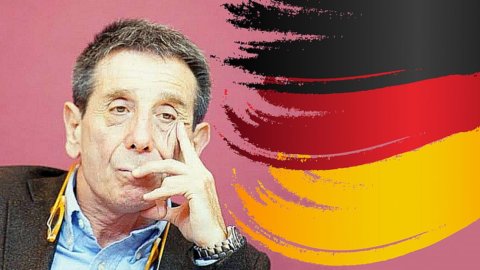
The real German problem is not the NazisAfD that on September 6th They made a breakthrough in the elections in the state of Saxony-Anhalt with almost 44% of the votes, and who, most likely, are preparing to govern a region, for the first time after 1945; rather it is the collapse of the historical parties, the CDU, the SPD, the Greens, whose downsizing – or defeat – leaves a political vacuum that it is not yet clear how will be filled.
Let's talk about the "German question" with Angelo Bolaffi, philosopher, political scientist, renowned Germanist, former director of the Italian Institute in Berlin. Let's start with the feeling that currently unites the majority of analysts, in Italy and in Europe, the concern for theblack wave which, after Germany, seems ready to drown democracy everywhere on the continent.
Professor, the Germans are rearming, they're voting for the Nazis: should we be afraid of Germany again?
“Look, this isn't going anywhere. It creates an unjustified and unjustifiable continuity with the past. Germany is a large, democratic, rich country; it has nothing to do with the past, neither with Bismarck nor with Hitler. So please, let's immediately get rid of the idea that we're once again on the eve of the collapse of the Weimar Republic. It serves no one, and for very real reasons: because there's a Constitution that prevents it, a Parliament that acts as a barrier, there's wealth, and because Germany is the world's third-largest power... In short, it doesn't exist. We can and must be afraid of the Russians, that's for sure. The Germans are arming themselves against the Russians, and I'd be even more afraid if they didn't arm themselves, don't you think?”
It seems clear and understandable to me, but the world isn't reacting with this aplomb, Professor. Starting with the Germans. They're very scared of this earthquake...
The Germans are right to be scared, let's be clear. But we must also not forget that we're talking about a single region, Saxony-Anhalt, with just over 2 million inhabitants. It's as if the PCI had won in Calabria in 1972 as well as in the red regions. Would we have cried out about the Sovietization of Italy? And let's not forget that the so-called black wave didn't start in Berlin; the Germans are last. In Italy, we have a fascist heir in government; in France, Marine Le Pen has long been leading the polls; in England, Farage is winning; in Spain, the fascists of Vox are predicted to win, while analysts believe the next Dutch elections will be won by the far right...
This isn't exactly reassuring...
Absolutely not. However, let's proceed in order. Who votes for the AfD? And why? Let's dispel the idea that we're talking about second-class Germany, about those dissatisfied with the country's unity, about the poor and/or impoverished. That's not true. And I'm not the one saying it. Recently, the Frankfurter Allgemeine Zeitung, a notoriously well-informed newspaper, published an interesting analysis. The eastern states are not poor and neglected. Besides, if that were the case, it would be easy to solve the problem: increase public spending (even more) and the issue is solved. But East Germany is rich, very rich; it's the political identity that is weak. Let's not forget that there has been an inexhaustible transfer of wealth from West to East. We're talking about a trillion and a half billion euros. So it's not a question of money; being more lax on pensions isn't enough to make Germans vote for the CDU again; it's a question of whether the government is strong or weak. And Merz's government, starting with Merz himself is extremely weak. Then there's the cultural problem, the differences between the two Germanies. And this is the most difficult aspect to address and manage, and so far it has only resulted in failures."
So what's the real problem? Why did they vote for the Nazis?
Emigration, there's no point in beating around the bush. Europe, and Germany (in primis)It's made up of old, rich, and weak people. And scared. And they don't want immigrants. Even though they need them. Starting with caregivers. And the paradox of paradoxes is that in East Germany, specifically in Saxony-Anhalt, there is no immigration because there is no work.
What are they afraid of then?
Three things. First, being colonized by external communities; these are frightened tribes. It happened in the West too, but it took them 80 years to accept Italians, Turks, and Slavs. And then there was economic progress, which made everything easier. Because immigrants in Germany cost money; they're not the poor people standing on street corners like in Italy, begging. When they arrive, they're taken care of by the state, checked, reported, assisted, sent to school, and cared for. I repeat, it costs money. And this also means there's competition between immigrations of different ages. In Italy, we can't talk about it calmly because immigration is a taboo on the left, while on the right, they think they can wipe them out by taking them to Uganda or elsewhere. It's nonsense, on top of being madness. Not even Trump managed it; he just created a scene with a few videos of poor people in chains. It was propaganda with a few dozen unfortunates, but we're talking about millions of people.
The second thing East Germans are afraid of?
“Of having wasted an entire life. That is, resentment toward something that made them feel like they were part of a pointless story. Remember Putin's famous, oft-quoted phrase: Whoever wants to restore communism is brainless, but whoever doesn't regret it is heartless.In the former GDR, they don't want the Wall back because they need Western money, but they lack that identity, perhaps negative, but precise. And instead now they have to deal with these "others," who say they did everything wrong, that they wasted 50 years, that a story is over. And so, by complaining, they transfigure reality into myth, inventing good old days. It's like Uncle Tom's Cabin: how good it was, just like when we were among ourselves.
And the third thing?
There was a very arrogant attitude from the West. During Merkel's time, the division was softened, as she was a woman from the East and thus physically reunited, if you will, the two Germanies. She was also a strong and determined chancellor. Unfortunately, after her came two nonexistent leaders. Both from the West, and completely devoid of charisma. This is not trivial because Germany is founded on the Chancellorship. A strong leader is very important to Germans.
And then there's the earthquake that affects politics as we've known it until now...
“Which is the basis of everything we're talking about. The parties that built Europe, the Christian Democrats and the Socialists, are dying. It's already happened in Italy, it's happening in Germany. A great tradition is dying because it's changing the entire history of consensus. Because the new men use TikTok, ride motorcycles to rallies, seem happy and propose to be so. Not to mention Russian propaganda. I have a suspicion: why a few days ago in Italy, Vannacci and Conte, and in Germany Ulrich Siegmund and Lafontaine used the same words: let's use rearmament money for peace, instead of cannons we make butter, let's focus on the welfare state, beware of the possibility of using the atomic bomb, etc., etc. So, is it a coincidence that a red-brown alliance is being consolidated with precisely the Kremlin's slogans?”
In short, is there a hysteria going on across Europe, as has been said, that is leading nowhere?
A hysteria 80% founded on ignorance and prejudice. Nobody knows anything about Germany. Besides, it's a bit early to mourn, given that the next national elections are two years away. But then there's the so-called 'eternity clause' of the German Constitution, written precisely to avoid what happened in Weimar. The Constitution can't be changed legally. You can't change the rules like the Nazis did. Why so much ignorance about Germany? Let's be honest, because, quite simply, nobody speaks German, or very few can read it. Just like the Russians, as the great Sovietologist Hélène Carrére d'Encausse recounts in her son's book. KolkhozIt's all written in their newspapers; they've never hidden anything about their intentions. But who reads them? In Italy, German newspapers weren't available, or were very rare, in press reviews. So who gets informed? Let's be clear, it's not that those who read the newspapers aren't scared. Or perhaps, better said, aren't disappointed. I am too. I'm not happy that Germany, the democratic and socialist one, must not win; but from this to saying let's create a 'cordon sanitaire' against the newcomers, or as the Germans say, a 'wall that cuts off the fire', is not enough. We must go further and understand how the new consensus works and how to respond.
Let's add that 80% of voters went to vote...
There was even a burst of anger and rage. You tell me I shouldn't vote for those people, I'll show you whether I can or can't. In the preceding months, there had been a huge debate in German newspapers among sociologists, economists, from both East and West, who were exchanging views and beating the shit out of each other. Westerners were accusing Easterners that, despite all they'd spent to reunify the country, they now had the Nazis on their doorstep; and Easterners were complaining about a total lack of respect. None of this was reported in the Italian newspapers.
In conclusion, if you are not afraid, or at least are disappointed rather than scared, what is really worrying you?
"The CDU. I'm worried it will suffer the same fate as the Christian Democracy party in Italy. This is my concern. What and who will take up its legacy?"
What if there were a change at the top? What if Merz left?
Let's say Merz was wrong from the start. And then he doesn't have the party under control. Look, half of the AfD's votes come from disgruntled members of the CDU. Yes, they should oust him, but are they capable of it? There's a historical precedent. It happened in 1974 in the SPD, when Willy Brandt was ousted to make way for Helmut Schmidt. It was an excellent decision, because Germany (we're talking about West Germany, of course) handled the oil crises, terrorism, and Soviet missiles in extraordinary fashion. A very strong chancellor, in short. While Merz is extremely weak. Not only do I not know if the CDU is capable of this, but I can't even see anyone who could replace the current chancellor.
Let's get back to Siegmund, known to his friends as Ulli. Do you think they'll be able to govern? Will the BSW's Red Lady, Sahra Wagenknecht, cast her vote?
"I think so. They'll try to negotiate, they'll raise the price. But in the end, they'll come into play. And some in the CDU might give in to the temptation to vote for them as snipers, having achieved something. But how long will they be able to hold on to their majority? Too fragile..."
And if they govern, will they be able to implement their program? The one, to be clear, that according to two journalists of the The daily newspaper, “could make life hell for many people (because) it can censor school books, give orders to the police, give directives to prosecutors and secret services…”.
"But the core of their program is immigration, as we've said. They were elected for this. And this isn't the responsibility of a single state. Sure, it could make life difficult for some. For example, cutting funding for theaters and culture, or for gender research. But then there's always the regional Senate that decides, and where there's a different majority. In short, it's not easy for the new Nazis to subvert the world. It's all propaganda."
However, the ordeal of the progressive forces is not over…
In a few weeks, there will be elections in Mecklenburg-Vorpommern, a state in northeastern Germany, where the AfD will likely win again. But then there will be the Berlin elections, where the Left, the Greens, and the SPD are expected to win. This will bring another bloodbath for the CDU. Then things will stall for several months.
Professor, given the European panorama, it seems that Giorgia Meloni in Italy is the most moderate.
Meloni has made a foreign policy choice far removed from the AfD. If she doesn't allow herself to be blackmailed by Vannacci, she can represent pragmatic Europeanism, that is, support for Ukraine, control of public finances, and controlled immigration, but without racist tendencies. Because let's not forget that the real winners in Saxony-Anhalt were Putin, Musk, and the American right. Trump let out a 'wow' when he heard the news of the Nazi victory, which forced Merz not to answer his phone.
I'll give credence to his optimism by reminding us that not everything is written yet: Orban was defeated in Hungary, there was a reaction in Portugal, in the Netherlands, and so we have proof that hysteria gets us nowhere because if we resign ourselves to the return of another Hitler, we would be powerless.
“Very true. And here too, it's enough to study history carefully. You have to reflect. Back in the 1930s, Communists, Nazis, and Fascists were young people with a bright future. Here, we're talking about frightened, elderly pensioners, a people living between Spritz cocktails and television. Back then, there was a civil war going on, with thousands of deaths. People were shooting in the streets. What are we talking about? I repeat, I don't want to underestimate anything, but we're faced with something else we still can't decipher. The 1930s have absolutely nothing to do with it. I want to point out that Togliatti, who was no fool, took 14 years to understand in 1936 that Fascism was a mass movement and not something for the elite. The truth is, paradoxically, it would be easier if we were faced with something we knew because we would know how to defeat it. Instead, we know nothing, and we have to study, analyze, and understand. Then we can react.”
Bolaffi made some serious inaccuracies:
18-24 year olds: AfD achieves significant gains, especially among young men, but does not dominate the entire youth segment because many young people also vote for left-wing or environmentalist parties.
25-34 year olds: support above the national average.
35-59 years old: this is the strongest age group for the AfD and represents the core of its electorate.
60-69 year olds: Support remains important but tends to be less than in the 35-59 age group.
Over 70: AfD is generally weaker; many older voters continue to prefer the CDU/CSU and SPD.
The bulk of AfD voters are young and active people, not pensioners. Bolaffi speaks without knowing.
The constitution is a piece of paper written 80 years ago and pieces of paper count for nothing in the face of political will.