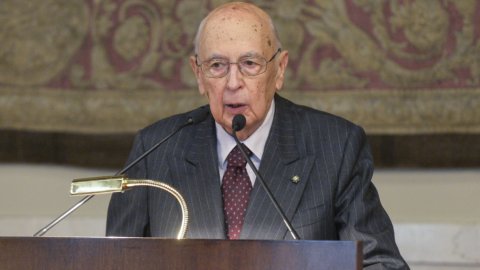
An intense life, full of experiences, fascinating that of Giorgio Napolitano which reflects all the good and all the bad of Italian, and partly European, politics from the post-World War II period up to the present day. I met him in Naples at the beginning of the 80s, but then I had many opportunities for comparison when he was President of the Republic and finally, in private, during the holidays in Capalbio. He had a deep understanding of people and things. A calm but always punctual dialogue, rich in historical references and current political events or those of the recent past.
Giorgio Napolitano from the PCI to the Quirinale
He had fought many battles both within the PCI, and in the nineties when the new party born in Bolognina found itself with direct government responsibilities. In 2005 he reached the age of eighty, and was nominated Senator for life, thought of taking a step aside from the heart of active politics, published an autobiography (From the PCI to European Socialism - Laterza Editore) of great interest for everyone, but particularly for young people who want to dedicate themselves to understanding something about facts that concerned our republic from the post-war period until after 2000.
But fate had another commitment in store for him: he was called to hold the office of President of the Republic and in that capacity he had to face numerous crises, until the country's near bankruptcy in 2011, when he imposed Prime Minister Mario Monti supported by a broad range of parliamentary forces. Not only that, in 2013, on the threshold of ninety years of age, he was again called to the Quirinale for a second mandate which he accepted, against the advice of the doctors, out of a sense of responsibility towards the institutions. The Parliament that emerged from the February 2013 elections saw a great affirmation of the Grillini and was unable to express any majority either for the election of his successor or for the formation of a government between homogeneous forces. It was necessary to launch a government of national unity, presided over by Enrico Letta.
On that occasion, Giorgio Napolitano made a strong speech in front of the assembled Chambers, accusing the parties of the delays, which were incapable, due to petty electoral calculations, of finding an agreement to launch the reforms that the institutions urgently needed (and today we are still more or less the same point). All parties were under accusation, but in particular the grillini (the only ones who did not applaud Napolitano's scathing words) received a couple of lessons which unfortunately they did not take advantage of.
That reformist dream
The President of the Republic said that simply calling for change makes no sense if you don't deal with concrete problems. And also that the contrast between the square and Parliament puts it at risk democracy. Finally, Napolitano reminded everyone that politics is not only the testimony of great ideas but also the ability to make concrete compromises to address problems.
These are concepts that Giorgio Napolitano had developed during his long journey within the PCI, quickly understanding that the communists, if they wanted to contribute to the consolidation of Italian democracy, would have to detach themselves from Moscow, abandon the revolutionary dream, and embrace a concrete reformism as they had done European social democratic parties. The book recalls the mistake of not having listened to Bobbio who already in the 50s had contested the Togliattian contrast between bourgeois freedoms and socialist freedoms, the silence on the need that whichever party had come to power would not have governed despotically, and finally the failure to recognize liberal institutions to guarantee the rights of freedom.
It was strong on the part of the patrol of the so-called reformists controversy towards Berlinguer when he placed the "moral question" at the center of the PCI's policy, which meant interrupting any political dialogue with the other parties and closing oneself in the contemplation of one's own purity. Hence the blows to the grillini. Extremism doesn't pay. The insults to Parliament, whose defects must certainly be corrected, but which must not be torn down or "opened like a can of tuna" because the extremism of the streets leads to tragic consequences for all citizens.
Napolitano's "lesson".
Giorgio Napolitano, even now that he is no longer here, continues to impart valuable lessons to the political class and to all citizens. We are still prey to extremism. Trust in institutions is at its lowest, as demonstrated low voter turnout of citizens. Disappointments follow one another continuously. Miracles are expected from the leader suddenly raised to the altars, and when these do not arrive quickly, he throws it down and turns us to someone else. It may be useful these days to reread that 2013 speech and understand why no decisive steps forward have been made in recent years.
For the former PCI, anchoring in Europe was an achievement that cost many battles. Now it must become the common heritage of the entire nation. The buck-passing practiced by many government parties is not tolerable, as when things go wrong, they find nothing better than to shift the blame onto Brussels, which is certainly not perfect, but which must be addressed with a constructive spirit and not with an attempt to do it alone, dusting off old nationalisms that have been overcome by history.
Napolitano taught us that democracy is an achievement that must be renewed every day. It's not forever. It is not perfect, but as Churchill said, it is better than all the other forms of government tested and under which many peoples of the world still groan today. For this reason it must also be defended against external aggression by illiberal regimes.