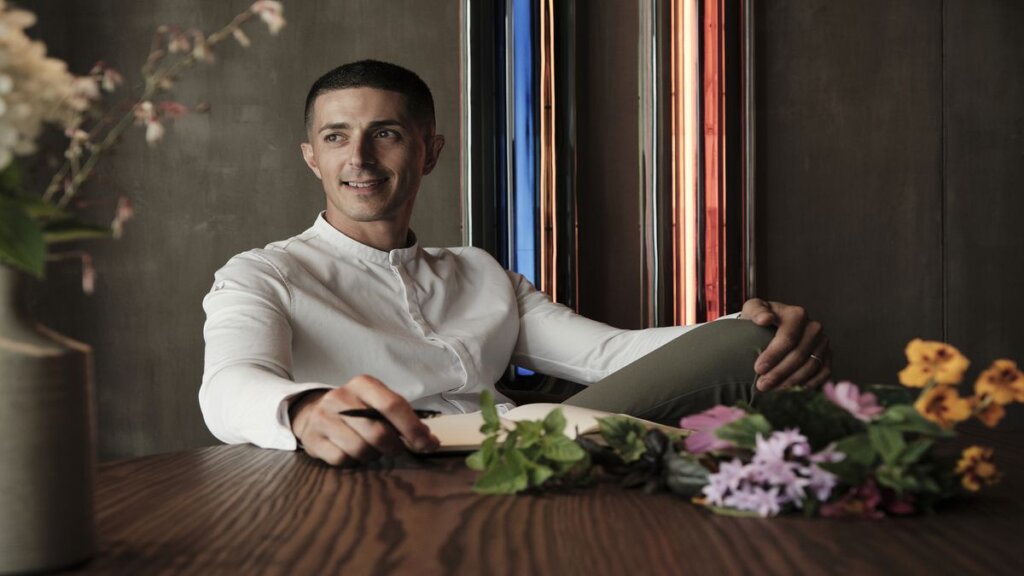
This is the revelation of the year: chef Michelangelo Mammoliti, originally from Giaveno (Turin), at the helm of the Rei Natura restaurant in Serralunga d'Alba (Cuneo), located within the prestigious Il Boscareto hotel. He is a proponent of natural, traditional, and instinctive cuisine. He has been awarded the highest recognition in the 2026 Michelin Guide: three stars, which establish him in the empyrean of Italian fine dining.
This award crowns a consistent and continuous professional career that began with Gualtiero Marchesi's team at L'Albereta and later at Marchesino. He strengthened and refined his skills over time working with two-Michelin-star Stefano Baiocco, and then with his time in France, where in five years he spent time at the courts of Alain Ducasse, Pierre Gagnaire, Yannick Alléno, and Marc Meneau. It was also in France that he further honed his baking skills with Fréderic Lalos, the best baker in France. Returning to Italy with this extraordinary wealth of experience, he earned his first Michelin star in 2017, earning two stars soon after his arrival at Le Rey Natura. And now, to crown it all, three stars have arrived.
His cuisine is based on the idea that a dish should express the chef's identity but also the place where he finds himself, because those who sit at his table should enjoy an all-encompassing and exclusive experience, one that cannot be replicated elsewhere, and that therefore has a strong connection with the valleys and hills of the extraordinary Cuneo landscape. "I've understood over the years," he says, "that to be a good cook, you have to have dirt on your hands. I couldn't imagine my kitchen without the garden, without the greenhouse. I would feel deprived of an important part. It would be like taking away the sense of smell from a nose. I think the garden and the greenhouse are a beautiful metaphor for life. The more you take care of them, the more you receive. I find there's a great deal of democracy in this. I learned as a child to take care of the things I cook, thanks to my grandfather. And I honed my knowledge as an adult, learning from the elders, from my teachers. The greenhouse is a treasure chest, an infinite palette of varieties to draw from, whose nuances change every day, and which is just waiting to be enhanced. Nature will always guide my actions and my choices, and it couldn't be otherwise. I am the one at its service.
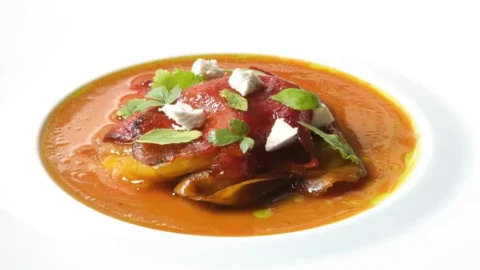
And the most eloquent testimony to his gastronomic philosophy is in the recipe we're offering Mondo Food readers this week. The chef reinterprets the albese, a traditional Piedmontese recipe based on raw meat. In his personal, entirely plant-based interpretation, the meat is replaced with Capriglio peppers, seasoned with walnuts and anchovies. The result is consistently convincing.
The Recipe for the Vegetable Albese
Ingredients for people 4
Pepperoni
• 1 Capriglio pepper
• 1 clove of garlic
• To taste thyme, basil, marjoram, extra virgin olive oil, icing sugar, salt
Burn the pepper with a blowtorch. Remove the peel, scraping it with a small knife, and remove the top part with the stem. Clean the inside, removing the seeds. Place in a container and season with the herbs, salt, and oil. Arrange on a baking sheet lined with parchment paper, making sure to place the herbs and garlic inside the pepper. Dust with powdered sugar and bake at 90°C (195°F) for 40 minutes. Halfway through cooking, lightly press the pepper to flatten it. Remove from the oven and let cool. Remove the herbs and garlic from the pepper and store in a container.
Walnut praline
• 200 g walnuts
• 5 g walnut oil
• Salt
Toast the walnuts in the oven at 160°C for 5 minutes. Let them cool and blend in a Thermomix at 60°C with the remaining ingredients. Sift through a fine sieve and reserve in a pipette.
Walnut sauce
• 50 g walnuts
• 1 clove of garlic blanched 3 times
• 100 g water
• 5 g walnut oil
• 5 g sugar syrup 1:1
• Salt
Blend all the ingredients for 10 minutes with the Thermomix, to obtain a smooth sauce.
homogeneous. Filter through a chinois étamine.
Anchovyade
• 100g anchovies
• 20 g extra virgin olive oil
• 250 g seed oil
• 2 cloves of Caraglio garlic
• 15g Taggiasca olives Terre Bormane,
• 200 g cold water
Clean and peel the Caraglio garlic. Remove the germ from the garlic clove. Blanch the garlic three times, starting from cold. Place the garlic and anchovies in oil in a food processor.
Blend and emulsify with the two oils and cold water. Add the olives and finish the emulsion by adjusting the consistency with vinegar and water. Refrigerate at 4°C.
Vinaigrette with Jerez vinegar
• 50 g Jerez vinegar
• 100 g of anchovy oil in oil
Emulsify with a whisk. Reserve in a pipette.
Walnut Pesto
• 1 clove of garlic without core
• 1 anchovy in oil
• 20 g peeled fresh walnuts
• 5 g lemon juice
• 10 g walnut oil
• Pepper to taste
Chop the garlic and crush it in the suribachi. Add the anchovies and mix to a paste. Add the walnuts and continue crushing. Finally, add the oil, lemon juice, pepper, and salt to taste. Set aside in a container.
Trim
Place a quenelle of walnut pesto in the center of the round. Place the bell pepper on a baking sheet and drizzle the anchovy paste over it. Repeat with the walnut praline, but don't completely cover the pepper. Place the seasoned bell pepper on top of the pesto. Add a few sprigs of tarragon and huacatay. Drizzle a few drops of vinaigrette around the bell pepper and let the sauce cool. Serve the sauce sliced on the side with a drizzle of vinaigrette.