While the sandwich first appeared in American cookbooks in 1816, becoming a staple in the States during periods of food shortages, such as the Great Depression and World War II, in parallel, in Japan, between the late 19th and early 20th centuries, the Katsu Sando emerged. This type of Japanese sandwich, a symbol of Western-influenced yoshoku cuisine, consists of a crispy pork cutlet (tonkatsu) seasoned with tonkatsu sauce and cabbage. Its distinctive feature is that it is wrapped in a soft white bread called shokupan, a type of sweet and very soft bread with a thin, brown crust, often (but not always) containing milk. For this reason, in Japan, the consistency of the food is called fuwa fuwa, an onomatopoeia that translates to "soft and like a cloud."
The origins of the sandwich are traced back to the Renga-Tei restaurant in Ginza, Tokyo, which is credited with popularizing the pork cutlet in 1899. The sandwich format then consolidated itself in the post-war period as a practical and substantial meal.
Today, Katsu Sando is considered a high-quality comfort food, even reinterpreted in gourmet versions. In addition to ekiben (station lunch boxes), it is extremely popular in konbini (convenience stores) and specialty restaurants, loved for the contrast between the softness of the bread and the crispiness of the meat.
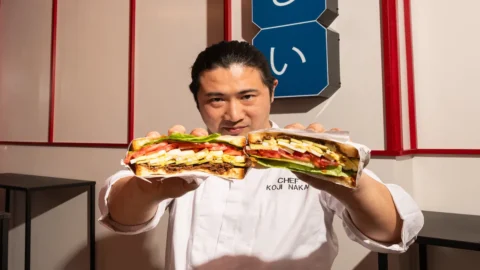
For those who want to taste a Katzu Sando according to the ancient Japanese rules, from today in Rome it is possible to go to the Prati area in via Andrea Doria, to SANDO IE KOJI, the first restaurant entirely dedicated to this specialty created by chef Koji Nakai
Born in Kobe in 1984, Koji grew up in Japanese restaurants and his city's fish market, learning from his grandfather, a chef, at an early age. After years in Japanese kitchens and specializing in Italian cuisine, he arrived in Rome in 2008 and immediately felt at home. He works in Tuscany, Udine, and abroad. In 2022, he opened Nakai, where he blends Japanese and Roman cuisine; in 2024, the izakaya Ie Koji, both of which were met with great acclaim; and in late 2025, he opened Sakaba Ie Koji, the first Roman sakaba. Alongside his entrepreneurial activity, the chef continues his cultural outreach through collaborations with the Japanese Cultural Institute and initiatives dedicated to the community of Japanese chefs in Rome, promoting opportunities for encounters and in-depth exploration of the country's authentic cuisine.
The new restaurant is a sleek and dynamic space, designed primarily for takeout and fast food, with limited seating inside and a larger outdoor area, in keeping with the urban spirit of Japanese street food. Open continuously from late morning until evening, SANDO offers immediate cuisine built on precise craftsmanship, developed in a dedicated production laboratory.
Its katsusando is prepared by Panificio Marè in Prati with soft, lightly toasted sandwich bread, selected after extensive research to be as close as possible to Japanese shokupan, recognizable by its aroma and buttery consistency.
The menu revolves around four main variations: from the classic pork cutlet to interpretations featuring naturally raised chicken, including a seasonal vegetarian option featuring vegetables from the Trionfale Market and an alternative featuring sautéed beef strips seasoned with soy sauce. But the Wagyu Sando, made with premium Wagyu beef, a Japanese delicacy and a symbol of how—even in a street food establishment—the search for the finest ingredients is the foundation of everything.
The offering is rounded out by bento boxes featuring rice, vegetables, and proteins, along with a generous selection of chips with traditional Japanese-inspired toppings (such as yuzu, nori seaweed, miso, teriyaki sauce, and katsuobushi), as well as a selection of Japanese drinks.
SANDO IE KOJI
Via Andrea Doria, 32 – Rome
Open every day from the 12 23
Closed on Tuesday