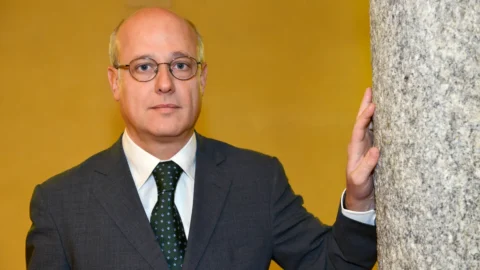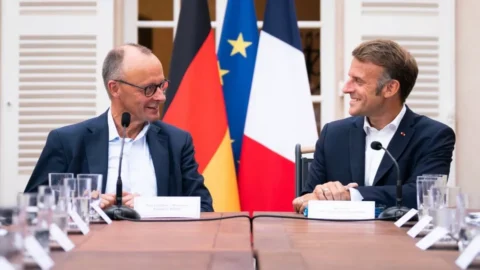
The success was predictable in some ways, but shocking in any case, of the AfD in Saxony-Anhalt risks rekindling the desire among anti-European parties to raise the stakes against the Union. Germany, and in the next few months in France and Italy, the various galaxies of the populist and extremist movements Left and right-wing movements could, with the external support of the increasingly uninhibited "anti-European international," reintroduce pressure against European institutions to a level that threatens the very stability of the Union. Precisely at the historical moment when the Union most needs ambitious new phases of integration, the specter of nationalism is concretely resurfacing in Europe, as explained by Federico Fabbrini, full professor of European law at Dublin City University and author of The European Army: Defense and Peace in the Trump Era (the Mill, 2026).
Professor Fabbrini, is the AfD's result in Saxony-Anhalt merely a dangerous twist in German domestic politics, or is it a turning point for the future of the European Union?
"The election result is a real earthquake. First of all, there is a short-term shock wave with local consequences, with the possible formation of a far-right regional government in a German region for the first time since 1945. But there is certainly also a long-term shock wave, impacting the whole of Germany and Europe."
The AfD is questioning EU membership, the euro, and policy toward Russia, but Saxony-Anhalt is a small region in terms of population and influence in German politics. So, how real is the risk of a gradual broadening of anti-European consensus in Germany?
The AfD's victory in Saxony-Anhalt is not an isolated result. For years, the AfD has been very strong in the former states of the German Democratic Republic (GDR), but the party is now also gaining ground in West Germany, and polls show it as the leading party nationwide. Given the AfD's clear ideological reference to the experience of the Third Reich, its rise risks calling into question the foundations of democratic Germany.
How dangerous could a resurgence of German nationalism be for the European Union? Germany could return to conceiving its interests more in national than European terms. And not just economic and industrial ones.
What is happening in Germany is extremely dangerous for Europe, especially considering that the rise of an ultra-nationalist party like the AfD is paralleled by Germany's rapid rearmament, which by the end of this decade will have a conventional army larger than the French and British combined. This is the result of the rearmament program promoted by the European Commission, and it is curious that its President, Ursula von der Leyen, who is German, did not anticipate the collateral effects of rearming member states instead of creating a European defense system.
The AfD's success has been warmly welcomed by Moscow and the Trump administration. Russia and the United States, but more generally, the actors of the so-called sovereignist international, seem determined to change their anti-European operations. Are you more concerned about external attacks on the Union or the internal issues of major European states?
"The two dynamics go hand in hand. If the AfD were to win nationally, Germany would end its military support for Ukraine. This is obviously in Russia's interest, which, not surprisingly, sympathizes with these populist forces."
France and Italy could also marginalize pro-European forces in terms of political representation in the next elections.
Italy is already led by a strongly Eurosceptic government coalition, and France, despite President Macron's superficial pro-Europeanism, is actually a Gaullist country at heart. It's enough to remember that in 1954, the French scuttled the European Development Cooperation (EDC) and in 2004, the European Constitution. Today, we need a European defense system, but France has done nothing to share its nuclear deterrent on a European scale, as Kohl did with the German mark at Maastricht.
After Brexit, the vote in Iceland, and now the AfD's result in Germany, where do you still see room for a relaunch of European integration?
There are those who delude themselves into thinking that Europe's success is measured by the number of member states. But beware: enlargements can reduce integration, rather than revitalize it. In fact, many countries in the Balkans or Eastern Europe today want to join the EU, but their idea of Europe is essentially economic, not political. If we want to revitalize integration, we need to consider smaller groups of countries, but ones more willing to cede sovereignty. The EU will not solve its economic competitiveness problems or strengthen its military security with its current governance, where decisions are made unanimously by the 27. To advance the integration process, a core group of countries will be needed that decides to move forward without the others.
In this context, is it realistic to imagine a multi-speed Europe in the near future: a core group of countries willing to further integrate defense, foreign policy, budget, and possibly taxation?
This approach has already been used in the past, think of Schengen, which abolished internal borders, and the euro. The same model can be pursued to move forward now, even on defense. In fact, as I explained in my recent book The European ArmyIt would also be possible to revive the European Defence Community, conceived in 1952 as a treaty between Germany, France, Italy, and the Benelux countries. Four out of six countries already ratified the treaty years ago, so ratification by Italy and France would be enough to create a common army. Other member states wishing to join could then do so.
Do you see room for political action by the European ruling classes, by the major political families capable of supporting Europeanism?
Europe was born as a Franco-German reconciliation project, with the crucial support of Alcide De Gasperi, the greatest statesman Italy has ever had, and who single-handedly positioned our country as the founder of NATO and the EU. However, if these three countries turn their backs on Europe, it will be difficult for the others to hold together the crumbling house.
What stage are the Draghi, Letta, and Niinistö plans at?
The three Plans have essentially ended up in the drawer. The ideas they advance are sound, but EU governance makes them impossible to implement. The truth is that in Europe we know what needs to be done, but we're unable to do it because we don't have the institutions suited to address today's challenges. And so we're jeopardizing the greatest achievement European integration has given us: peace.