Ten years of rollercoasters for Italian industry between the pandemic, rising energy prices, tariffs, and inflation. Yet the 2015-2024 budget is positive. The new Cumulative Data Report ofMediobanca Research Area shows the turnover Of the 1.905 companies analyzed, revenues grew by 37,6%. In 2020, the pandemic wiped out 11% of revenues, but the rebounds in 2021 (+22%) and 2022 (+28,1%) have restarted the engine. Made in Italy products are the undisputed leader: +52,6% in ten years, with exports +59,6% and domestic sales +45,5%.
The Mediobanca perimeter covers almost half of the productive fabric: 45% of industrial turnover, 48% of manufacturing, 44% of retail, and 43% of transportation. This includes public and private giants, multinationals, and the "fourth capitalist" (Italian-controlled medium- and medium-large enterprises). Foreign penetration is also high: among companies with more than 250 employees, 48% of turnover is generated by foreign groups, a share that rises to 75% in manufacturing.
Ranking of the giants: Eni the queen, the top 10
Who takes home the title of revenue queen? On the top step there is Eni, which reached a turnover of 113 billion in 2024. Behind it Enel with 102 billion, while on the podium also climbs Exor, the Agnellis' safe, with 86 billion. It's just a hair's breadth away Stellantis Europe (84 billion), the Italian-French automotive hub born from the FCA-PSA merger. Fifth place for GSE – Energy Services Manager, the State's operational arm in the energy transition, with 54 billion.
Here is the recipe top 10 of the Italian giants:
- Eni – €113 billion
- Enel – €102 billion
- Exor – €86 billion
- Stellantis Europe – €84 billion
- GSE – Energy Services Manager – €54 billion
- Leonardo – €20 billion
- Prysmian – €16 billion
- Fincantieri – €8 billion
- Italgas – €7 billion
- That – €6 billion
Three of the first five places belong to the energy sector (Eni, Enel, Gse), confirming that the green transition and resource management are the true drivers of the national economy. Stellantis maintains its position in the automotive sector, while Exor confirms its role as the Agnelli family's financial backbone, capable of competing globally.
Profitability matters beyond revenue
In addition to revenues profitability counts. In the five-year period 2015-2019 theEbit margin The average was close to 6%. In 2020, it fell to 4%, but recovered above 5% in the two-year period 2021-22. In 2023-24, it stood at historically high levels, around 6,5%. The gap remains clear: public companies have margins above 9%, thanks to the concentration in the energy and infrastructure sectors; private companies, on the other hand, dropped to 5,7%, penalized above all by the tertiary sector.
The long wave of US tariffs
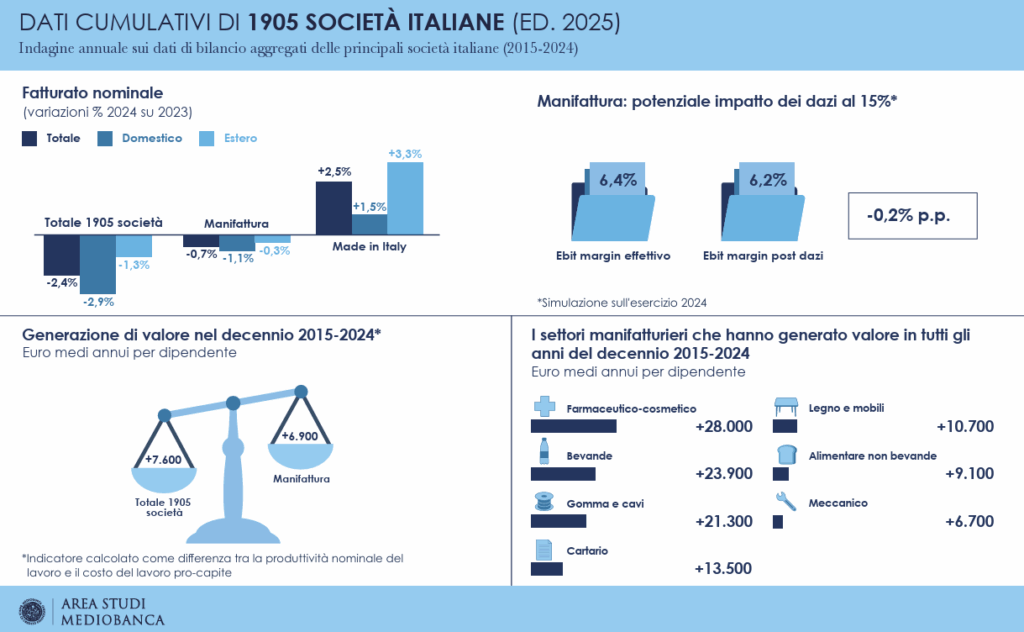
2024 also brought new trade tensionsThe United States has raised the duties on Italian manufacturing to 15%, compared to the previous 3%. Mediobanca, however, estimates a limited impact, with the EBIT margin decreasing by only 0,2 percentage points, from 6,4% to 6,2%. The burden is expected to be distributed along the entire supply chain, from the producer to the American end consumer.
Investment and employment are the key drivers of growth, but wages remain a key issue.
- net material investments In 2024, they reached a decade-high, representing 4,1% of turnover (2015-22 average: 3,3%). The main drivers are public companies, engaged in renewables, grid digitalization, and electric mobility. Private companies accounted for just 3%.
On the employment front, the decade records a +9,5% employment, with a 10,2% increase in the private sector and a 5,6% increase in the public sector. The "fourth capitalism" stands out: a 16,9% increase in employees, with peaks of 17,9% in medium-sized companies and 16,6% in medium-large ones.
The cumulative inflation of the decade (19,7%) has eroded purchasing power: -2,8% compared to 2015, -5,8% compared to 2021. Mediobanca calculates that an average increase of 4.000 euros per capita in the four-year period 2021-24 to bring real wages back to pre-inflation levels, without affecting shareholder remuneration.
Who creates value and who destroys it?
From 2015 to 2024, Italian companies generated on average 7.600 euros per year per employeeBut the numbers change depending on the sector:
- public: +22.700 euros per employee;
- private: + 4.600 euro;
- medium and medium-large manufacturing: +10-11 thousand euros;
- tertiary: -800 euro, weighed down by telecommunications (-32.200 euros).
I winning sectors The sectors with the highest growth rates are energy (+85.800 euros per employee), pharmaceuticals (+28.000), beverages (+23.900), leather and hides (+24.400), rubber and cables (+21.300), paper (+13.500), food (+9.100), and mechanical engineering (+6.700). The losers, however, are concentrated in telecommunications, plant engineering, construction, and transportation.
A future of challenges
Il 2024 was not a brilliant year: overall revenues fell by 2,4%, hitting the domestic market (-2,9%) more than the foreign market (-1,3%). But the framework remains resilientThe photograph taken by Mediobanca tells a country that holds its own, but which must face the new era of global trade tensions, American tariffs, and technological acceleration. The future of Italian industry lies here: energy, innovation, and resilience.