
La policy he goes on vacation and prepares for the showdown of the resumptionlatest budget law of the legislature, bringing with it a series of qualified reports that take stock of the state of health of the production system and society in the context of a geopolitical situation that is not only complicated but unprecedented. We were able to consult the 25th INPS Report, Note No. 1 of the UPB, ISTAT statistics, and the Rapid Surveys of the Confindustria Research Center. We are witnessing the beginning of the dialogue between the trade union confederations and the entire business associations on the issues of “fair wage”, each part collected in a unitary position. The most recent contribution comes from CnelWhich, together with Union Chambers, Istat, Meat Cutter Institute e Ministry of Labor, fired the Third Report on the Mismatch between Labor Supply and Demand, which examines one of the main problems that characterise the Italian labour market today: difficulty in matching the needs of businesses with the skills and availability of job seekers.
This is a sore point both for the government (which does not have adequate active labor policies) and for the trade unions who feel contradicted by the mismatch in their catastrophic labor market analyses. Yet this emergency of new type profoundly affects the growth of the economy and on the same productive investments Because companies, lacking the personnel capable of managing new technologies, continue to follow previous organizational models. In the first half of 2026, the difficulty in recruiting staff affected 44,8% of projected revenues, down from 47,6% recorded in the same period in 2025. Despite the slight improvement, the phenomenon continues to affect most production sectors across the board.
The major critical issues are observed in the sector of construction, where almost 6 out of 10 workers are difficult to find (59,8%), followed by the wood and furniture industries (59,6%) and the metalworking and electronics industries (55,0%). Among the services, a particularly complex situation remains in IT services and telecommunications, the only sector to see an increase in difficulty finding supplies (50,6%). Conversely, the commerce, tourism, and business operational services sectors have shown a reduction in difficulties compared to the first half of 2025, although significant difficulty levels remain.
Furthermore, the major critical issues are concentrated between the micro enterprises (1-9 employees) and the small businesses (10-49 employees), which experience higher rates of difficulty than the national average. For these organizations, recruiting is often more complex, both due to a lower ability to attract qualified candidates and a more limited availability of financial and organizational resources for selection and recruiting activities.
Difficulties progressively decrease in medium-sized companies (50-249 employees), while they reach the lowest levels in companies with 500 or more employees, where the share of hard-to-find revenue remains significantly lower than in other size classes. Larger companies can in fact benefit from greater awareness on the job market, more structured career paths, generally more competitive remuneration and welfare policies, and a greater ability to plan employment needs in the medium term, elements that favor the attraction and retention of human resources.
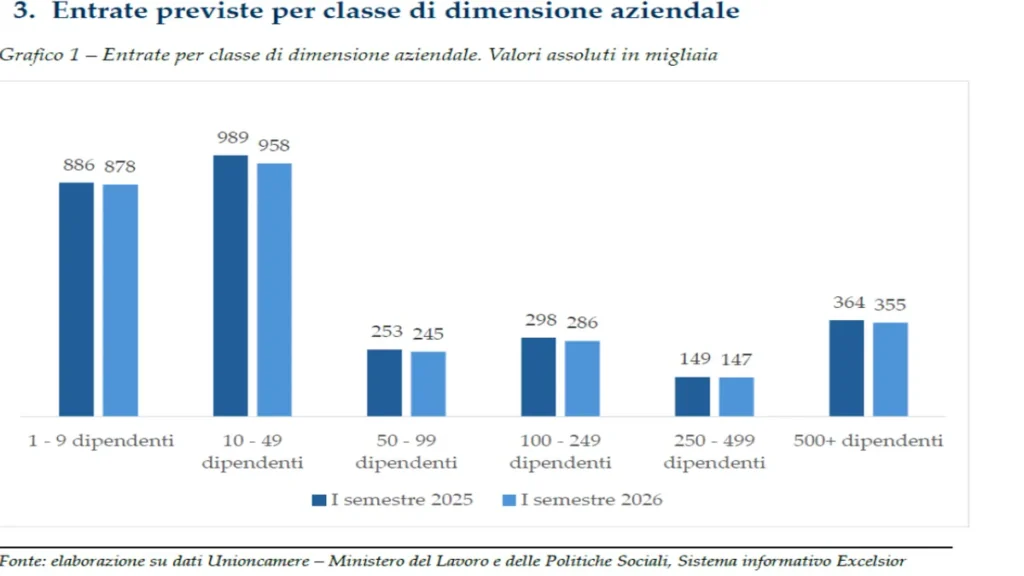
Compared to the first half of 2025, a slight improvement in the ability to find jobs has been observed in almost all size classes, consistent with the reduction in average difficulty recorded overall. Despite this, the phenomenon continues to affect a significant share of hiring even in the most structured companies, confirming how the misalignment between required skills and available workers represents a critical element across the Italian production system.
Businesses predict 2,869 million in employment revenue in the first half of 2026, decreasing by 2,4 % compared to the same period of the 2025.
- The field of services It continues to represent the main basin of labor demand, concentrating approximately 72% of the expected hires; only tourism and personal services are growing, while the other sectors are registering a decline.
- Among the workers foreign Hiring is increasing in construction, tourism, and the metalworking industry, confirming the role of foreign labor in sectors with the greatest employment needs. In the industrial sector, the percentage share of total foreign workers required by companies increased from 15,9% in the first half of 2025 to 19% in 2026. The metalworking sector (8,3%, +1,2 percentage points) and the textile, clothing, leather, and footwear industries (3,3%, +2 percentage points) recorded the highest percentage growth in planned hiring. These are significant figures, demonstrating the presence of foreign workers even in the most highly qualified sectors. Even considering only foreign workers (EU and non-EU), the services sector maintains its leading role in planned hiring, accounting for 65,6% of the total, albeit a decline compared to the first half of the previous year.
The sectors with the greatest demand are those of tourism, accommodation and catering (26,4%, an increase of more than 5 points compared to the same semester of the previous year), construction (15,4% with an increase of 3,2 points compared to the first semester of 2025) and operational support services for businesses and individuals (10,3% of the total but a decrease compared to a year ago).
Le skilled professions In fact, in commercial and service activities, they continue to represent the main demand, with 887 expected entries, equal to approximately a third of the total and a value essentially unchanged compared to the first half of 2025 (+0,1%). Skilled workers follow, with 470 entries, which maintain a central role in businesses' needs despite recording a slight decline (-1,7%). Demand for unskilled professions (465 entries) and technical professions (332) also remains significant.
The reduction in hiring mainly affects unskilled professions, which show the most significant contraction in absolute terms (29 thousand fewer entries compared to the first half of 2025, equal to -5,8%), followed by technical professions (-15 thousand; -4,4%) and intellectual, scientific and highly specialized professions (-9 thousand; -5,6%). Office workers and plant operators, machine operators and motor vehicle drivers also show a moderate decrease in demand, equal to -2,4% and -1,8% respectively.
The only professional group that records a growth it is that of the administrators, directors and managers, whose projected hires are expected to increase by 7,8%, from 5 to 6. While representing a very small share of total hires, this increase may reflect the strengthening of certain managerial and organizational roles within companies.
In the five-year period 2025-2029, the overall employment requirement is estimated between 3,3 and 3,7 million workers, depending on the macroeconomic scenario considered.
- About three-quarters of future labor demand will be in the service sector, with a central role for services to people, commerce and public administration.
- In industry the main demand will continue to be concentrated in metalworking and electronics industries, while construction will maintain a significant weight thanks to planned investments.
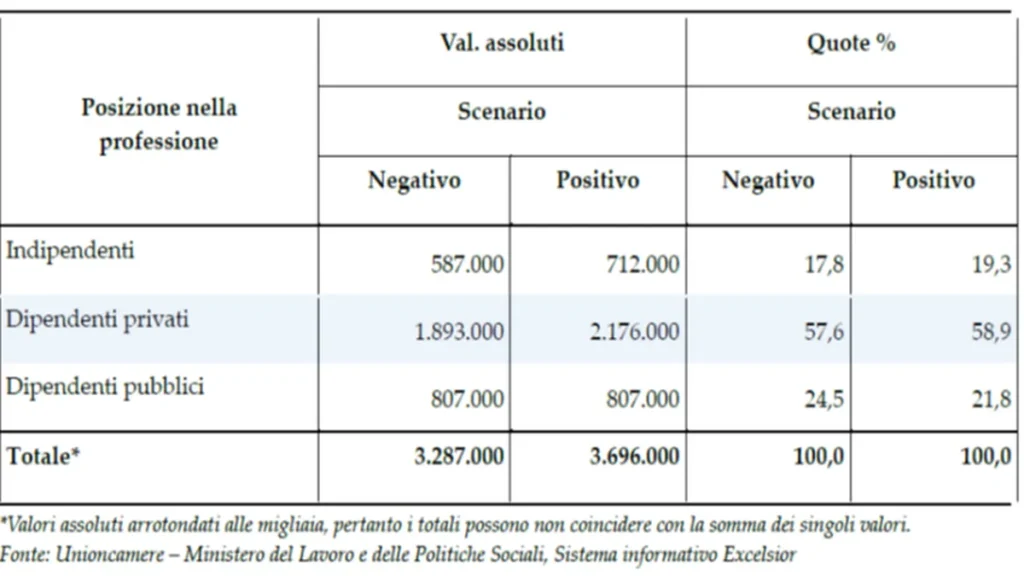
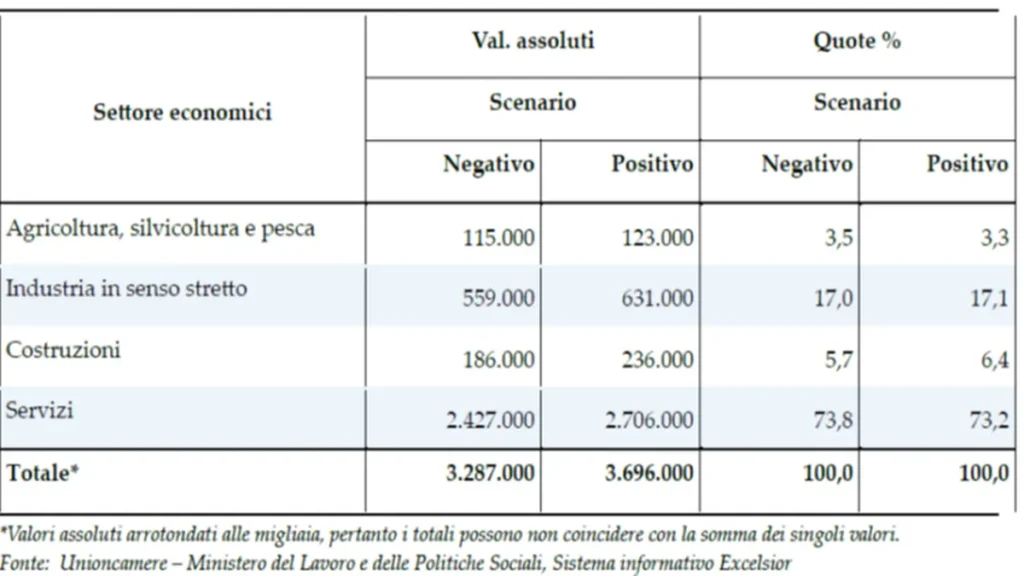
The main criticality of the Italian labour market concerns inactivity rather than unemploymentGender differences among the unemployed are relatively small, while among the inactive the gap is much more marked: there are almost 15 million women aged 15 and over, approximately five million more than men, highlighting a large potential workforce that is still untapped.
- The reasons for inactivity change with age. Among the young study and training prevail, while in adulthood family responsibilities, discouragement and other factors on which public policies can intervene take on greater importance.
- Inactivity female This constitutes a structural criticality. In middle age, family and care commitments continue to represent the main obstacle to women's participation in the labor market.
The job offer: the unemployed
Istat data fromLabour Force Survey reveal that in 2025, the population over 15 years of age recorded over 24 million employed, 1,6 million unemployed and 25 million inactive. Evaluating the gender composition, among the men against 13,9 million employed people there are 10,1 million inactive people and 831 thousand unemployed. Among the women, on the other hand, there are 10,3 million employed women, while the inactive number reaches almost 15 million and 745 women are unemployed. The picture outlined confirms that the main imbalance concerns not so much the search for employment, but rather the permanence outside the labor market.
To identify potential labor supply pools, it is therefore necessary to look not only at the unemployed, but above all at the inactive, analyzing their composition by gender, age, and region, so as to more effectively target activation policies.
In the year 2025 the unemployed are slightly more numerous among men (831 thousand) than among women (745 thousand), but their characteristics are different. Among men, the majority are formerly employed (467), highlighting a higher incidence of job loss. Among women, the largest component is also made up of formerly employed women (330); however, compared to men, the share of people coming from inactivity is higher (188, or 25%, versus 150, or 18% of men) and of those who have never had any work experience (226, or 30%, versus 215, or 26% of men). These differences indicate that, for women, unemployment is more frequently associated with difficulties accessing and entering the labor market, as well as with job loss.