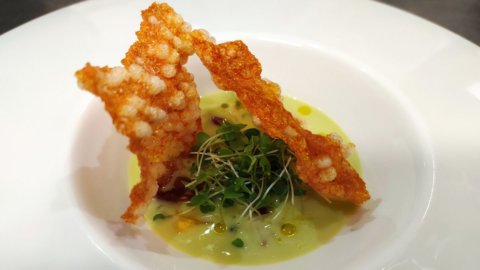
Has been considered among the "novelties of the year" in the 2021 Identità Golose Guide, the bible of signature restaurants in Italy and around the world, in the awards for young stars. The judgment reported in the evaluation sheet reads: "The break of the Covid-19 gave him the opportunity to focus even more on the Piedmontese raw materials which, according to him, "help him a lot in the preparations", but probably it is of a new reading, new eyes and maturation, a bit the summation of the experiences they have also seen a collaboration with Andrea Ribaldone”. And further on "In the dishes, starting from the appetizer - strongly desired by us - Summer salad "Spiciness and acidity" we find the absence of geometries since it is a liquid form of flavors invaded by a gustatory primitism already perceptible in its color , green, dense and uniform. A curly salad, with daikon sprouts, pea, mustard, ginger oil and sunflower seeds accompanied by tomato-based tapioca chips. The pulverization of the edges, although present in their essences, are perfectly balanced and balanced by the acidity, in clear value. A two-dimensional plate where there is only one color. But a triumph of taste, a little vegetable and a little salacious”. But we can also talk about his superb zucchini flowers stuffed with Robiola di Roccaverano, Albenga trombette cream with quinoa, in the form of a crumble, and tamarind extract, "A dish that could appear involved in the aesthetics but cooking the vegetables is perfect and crunchy, the accentuation of the flavors is balanced in its parts, and creates that right contrast that is never tense” or of his signature dish, the Three cookings of rabbit: the leg with vegetable caponata, the loin, cooked at low temperature , together with its reduction, and the "porchetta" served with a green sauce, "the most cerebral part".
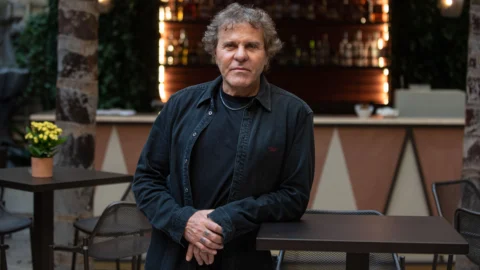
In short, at thirty years, Marco Molaro, a young chef originally from Udine, who at the "Due Buoi di Alessandria" inherited the starred cuisine of two great masters such as Andrea Ribaldone former executive chef of Eataly in Tokyo, at the helm of the Identità Expo San Pellegrino restaurant for the entire Expo Milano period, Food & Beverage Director for JSH Hotels, and like the Japanese Jumpei Kuroda, he has already been authoritatively awarded an honor of great honor and already suggests a career destined to make noise.
It all started from one children's cookbook that a neighbor gave him when he was 10 and which he still jealously guards. It was supposed to be the cue for a game became a sign of his fate. It was therefore consequent, when he was of age, to enroll at the Bonaldo Stringher hotel institute in Udine. And also the choice of university went in this direction. Influenced by the great talk of the "molecular" cuisine of the great Ferran Adrià at the time, the young Marco graduated in Food Science and Technology, deepening his knowledge of food chemistry and technologies applied to food.
Then the internships in excellent restaurants begin. One collaboration marks him more than the others is the one with Emanuele Scarello, from Udine like him, Chef and patron of the family restaurant, "Agli Amici dal 1887" in Udine, which has achieved two stars on the Michelin Guide, Italian president of the Jeunes Restaurateurs d 'Europe. Finally he arrives as Sous Chef of the Japanese Jumpei Kuroda, at the Due Buoi.
And when the property closes its relationship with Kuroda, there is no doubt, the young Molaro who has proven to be a creative chef, respectful of the raw material, its origin and its authenticity, as befits a restaurant with an ancient tradition territorial but in the meantime open to the suggestions of innovation, of creativity capable of pursuing constant balances, is enthroned at the age of thirty as a successor to starred chefs and virtually charged with making a new star shine over Alexandria.
For the readers of Mondo Food, Marco Molalo offers a recipe that summarizes his ability to innovate with unusual combinations while expressing all his refined gastronomic sensitivity.
The liquid salad is a preparation that was the most popular in the early 2000s, on the wave of the improperly called "molecular" cuisine, headed by Ferran Adrià. For many years it was no longer seen on restaurant menus. "Although I'm not a great admirer of "unstructured" dishes - explains the chef - I thought I'd dust off this preparation when I found myself having to use very unripe apricots". Apricots are prepared confit, like cherry tomatoes, in doing so it aims to soften and dampen that astringent note typical of very unripe fruits.
However, the main component, the true protagonist of the salad, are sprouts (or better called microgreens) "produced with extreme meticulousness by one of our trusted suppliers (https://www.microgreensitaliane.it/microgreens-italiane-prodotte-dalla-ditta-zafferaglio-di-alessandro-erdas/) that raise the bar of taste upwards”. The dish, as the name suggests, plays on spicy and acidic notes, balanced by the sweetness of the tomatoes.
The recipe: Spiciness and acidity: the summer salad
Ingredients for 4 people:
100 g curly endive
100 g iceberg lettuce
200g ice
Juice of half a lemon
20 g extra virgin olive oil
Barber vinegar
20 datterino tomatoes
1 tablespoon of icing sugar
Sale
Garlic and herbs
Fresh ginger
4 unripe apricots
Sprouts (mustard, watercress, sunflower and rocket)
60 g Tapioca pearls
250 ml Water
Seed oil
Procedure:
Blend the curly endive, iceberg lettuce, ice and lemon juice in a blender. Filter through a fine mesh sieve, season with salt and vinegar and emulsify with extra virgin olive oil
Blanch the cherry tomatoes and apricots in boiling water. Remove the skin from the cherry tomatoes and dry them in the oven at the lowest possible temperature. Once everything is dry, blend in a coffee grinder until you get a very fine powder.
Season the cherry tomatoes and peeled apricots with icing sugar, salt and aromatic herbs. Arrange on a tray and bake at 80/90 °C for about 3 hours.
In a saucepan, combine water and tapioca, bring to the boil, leave to rest for 10 minutes.
Add the previously obtained tomato powder and spread the mixture evenly on a mat of food grade silicone trying to obtain a very thin layer. Dry the mixture in the oven at 30/50 °C and, once a completely dehydrated sheet has been obtained, fry in very hot seed oil.
Composition of the dish:
Pour the cream of lettuce and endive into a bowl, arrange the cherry tomatoes and apricots cut into small pieces, cover with the sprouts and very thinly sliced ginger.
Finally, place the tapioca and tomato chips to complete the dish.
The liquid salad is a preparation that was the most popular in the early 2000s, on the wave of the improperly called "molecular" cuisine, led by Ferran Adrià. For many years it was no longer seen on restaurant menus. Although I'm not a great admirer of "unstructured" dishes, I thought I'd dust off this preparation when I found myself having to use very unripe apricots. The apricots have been prepared confit, like the cherry tomatoes, in such a way as to soften them and dampen that astringent note typical of very unripe fruits.
However, the main component, the true protagonist of the salad, are sprouts (or better called microgreens) produced with extreme meticulousness by one of our trusted suppliers (https://www.microgreensitaliane.it/microgreens-italiane-prodotte-dalla-ditta-zafferaglio-di-alessandro-erdas/) that raise the bar of taste upwards. The dish, as the name suggests, plays on spicy and acidic notes, balanced by the sweetness of the tomatoes.