The building, located in the popular district of San Lorenzo, gave its name to the group (Scuola di San Lorenzo) inaugurated by Achille Bonito Oliva with the "Ateliers" exhibition in the summer of 1984. It was Nunzio himself, the only sculptor of the six, to move first to the spaces of the former pasta factory, followed later by the others. But the six artists have never felt part of a real e
own group and also the partnership does not last long. Each of them, in the space of a few years, resumed their own individual path, being represented over time by various galleries, despite Italian and foreign museums such as the Macro in Rome, the MoMa in New York and the Mart in Rovereto they had dedicated group exhibitions, albeit with solo exhibitions that emphasized their singularity
and original artistic research. And Nunzio, as he was the first to arrive, was also one of the first to take his way back.
Born in 1954 in Cagnano Amiterno in the province of L'Aquila, Nunzio Di Stefano, known as Nunzio, studied at the Academy of Fine Arts in Rome, graduating in 1977 with Toti Scialoja. “He taught scenography and not painting. One thing that he passed on to his pupils, including Pascali and Kounellis, was his love for the theatre. All the young people of my generation – so the artist recalls his Master in an interview – looked for him because he brought new ideas and communicated his experiences, his encounters. He told me incredible stories about De Kooning and Rothko, he introduced me to Motherwell. In the academy I was a rather petulant student, I followed Scialoja closely. Then we became close friends. When he passed away, in his will it was written: 'To Nunzio, who is like a son to me'. Now I am part of the Foundation named after him”. Since the mid-XNUMXs he has been creating works in wood and cast lead sheets organized in regular shapes, arranged like sculptures on the wall, grouped by contiguous elements, with rare interventions of colour. More recently, he has started drawing. Using charcoal capable of leaving traces of absolute black, he creates strong, geometric images," sometimes based on mathematical rhythms and balances, or on a constant idea of orthogonality" that occasionally breaks, or, again, "on scansions that make up a fugue perspective". But between his sculptural work and the drawings "there is no direct relationship" in terms of design. “My sheets – explains the artist – have their own history, their own life. I don't know if some of these drawings will become sculptures or if they will look like us, but it is very unlikely. They are two parallel aspects of my work”.
Nunzio – writes the critic Marco Meneguzzo when presenting one of his exhibitions – “excites solid, tangible, traditional, even artisanal matter, because it restores to the surface and therefore to the observer, those qualities that are intrinsic to the matter itself such as colour. The black of his woods is not painted but is the result of the superficial combustion to which the artist subjects it: a small blowtorch burns the skin, however, preventing it from catching fire. The result is a deep, uniform black, not 'coloured' but colour.........
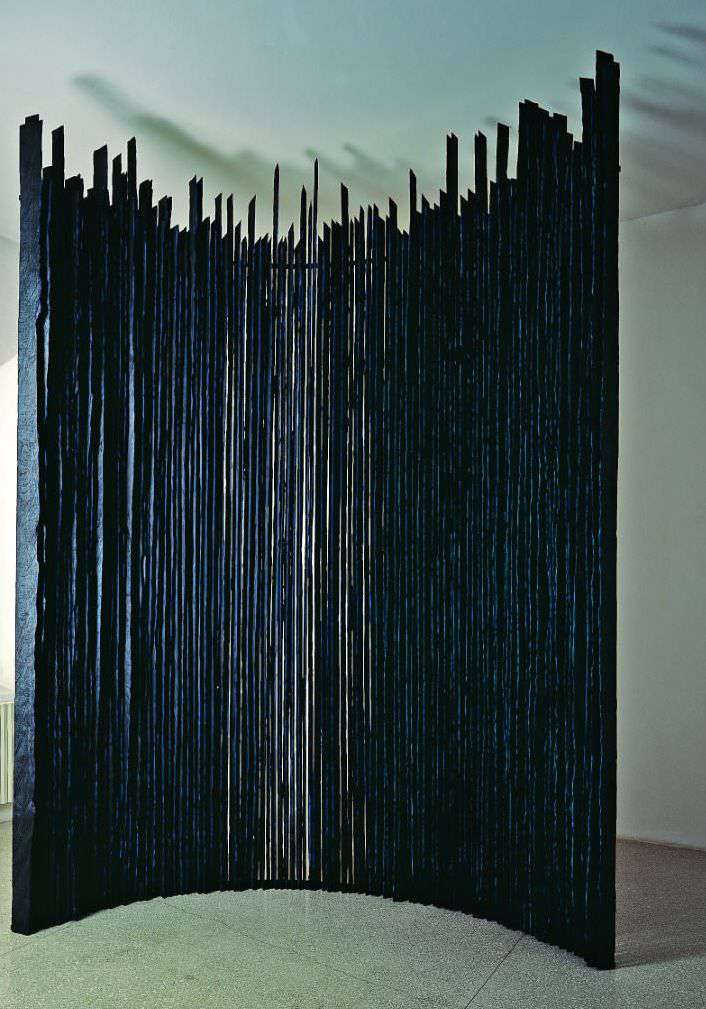
Deluge 2015
Burnt wood installation at the Church of Tears in Carrara
Photo Claudio Abate
“When the sculptor stages lead, its material qualities – underlines Meneguzzo – are chosen and exalted for their negative value: it does not reflect, it does not shine, it does not resist manipulation too much and it does not react with formally unpredictable actions (such as rust , for example). In a word. it is an 'opaque' material. Black matter and opaque matter”. Nunzio currently lives and works between Rome and Turin.
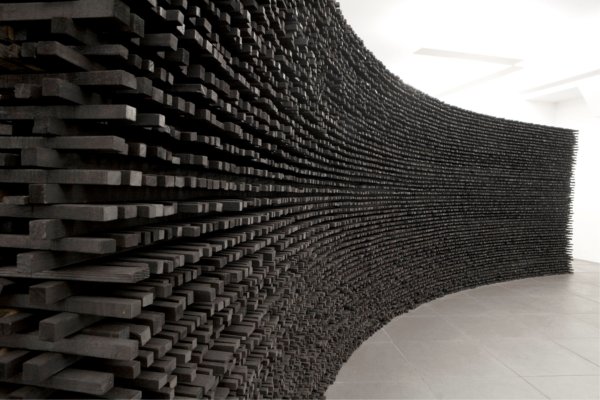
Avton, 2007
Burnt wood installation at the Maxxi in Rome
Exhibition activity
After a first exhibition in 1981 at the Galleria Spatia in Bolzano, in 1984 he exhibited large plaster sculptures at the Galleria l'Attico in Rome in an important personal exhibition presented by Giuliano Briganti. In the same year Achille Bonito Oliva organizes the collective Ateliers focused on the artists who work in the studios of San Lorenzo. His first exhibition in New York was in 1985, in the Annina Nosei gallery, which opened the doors to collecting and the American market and contributed to the international diffusion of his expressive language. In 1986 the artist presented his first works in wood and lead at L'Attico in Rome. Some of these works then participate in the LXII Venice Biennale where Nunzio wins the 2000 Prize as best young artist. Plasters and burnt woods were brought together in 1987 in the one-man show at the Civic Gallery of
Modena. Between the end of the 1985s and the beginning of the 1986s, the exhibitions - both personal and collective - followed one another in Italy and abroad. Among these: in 1996, Nouvelle Biennale de Paris, L'Italie aujourd'hui, at the Center National d'Art Contemporain in Nice, Nuove trame dell'arte, at the Colonna Castle in Genazzano, Anniottanta at the Galleria Comunale in Bologna; in 1989, Aspekte der Italienischen Kunst, a traveling exhibition that visits various German cities, the XI Quadrennial of Rome, in which he will also participate in 89, and the VI Biennale of Sydney; in 1991, Los Nuevos Romanos in Santiago de Compostela and in Madrid, and Prospekt '1995 in Frankfurt; Internal Rome, at the Museum Moderner Kunst Stiftung Ludwig in Vienna, in XNUMX, and the III Istanbul Biennial the following year. In XNUMX Nunzio was invited to the Venice Biennale with a personal room: he was awarded an Honorable Mention.
The first solo exhibition in Japan was in 1994 at the Kodama Gallery in Osaka, followed by participation in the Fujisankei Biennial in 1995 where his sculpture Ombre, located in the spaces of the Hakone Open-Air Museum, won the Prize for Excellence. In the same year is the one-man show set up at the Villa delle Rose headquarters of the Galleria d'Arte Moderna in Bologna. In 1997 he presented works in bronze for the first time at the Alice Pauli Gallery in Lausanne; in 2000 the one-man show at the Galleria Fumagalli in Bergamo was accompanied by the publication of a monograph. In 2005 he held his first solo exhibition at the Galleria dello Scudo in Verona, curated by Lea Vergine, where he presented a series of installations in burnt wood that create new and alienating living spaces.
The anthological exhibitions set up at the MACRO in Rome, curated by Danilo Eccher, and at the Museum of Contemporary Art in Belgrade, curated by Bruno Corà, date from the same year and the following year. In 2012 he held a personal exhibition at the Museum Biedermann in Donaueschingen in Germany. In 2016 he exhibited at the Madre in Naples, and the Museo Riso in Palermo dedicated a large personal exhibition to him; In 2017 he is among the protagonists of the review
“YTALIA – Energy Thought Beauty. Everything is connected”, at the Forte di Belvedere and other locations in Florence. His works are present in public and private permanent collections, including the GAM in Turin, the National Gallery of Modern and Contemporary Art, the Macro and the MAXXI in Rome, the Museum Moderner Kunst Stiftung Ludwig in Vienna, the Maramotti Foundation in Reggio Emilia, the Biedermann Museum in Donaueschingen.
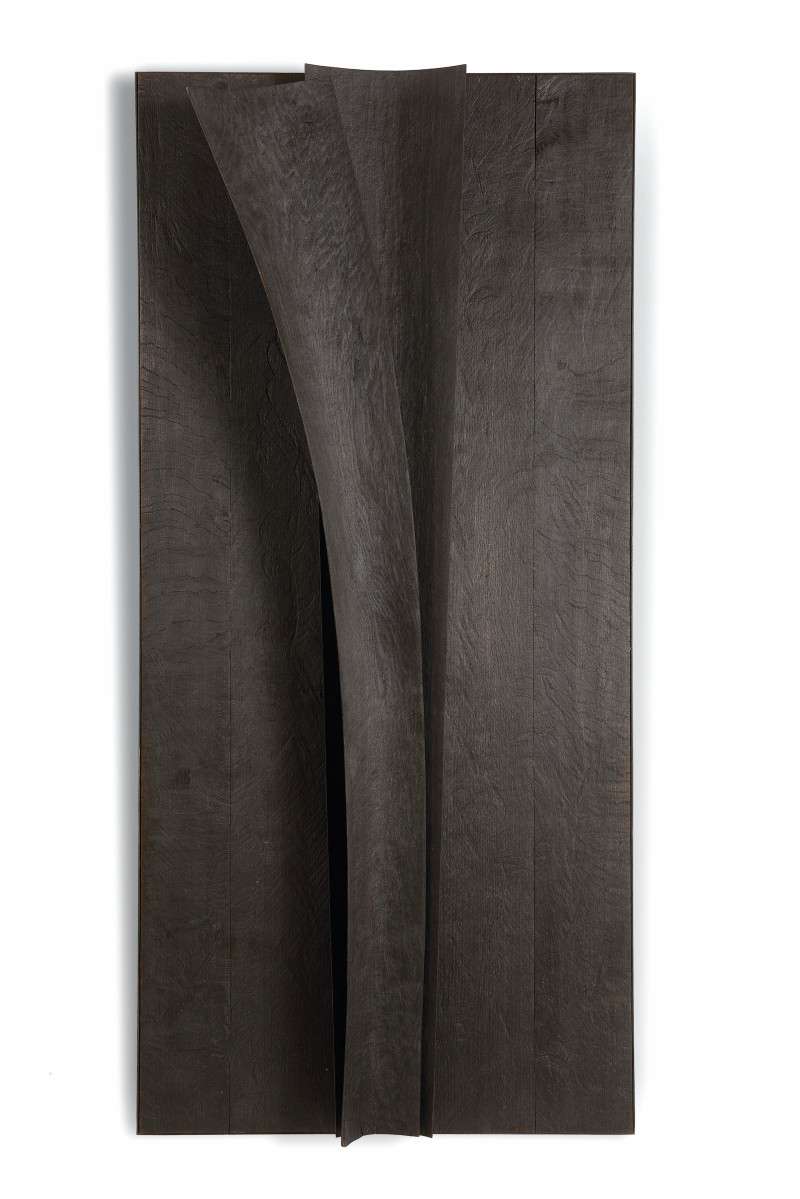
Untitled 2010,
combustion on wood, 200 x 93 x 30 cm
courtesy Mazzoleni gallery
Basket Market
Nunzio is a meticulous artist and particularly rigorous about the quality of his work. A few selected works come out of his studio every year and this has an absolutely positive repercussion on his prices which have been growing steadily for some years. His sculptures with minimal shapes that investigate the nature of materials are in great demand by Italian and international collectors and – confesses one of his reference gallerists – there is a sort of waiting list to have a work by Nunzio with times in any cases of more than a year. Also active on the secondary market with over 150 passages in international auctions which have intensified in recent years, causing the unsold share to fall below 40% and achieving a turnover of more than 150 thousand euros in 2017.
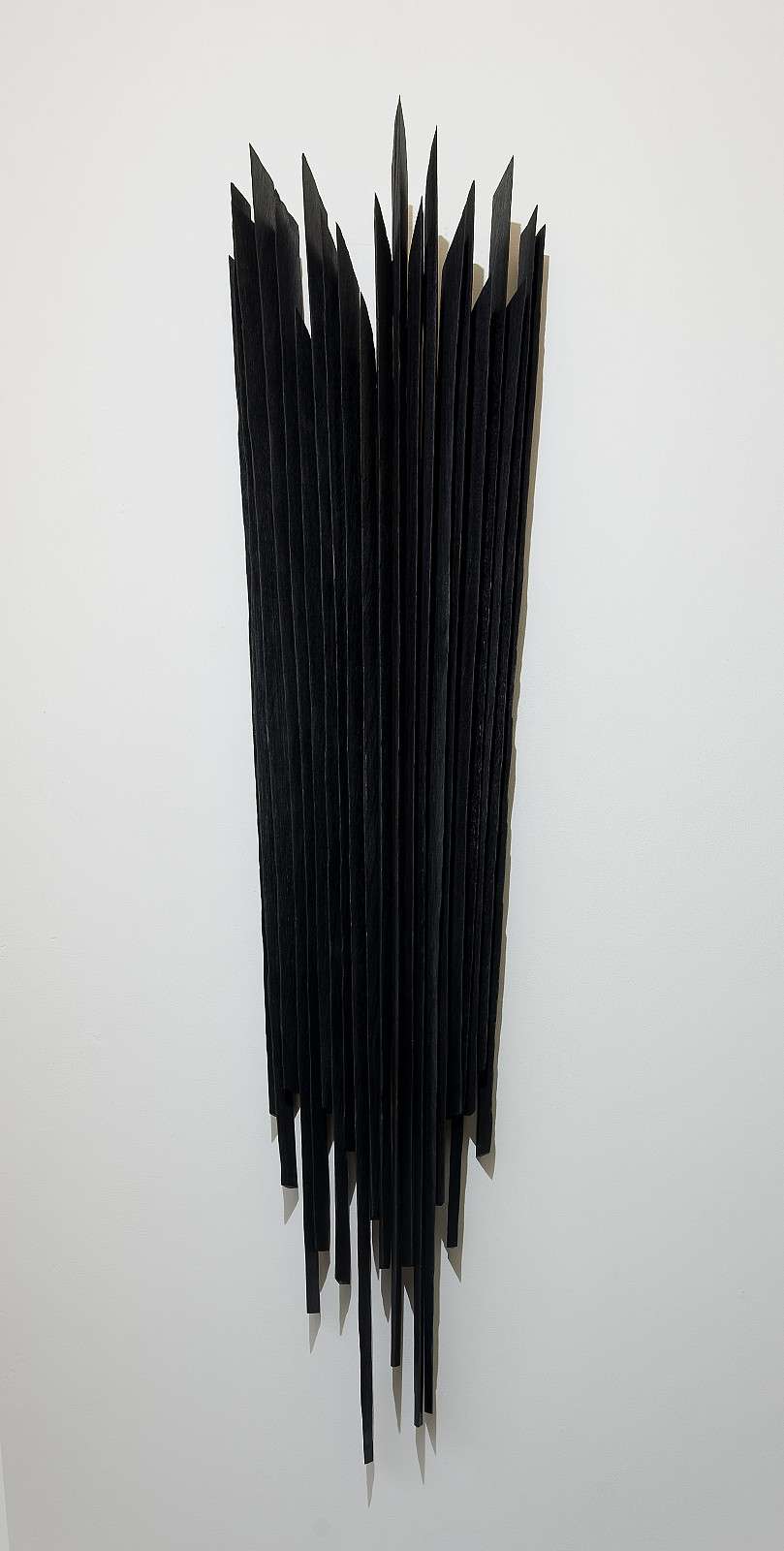
Senza titolo 2017
Burnt wood – 218cmx60cmx25cm
Private collection
Gallery: Nunzio's work is treated by various galleries including Mazzoleni Art (London, Turin), Galleria dello Scudo (Verona) and De Foscherari (Bologna).
Pricing: in the gallery his burnt wood can be purchased within a price range that goes from around 25 to over 100 euros depending on the quality and size. More or less the same figures are also needed for lead weights (just to give an example for a lead on a 100×100 cm board. the request is around 40-50 thousand euros). The prices of his papers are decidedly more contained and can be purchased starting from a few thousand euros up to over 20 thousand depending on the techniques and dimensions.
Top price at auction: “Untitled” 1989, Sculpture (combustion/bois) of 243 x 45 x 45 cm changed hands for 70 thousand euros from Farsetti auction house in Prato in December 2017.
“Untitled“ 2002, Lead foil on board 120 x 121 cm was sold for over 50 euros by Sotheby's Milan in April 2008.