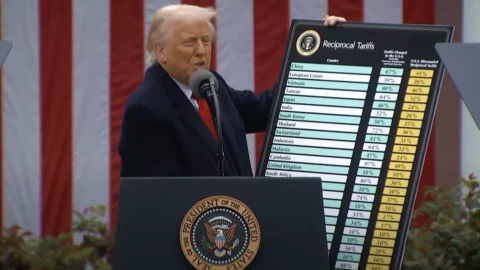
In the absurd "duty show” staged on Wednesday evening by the President of the United States, Donald Trump, between unlikely tables, fake workers and musical accompaniment of dubious taste, one case stands out above all others: that of the small Vietnam, hit by very high tariffs, equal to 46%, more than double those imposed on the European Union, so to speak. Historical recrudescences? No, questionable calculations and theories difficult to demonstrate.
According to the star-spangled administration, in fact, Vietnam and Cambodia would apply tariffs on the United States equal to, respectively, at 90 and 97%. Not only that, both countries would be exploited by China, which would move its products there to then sell them in the US, bypassing the customs barriers. Hence, the “logical” consequence (for Trump, at least): both countries have been punished with very heavy duties, among the highest of all: 49% on Cambodia and 46%, as mentioned, on Vietnam, who should also be grateful, given that both percentages, according to Trump, represent an "unmissable" discount, one that not even on Black Friday, due to the proverbial "American kindness". And who will pay the bill of this phantom kindness? US consumers, the sportier ones in particular, who from today may have to shell out exorbitant sums of money to be able to afford a simple pair of sneakers. But let's go in order.
READ MORE: US tariffs: they could cost Italy up to 20 billion
The formula of duties
Since last night, that is to say in the hours following to Trump's tariff announcements, one of the most debated topics at international level concerns the formula used to calculate duties to be imposed on the different countries. It seems that the White House experts used the following approach: they would have started from a 10% base rate for everyone, to which they then added additional duties, calculated on the basis of the treatment that individual countries reserve for the USA (hence the name "reciprocal duties”). This second calculation would include not only customs duties, but also the so-called “non-monetary rates”, such as rules and regulations on goods and services. The problem? Even for the most gifted economists it would be impossible to calculate the real weight of these “non-monetary” barriers, so in the end it turned out that the tycoon's strategists would decide the amount of the duties by making a simple division within the reach of a primary school student. They took the trade deficit with each country and divided it by the total value of exported goods. We won’t go into the dismay of the vast majority of world economists – some of whom apparently needed “salts” to recover from the shock – and let’s move on.
US tariffs and the Vietnam case
We arrive at the Vietnam which today has a trade surplus of 123,5 billion dollars with the United States compared to a total value of exports equal to 136,6 billion dollars. Based on these numbers, the US would have calculated 46% tariffs on imported products from Hanoi and surroundings.
Few people know that, precisely for the purpose of reducing their exposure to China (as requested by the US administration, among other things), the giants of global sportswear have moved their production to Vietnam. The result? In recent years Vietnam has become one of the world's largest sneaker production centers racing, but also sportswear.
To be clear, industry giants such as Nike and Adidas produce a large portion of their goods there. As explained by Courier, The American company, for example, produced 50% of its shoes and 28% of its clothing in Vietnam last year, while for the German company the percentages amount to 39% and 18% respectively.
Stock market reaction
And it is no coincidence that today, while the world stock markets are trading in the red without registering any noteworthy collapses, they are being hit by a real sell off are precisely the companies in the sportswear sector: in Frankfurt Adidas loses 10,19% at 198,40 euros after touching an intraday low of 196,90, the lowest price in almost a year. Things are not going any better at Puma, which records a decline of 9,9% at 20,65%, the lowest since 2016. And Nike? In the Nasdaq pre-market, the title of the American giant yields more than 9% of its value, falling to 58.67 dollars, the lowest level since 2018.
According to UBS analysts, investors' reaction to tariffs in the sporting goods sector It mainly concerns Vietnam, because the announced tariffs are "significantly worse than expected". In fact, given the growing importance of Vietnam in footwear production, it is to be expected significant obstacles to profitability of the sports footwear sector.
Outrageous prices for sneakers in the US?
But the consequences of Trump's moves will not only affect the stock market. After all, we have already seen it and will probably see it again in the coming days. In the vast majority of cases, the effects of trade wars do not only hit producers and exporters, but also and above all consumers. The only way to avoid this would in fact be to push the giants of the sector to move their production. But in this case, two factors must be considered. The time factor: it takes years to do this, not days. And the place factor: where should Adidas, Nike, etc. go, considering that many other Asian countries – China above all – have also been hit by very heavy tariffs?
The short-term effect of the duties imposed by Trump can therefore only be one: to try to contain the impact of the tariffs and keep their profitability intact, the various brands will have to increase product prices that are imported into the US. Translated: the ones who will pay will be the citizens who risk having to shell out exorbitant sums of money to be able to afford a pair of sneakers to use for running or just for a walk. Was it really worth it?