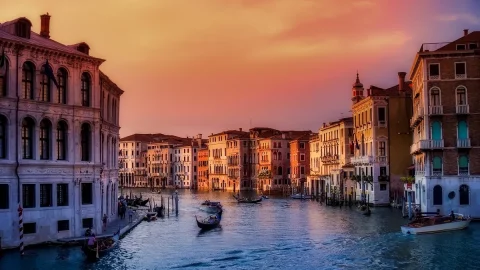
Venice must be added immediately to the list "world heritage in danger” because it is a risk. This is requested by the World Heritage Centre, a branch of Unesco. "Continuous development, the impacts of climate change and mass tourism risk causing irreversible changes to the exceptional universal value of Venice", notes the organization which also underlines "the ineffectiveness and lack of coordination between local authorities and national ones", with the dragging on of "year-old but urgent problems". The recommendation requesting that the city, the cradle of arts and commerce, be included in the list of heritage sites that require immediate safeguarding action to be implemented, will have to be voted on by the member states of the UN body at the 45th session of World Heritage Committee, scheduled in Riyadh, in the United Arab Emirates, from 10 to 25 September.
Venice is at risk: Unesco explains why
The World Heritage Center places emphasis on mass tourism and on climate changes that threaten the integrity of the site, but also on "buildings" that are too tall, which can "have a significant negative visual impact" on the city, and which should be constructed away from the center of Venice.
Thus the city of Venice, a UNESCO World Heritage Site since 1987, is in danger and risks "irreversible damage". It's not a new. The registration in the "danger list" had already been requested two years ago, at the last avoided by some measures adopted urgently by the government, in particular the decision to ban large ships in the San Marco canal (thanks to the executive led by Mario Draghi), the decision to dismantle the LPG depot in Chioggia, the activation of the Mose for defense against flood waters - for which, however, a complete and detailed environmental impact study is still missing - and the promise to launch an ambitious conservation plan for the lagoon city. If the ban on large cruise ships has been respected – even if according to UNESCO it should be extended both geographically and to other particularly polluting boat models – the program for save the city he remained at the post. Since 2021, Unesco experts have repeatedly asked Rome for updates on "corrective measures with a timetable for their implementation". So far, the responses have been judged insufficient.
What does it mean to enter the list of heritage in danger?
But what does it mean to enter the list of world heritage in danger? UNESCO does not plan, at least for the moment, to withdraw Venice from the list of the 900 world cultural heritage sites: the inclusion of a property among the sites at risk should be a stimulus "to remedy". But it is not even a hypothesis to be excluded. In any case, it would be a great "humiliation" for Italy if one of its jewels ended up on the list of world sites in danger.
The decline of Venice, a victim of mass tourism
That the precious artistic heritage of Venice was threatened by the effects of the climate changes we've known that for a long time. Just as we have long known that the unrestricted tourism it has brought the Venetians to their knees who have to deal with the scarcity of housing, taken away from the residents in favor of the tourist market. Furthermore, the many - too many according to UNESCO - urban and infrastructural development projects in the city, almost always aimed at welcoming more visitors, risk increasing the depopulation in progress.
The relationship between Venice and tourism, however, has a long history behind it. What is today a divisive issue but of fundamental importance for the future of Venice, at the beginning of the twentieth century - when the population was more than double that of today - was seen as an opportunity. Then from elite tourism it turned more and more into uncontrolled tourism, distorting the identity of the city and reducing it to a mere tourist attraction. And the measures that we intend to adopt reinforce this image even more. As the introduction of the daily access ticket for all those who want to visit Venice (approved in 2019 by the City Council and postponed for now to 2024) because it does not act upstream of the problem but limits itself to making a profit on visitor entrances.
And overtourism is just one of the many criticisms of Venice and its decline.
Another is theair pollution. Cruise tourism, for years in the sights of the No Grandi Navi civil association, has contributed exponentially to pollution. Cruise ships also contribute to rising tides, of which we have seen i disastrous effects in 2019.
Venice at risk: reactions to the UNESCO recommendation
Obviously there was no lack of controversial reactions to the alarm raised by UNESCO, such as that of Massimo Cacciari, former mayor of Venice: “The risk of Venice is linked to natural and climatic disasters. After that, certainly there is a great tourist pressure, as indeed in Florence or Rome. But what are we to do? Losing tourism too because Unesco tells us it's harmful? Rather, you take out the money to do the works you need instead of talking nonsense… more facts and less words!”. While the Municipality of Venice limited itself to issuing a brief note explaining that "it will read the proposal carefully, but it is the responsibility of the government".
Despite the differences, the warning launched by UNESCO calls for reflection on the future of the city and the lagoon. If you want to save Venice from its decline, you need to change the direction in which you think about the development of the city. If, on the other hand, we continue to think of Venice as an open-air museum to "raise cash" rather than a city in all respects, then its end is sealed.