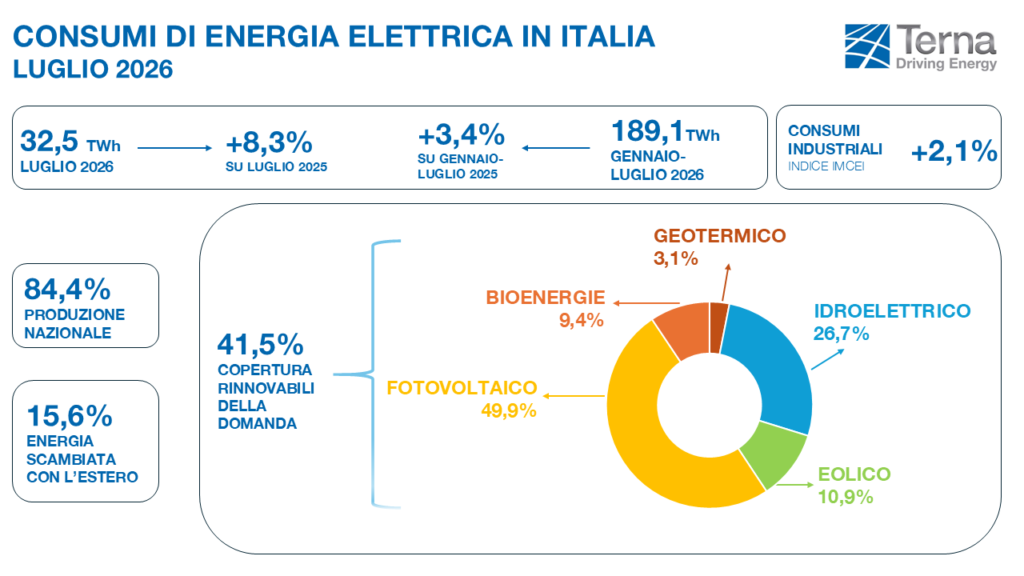
Le temperature exceptionally high push Italian electricity consumption at historic highs for the month of July. According to data released by TernaIn July 2026, electricity demand reached 32,5 TWh, marking an increase of 8,3% compared to the same month in 2025 and setting the highest monthly value ever recorded. The strong energy demand also led to the annual peak demandOn July 15, demand reached nearly 58 GW, 4,5% higher than the peak reached in 2025. From the beginning of the year, between January and July, electricity consumption has increased by 3,4% overall compared to the same period last year.
Heat pushes consumption to its highest
The surge in demand was mainly driven by weather conditions. In July, the average temperature was 10°C higher. 1,2 degrees compared to the same month in 2025 and almost 2 degrees above the ten-year average. In the last five days of the month, in particular, temperatures exceeded seasonal values by about 6 degrees. The 8,3% increase thus more than made up for the 3,1% decline recorded in July of last year. Furthermore, the comparison was made with the same number of working days, 23 in both months.
Adjusting for temperature and calendar effects, the increase in consumption slowed but remained significant, standing at 5,1%. On a quarterly basis, seasonally, calendar-adjusted demand increased by 1,6%. This is the third consecutive month of growth, and according to Terna, the trend is returning to levels prior to the 2022 energy crisis for the first time.
The the increase affected all areas of the countryConsumption rose by 8,3% in both the North and the South and on the islands, while Central Italy recorded an increase of 7,9%.
Photovoltaic growth accelerates, with renewables accounting for 41,5% of demand.
On the production front, in July Italy satisfied the demand with energy produced on the territory84,4% of national demand, while the remaining 15,6% was covered by the balance of foreign trade. net national production The current account for 27,7 TWh, up 7,9%. The foreign trade balance also grew by 10,2%, with imports up 4,4% and exports down 49,3%. To meet the increased energy demand, thermoelectric production increased in particular, rising 14,1%, while overall renewable sources recorded a limited increase of 0,8%.
Renewables have covered the 41,5% of the national electricity requirement, a share lower than the 44,5% reached a year earlier. The declines were impacted by declines in wind power, down 20,3%, hydroelectric power, down 14,9%, geothermal power, down 3,6%, and biomass, down 2%.
Photovoltaic, which has produced a counter-trend 6,7 TWh, with a growth of 20,6% compared to July 2025The increase, equal to 1.144 GWh, is mainly linked to the expansion of installed capacity, which contributed 946 GWh, while another 198 GWh came from increased producibility.
New 745 MW of renewable capacity in July
Meanwhile, the expansion of Italy's renewable energy portfolio continues. In July alone, 1,000 plants were installed. 745 MW of new capacity, of which 405 MW comes from solar and wind plants connected to the high-voltage grid.
Between January and July 2026, new installed photovoltaic capacity reached 3.791 MW, while the overall increase compared to July of last year was 6.874 MW. As of July 31, installed renewable capacity in Italy amounted to 87,70 GW. Solar accounted for 47,30 GW, while wind power reached 14 GW.
The spread of storage systems also continues. Terna takes note in Italy 948.154 plants, for a total capacity of 19,43 GWh and a nominal power of 8 GW. Detailed data on the performance of the electricity system are collected in the "Monthly Report on the Electricity System" published by Terna.
Industry still growing, services also rising
Positive signals are also coming from the production system. The Imcei index developed by Terna, which monitors the electricity consumption of approximately one thousand companies considered "energy-intensive", recorded a growth of 2,1% on an annual basisIn the first seven months of 2026, the industrial indicator overall showed an increase of 4% compared to the same period in 2025.
Electricity consumption in the service sector is also increasing. The Imser index, released two months later than the Imcei, shows growth of 1,2% for May 2026. In the first five months of the year, the overall increase was 1,1%.