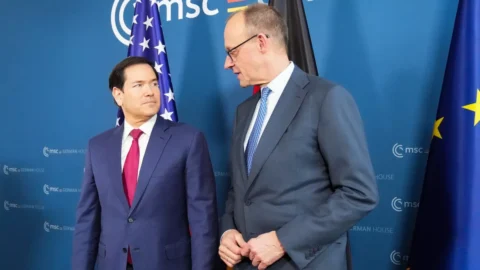
“We are part of a single civilization, Western civilization. We are connected. We want Europe to be strong. We believe that Europe must survive. Ultimately, our fate is intertwined with yours." This was stated by the US Secretary of State. Marco Rubio at the Munich Conference, responding to the words of the German ChancellorFriedrich Merz who yesterday, in a harsh speech, had spoken of a "fracture between the US and the EU”, admitting that “the post-World War II world order no longer exists.”
Speaking today from Monaco Park, Rubio chose to play the role of the good cop, trying to mediate between Trump's excesses, Vance's attacks and the new EU temperament which, after the Greenland affair, no longer seems willing to accept it without reacting.
Rubio: "We made mistakes together, let's fix them together."
"Let's build a new Western century with Europeand.” “We need strong allies who can defend themselves. With strong allies, we are stronger too,” Rubio said. When the United States disagrees with Europe, it is because it is concerned about the fate of the old continent, a fate “that will always be tied to that of America.”
The post-war triumph led to a “dangerous illusionSecretary of State Marco Rubio is convinced of this, and underscored it in his opening remarks at the Munich Conference, stating that “The euphoria of this triumph led us to the dangerous illusion that we had entered the 'end of history' and that every nation was a liberal democracy, that bonds forged by trade and trade alone would replace nationality, that the rules-based global order, an overused term, would replace the national interest, and that we would live in a world without borders, where everyone would become a citizen of the world.” “This was a crazy idea that ignored both human nature,” he said, “We made these mistakes together and now, together, we have a duty to our people to face reality and move forward,” he added.
In a passage of his speech, Rubio recalled the American and European soldiers who fought together in Afghanistan. These words come just a few weeks after Trump, on the contrary, dismayed his allies by downplaying the role of NATO allies, prompting an unprecedented and harsh reaction from Italian Prime Minister Giorgia Meloni. Yesterday, Bavarian President Markus Soeder bitterly recalled that speech in his opening remarks at the event.
Rubio: "The end of NATO is not our goal."
The end of the transatlantic era “is neither our goal nor our goal "Nor our desire," the US Secretary of State said in his address to the Munich Conference. "In an age of headlines announcing the end of the transatlantic era, let it be clear to everyone that this is neither our goal nor our desire, because for us Americans, our home may be in the Western Hemisphere, but we will always be children of Europe." "We have bled and died side by side," he added, emphasizing that the United States is "charting the path to a new century of prosperity" and wants to do so with Europe.
Merz: "A rift has opened between the US and the EU."
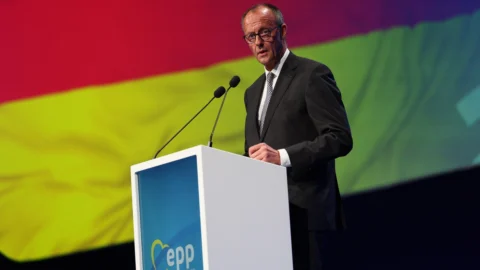
"A rift has opened between us." German Chancellor Friedrich Merz made this clear on Friday, speaking from the stage in Munich. This time, there was no attempt to mediate, to calm things down in the hope that Donald Trump would change his mind or turn his attention elsewhere. A year after J.D. Vance's shocking speech at the Security Conference, which clearly showed what the new MAGA era would bring to the leadership of the United States, Merz admitted that the American vice president "was right."
Not for the reasons, but because "the cultural struggle of the Maga movement is not ours," attacked the Berlin leader, who immediately found support from the most defensive of European leaders, Emmanuel Macron, according to whom "everyone should take inspiration from us and should stop criticizing us."
The Chancellor, however, launched an appeal: "Repairing and reviving transatlantic trust together” which remains essential. In this, “Europe is doing its part.”
Merz: "The post-World War II world order no longer exists."
"We need to talk, it's more urgent than ever", said Merz, underlining how “for several years now, even here in the room, there has been a mood marked by increasing tensions and conflicts in the world,” and then cited the conference motto, which says it all: 'Under destruction'. “I fear we need to say it even more clearly: lpost-war world order, as imperfect as he was even in his best moments, it no longer exists“, Merz declared in a speech in which he wanted to highlight the difference that now exists between the United States and Europe.
“From us, freedom of speech It ends when it turns against human dignity and the Constitution. We we don't believe in customs duties and in protectionism, but in free trade. And Let's stay faithful to the climate agreements and the WHO because we are convinced that only together can we solve global challenges,” he listed, in contrast to Trump’s line.
But that doesn't mean there's no room for reopening. "For three generations, trust between allies, partners, and friends has made NATO the strongest alliance of all time. And in the era of great-power rivalry, not even the United States will be powerful enough to act alone." With this in mind, however, it's now time for Europe to react. "A sovereign Europe is our best response to the new times. Uniting and strengthening Europe is our most important task today," he said, calling on the Old Continent to "focus on increasing our freedom, security, and competitiveness" to become a "true global player" with "its own security policy strategy."
Merz: Talks with Trump on nuclear power
During his opening remarks at the Munich Security Conference, German Chancellor Friedrich Merz confirmed that Germany and France have been holding confidential talks for over a year on a possible European nuclear umbrella supplementing NATO, while French sources revealed that Poland, Sweden, Denmark, and the Baltic states are also participating in the negotiations.
Meloni cautious:
“It is evident that we are in a very complex phase of international relations, we are also in a particular phase of relations between Europe and the United States. I believe Merz makes a correct assessment when he says that Europe must take care of itself, that it must do more on security, on the European pillar of NATO. I agree with this, independently, as I have said many times, of the relationship with the United States." This was stated by Prime Minister Giorgia Meloni, in Addis Ababa, speaking with some journalists, who also asked her if she shares the Chancellor's reflections German Friedrich Merz on Maga culture: “No, I would say no Meloni replied. "These are political assessments. Every leader makes them as they see fit, but it's not a matter for the European Union; they're assessments by political parties."
In the same context Meloni announced that Italy will join the Peace Council, but as an observer. There will be a meeting in Washington on Thursday. "We were invited as an observer country, in our opinion It's a good solutionI'm addressing the issue of constitutional compatibility with membership. Italy is working to stabilize the Middle East, but the situation is very complex and fragile. I believe an Italian and European presence is necessary, so I think we will respond positively to this invitation to participate as an observer country.
Macron: "Everyone would like us to be stronger, except our enemies."
The President of the French Republic, Emmanuel Macron, then intervened to support the German Chancellor: “I am here with a message of courage and determination“, said the occupant of the Elysée Palace, opening his eagerly awaited speech at the Bavarian meeting. “Everyone would like us to be stronger with our defense, except our enemies. We want a stronger Europe”, he added before calling for people to avoid “criticizing” or “caricaturing” Europe, again replying to Vance a year later.
The French President then focused on one of the key themes of the conference, addressed in a specific meeting also attended by Antonio Tajani: Ukraine and the path to the end of the war. “There will be no peace without Europeans, rest assured,” warned the head of the Elysée, relaunching the invitation to reopen “a transparent channel of communication” with the Russians (in truth already started by Paris, albeit at the advisory level).
(Last update: 15 pm on 14 February).