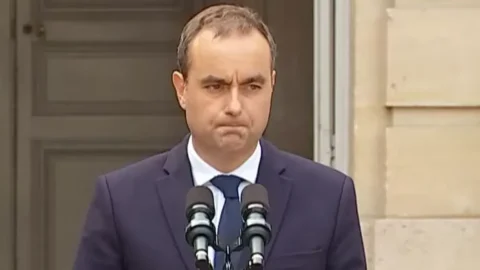
A record: Sébastien Lecornu has resigned the day after announcing his new government which lasted only 14 hours. He thus became the prime minister with the shortest term in history, as well as the fifth French prime minister to leave since 2022.
Lecornu was appointed by Emmanuel Macron on September 9, following the resignation of his predecessor, François Bayrou, who had been ousted by a vote of no confidence in the National Assembly. The President of the Republic, after initially accepting the resignation, asked Lecornu to conduct new consultations. If he fails to save the legislature by Wednesday, Macron promises to "take responsibility for one's actions“, words that seem to foreshadow the possible dissolution of the National Assembly and new early elections.
Lecornu: "The conditions for staying weren't right."
"There were no conditions to remain prime minister“: said Lecornu after having resigned, initially accepted by President Emmanuel Macron but then relaunched for a last attempt: the President of the Republic he asked the Prime Minister to negotiate until Wednesday“If it fails,” Macron said in the evening, “I will take responsibility.”
In a brief conference, the outgoing Prime Minister partially explained the reasons for his choice: “The political parties continue to adopt a position as if they all had an absolute majority in the National Assembly. Each political party wants the other to adopt its program.", he has declared.
Lecornu explained that he had been trying for three weeks "to build a path with the social partners, employers' associations, and representatives of employee unions, particularly on issues that have been stalled for many weeks," such as unemployment insurance, pensions, and social security, to "restore joint management" and "build a roadmap" with the common core of the majority parties. However, this attempt failed. “the appetites of a part” of the parties related to the upcoming elections 2027 presidential election. The not-so-subtle reference is to Republican Party leader Bruno Retailleau, but not only.
"We must listen to our activists, but always think of the interests of French citizens," said the now former prime minister, assuring that he was "ready to compromise." Political forces "sometimesand pretended not to see the change, the profound breach represented by the failure to use Article 49.3 of the Constitution,” which allows the government to pass a law without a parliamentary vote, barring a motion of no confidence. Furthermore, he argued, there was no longer “a pretext for preventive censorship” in parliament.
Lecornu finally reiterated that “It wouldn't take much for things to workThis “little,” he explained, would mean more personal disinterest, more humility, and “a little renunciation of certain egos.”
France: What happened?
Lecornu was supposed to present his general policy statement to the National Assembly on Tuesday, but now it seems he will instead make a final attempt at negotiation. On Sunday, he presented his government, which was almost identical to the previous one: 12 out of 18 ministers had been reconfirmed. The list also included the former Minister of Economy, Bruno Le Maire, a Macron loyalist and highly disliked by the opposition, who hold him responsible for the explosion of public debt. The names chosen had also sparked considerable discontent within the coalition, with the Republicans highly critical of Lecornu.
France: What happens now?
What is happening in France is unprecedented. Lecornu's resignation opens a phase of great uncertainty. Le Maire has decided to step aside in order to facilitate dialogue with the Republicans, with whom Lecornu will try to start new lightning negotiations.
In case of failure, the ball will pass back into the hands of President Emmanuel Macron has two choices ahead: try to name the sixth prime minister in less than three years, perhaps trying to give the government a different imprint – after three centre-right prime ministers he could nominate a centre-left one or he could opt for a technician – with the risk of clashing with the contrary votes of parliament, or resigning himself, dissolving the national assembly and call new early elections, the second in just over a year after the one decided in June 2024. There is also a third possibility, which however is currently considered the least likely, even if after Macron's phrase of "taking responsibility" in the event of yet another Lecornu flop the possibilities increase: the President of the Republic he might decide to take a step back himself and call early presidential elections to break the political impasse paralyzing France.
The reaction of politics
Following Lecornu's announcement, the opposition has almost unanimously called for early elections. Both the National Rally (RN) and Jordan Bardella and Marine Le Pen They are calling for the dissolution of the National Assembly: "We are at the end of the road. Tomorrow will not be better (...) We are at the end of the joke, the farce has gone on long enough," declared Le Pen, thus calling for a return to early elections.
La France Insoumise (LFI) goes further and calls for "immediate consideration" of the motion to impeach Macron. "Following the resignation of Sébastien Lecornu, we call for the immediate consideration of the motion tabled by 104 deputies for the impeachment of Emmanuel Macron," writes the leader of the radical left party in a message published on X. Jean-Luc Mélenchon.
Olivier Faure, secretary of the Socialist Party, instead emphasized the "dignity" in the choice to resign of the Prime Minister, whom he sees as a "true Gaullist," and called on the Elysée to finally open the leadership of the government to the left.
The former French Prime Minister François Bayrou He calls for "confidentiality" in the face of a situation he considers "serious and worrying." Returning to his fiefdom in Pau, the former prime minister refuses to comment on the current political situation in France, calling for a "minimum level of confidentiality" to be maintained "in these circumstances, both serious and worrying."
The market reaction
After Lecornu's resignation, the Paris Stock Exchange recorded a decline of 1,36%, weighed down mainly by the banking sector. TheTen-year oat closed with a yield of 3,57% and a spread with the German 10-year bond of 86 basis points. This is the same spread with the Bund of the Italian paper, which also sees the same return with the benchmark of the same duration. Meanwhile, rating agencies have warned Paris: political paralysis could cause the country to regress.
(Last updated at 8:20 a.m. on Tuesday, October 7)