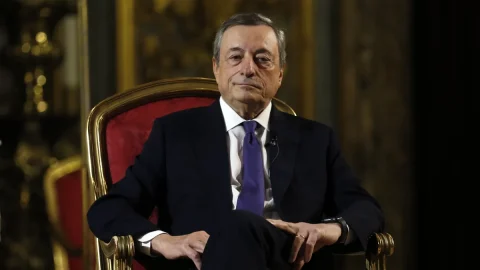
“In a world where alliances are constantly evolving, every strategic dependency must now be reexamined. For the first time in living memory, we are truly alone togetherEurope is reacting to this new reality. But it is doing so within a system that was never designed to address challenges of this magnitude." For the umpteenth time, the former Prime Minister Mario Draghi He tries to wake up a European Union that seems incapable of reacting to the changes taking place, starting with the distancing from the United States. And he does so during his speech in Aachen where he received the Charlemagne Prize, the highest German award.
Draghi: "We need to be more assertive with the US."
As usual, Draghi's analysis is crystal clear. Without frills or mincing words, the former prime minister explains that "The partner on which we still depend (the US) has become more confrontational and unpredictable. Europe has sought negotiation and compromise. For the most part, it hasn't worked. A posture designed to de-escalate is instead inviting further escalation" he said. Mario Draghi stated this in his speech in Aachen on the occasion of the awarding of the Charlemagne Prize.
From here, the inevitable conclusion: “Europe needs the ability to respond more assertively To restore the partnership to a more equitable basis. What's holding us back is security. An alliance in which Europe depends on the United States for its defense is an alliance in which security dependence can extend to every other negotiation: trade, technology, energy.
Draghi and Europe's three vulnerabilities
For the former central banker they are three vulnerabilities that Europe is suffering from: exposure to external demand; the growing strategic dependence; il deterioration of the position in technologies that will define the next decade. "All three point to the same source: Europe has opened up to the world without completing its domestic market. It has become too dependent on foreign demand, too dependent on capacities controlled elsewhere, and too fragmented to mobilize its own scale." The more "Europe reforms, the less it will have to rely on debt, national or common, to compensate for its fragmentation. The single market and industrial policy should not be treated as rival philosophies. If properly conceived, one reinforces the other." In a word, a leap in integration is needed.
Draghi highlighted the shortcomings in the European construction that had been underestimated for too long: "Externally, we dismantled trade barriers, embraced global supply chains, and built the most open of the world's major economies. Internally, however, we never fully practiced the openness we preached: we left the single market incomplete, fragmented capital markets, insufficiently connected energy systems, and large parts of our economy enmeshed in layers of regulation.” European companies were pushed outward in search of the growth that Europe itself could not provide, while on energy, “if we had taken the necessary steps to integrate our economy, capital markets would have channeled a greater share of European savings towards domestic production risk. Energy would move more freely across borders, supported by networks, interconnectors, and storage. Decarbonization would be more within our reach, and our economies less sensitive to fossil fuel shocks.”
Finally, the deterioration of Europe's position in the technologies that will define the next decade: there is a growing divergence in production capacity, which reflects not only the larger size of the American tech sector, but also the deeper digitalization of businesses and workflows in the US, and artificial intelligence is now adding to that gap. This is while the OECD indicates that about half of productivity growth over the next decade could come from AI and its diffusion throughout the economy.
Draghi: "The vicious circle paralyzing the EU must be broken."
For the EU it is time to have a shot for "break the vicious circle” that paralyzes her because “our current experience shows that action at the level of the Twenty-Seven is often unable to deliver what this moment requires to face the multiple geopolitical and economic challenges”.
The former ECB president emphasized that "an EU that takes responsibility but repeatedly fails to deliver on its promises enters a vicious circle from which it cannot escape: weakness in implementation erodes legitimacy, and weak legitimacy makes implementation even more difficult. The problem is not a lack of ambition among leaders, but what happens after ambition enters the mechanism. Agreements are hammered out through committees that water them down and delay them, until the outcome bears almost no resemblance to what was expected."
The former central banker and prime minister calls for follow the path taken with the euro recreating the same dynamic in the energy, technology and defence sectors. European leaders know what needs to be done, they must now decide whether they are willing to prioritise substance over procedure and choose the tools that can deliver results. It is time for 'pragmatic federalism'.