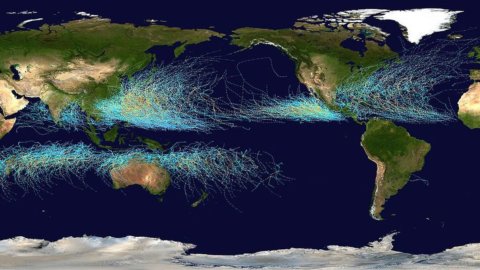
But who are they, or rather, what are Harvey and Irma? And before them Ike, Wilma and Katrina… The latter, among the five most serious hurricanes in the history of the United States (2005), in terms of economic damage and one of the most serious in terms of the number of deaths (1.836! ). We know them by first name... And we already wonder: where do the names of hurricanes come from? The answer comes from the World Meteorological Organization, which has drawn up six lists of names, used in rotation year after year. Each list consists of proper nouns, one for each letter of the alphabet (except for the letters Q, U, X, Y, Z).
The names are "unisex": initially the custom included only female names but since 1978 male names have also been added. The criterion adopted also establishes that the names attributed to catastrophic hurricanes are eliminated from the list and replaced: thus Katrina, for example, will forever indicate the tragedy experienced in New Orleans.
And what else do we know about them and the weather phenomena to which they are linked?
There are many feared theses on the triggering causes of the phenomenon linked to hurricanes, and among these there is that of global warming ... "The contribution by man to the total amount of rain that comes from the storm reaches almost 30%" ... Cite the prestigious magazine TheAtlantic.com.
Climate scientists, scholars of the Earth system as a whole, reads the US magazine, are often reluctant to link a weather event to global climate change. But they agree that both in Harvey's case and in the recent history of tropical cyclones around the world, global warming cannot be pointed to as a direct cause… However, these phenomena have further enhanced the precipitation that tropical storms bring.
In fact, climate change is caused by the release of greenhouse gases such as carbon dioxide and methane into the atmosphere. These gases prevent some of the sun's rays from bouncing back into space, trapping heat in the planetary system and raising air temperatures around the world.
Some testimonies collected by Planet experts tell us that: "It is difficult to establish exactly how much climate change has contributed to Harvey's impact, but human action has absolutely exacerbated the effects, in particular, of the flood", he says to Xinhua Andrew King, a scholar of extreme weather conditions at the School of Earth Sciences of the University of Melbourne.
Limiting future damage from these types of events can certainly be seen as an incentive to follow the Paris Agreement and try to keep global warming below 2°C,” adds King. Harvey's strongest effect came through its heavy and prolonged rainfall, he notes. “We know that climate change is increasing extreme rainfall.
An atmosphere that gets hotter can hold more moisture, about 7 percent more for every 1 degree Celsius increase in temperature,” King explains. “This means that when the circumstances are there for extreme precipitation, climate change is likely to make these events worse than they otherwise would have been,” he continues. wetter ones bring heavier rain,” he remarks.
“Climate change cannot be said to have 'caused' Hurricane Harvey, but the severity of the storm and associated damages were 'worsened' by human activities, especially greenhouse gas emissions that are warming the oceans and the air above,” underlines Richard Allan, Professor of Climatic Processes at the University of Reading. “A warmer ocean and overlying air are capable of injecting greater amounts of moisture into the storm leading to an intensification of already extreme precipitation, he says. Additionally, sea level rise caused by climate warming combined with human-related coastal subsidence increased the storm's impact while urban developments such as grassland paving likely intensified flooding,” according to Allan .
From an economic point of view, according to the estimates of some analysts, Harvey's move to Houston will have an impact on American economic growth, slowing it down by at least 0,2% in the third quarter (Goldman Sachs ed). Between July and September, a slowdown in consumption was expected which will above all involve Houston, the city most affected and the fourth largest city in the United States, with inevitable effects on the American GDP. Waiting to count the further damage that Irma's passage will unfortunately cause.
In an age of secularization, excluding the causes of weather disasters as forms of "divine punishment", we just have to entrust ourselves to the theses of the scientific community which, while not attributing direct responsibility to the work of mankind, does not exempt us for competing causes that awaken our conscience and invite us to work to contain future irreversible damage.
From the site eniday. com.