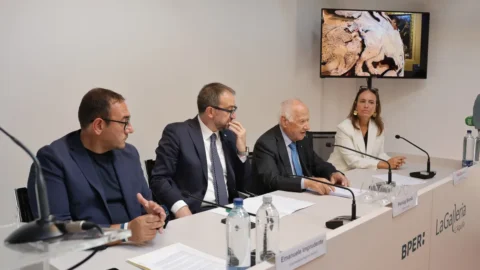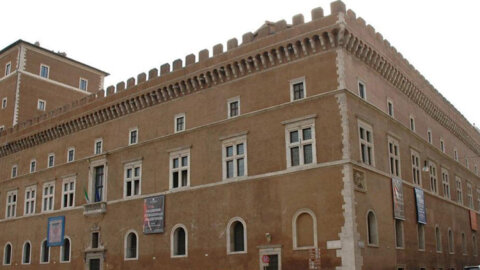
Now in its The third edition, the exhibition represents a consolidated event for lovers of art, history and culture; a significant initiative that underlines the Institute's commitment to disseminating cultural heritage as a virtuous place for meeting, socializing and knowledge.
This year's edition includes five cycles of meetings, on a weekly basis. In addition to the events dedicated to history, art and architecture, there are others all dedicated to Rome:
Thursday 7 March at 18.00
From wanting the empire back to the forgotten ancient city
CYCLE: Landscapes of the center of Rome
RAPPORTEUR: Andrea Carandini, professor emeritus of Archeology and history of Greek and Roman art. From the museum of Mussolini's empire to no museum in the capital city of the Republic.
Biography: Andrea Carandini is professor emeritus of Archeology and history of Greek and Roman art at the “Sapienza” University of Rome, president of the Superior Council of the Ministry of Culture, president of the FAI and collaborator of Corriere della Sera.
Thursday 14 March at 18.00
Rome seen from English eyes: a long history of cultural fascination CYCLE: An international capital: Rome and foreigners. RAPPORTEUR: Abigail Brundin, director of the British Academy in Rome
The English fascination with Rome is well known: the time spent in this city has had a profound impact on the British cultural landscape throughout the centuries. The conference will focus on the personal stories of Britons who traveled to Rome through different eras, starting with the Grand Tour and ending with the foundation of the British Academy (1901), a space where we continue to cultivate cultural encounters with the city today.
Biography: Abigail Brundin is professor of Italian studies at the University of Cambridge and fellow from St Catharine's College, Cambridge and specializes in the literature and culture of Italy in the early modern period. Since 2021 she has been the director of the British Academy in Rome.
Thursday 21 March at 18.00
Christina of Sweden, a queen in Rome. CYCLE: Historical figures in the Rome of the past.
RAPPORTEUR: Lisa Roscioni, professor of modern history, “Sapienza” University of Rome
Converted to Catholicism and no longer Queen of Sweden since she abdicated the throne in 1654, Cristina was welcomed in Rome at Christmas 1655 with every pomp. In a Europe that had just emerged from a thirty-year war that had forever sealed the division of Christianity between Catholics and Protestants, her conversion represented an unprecedented victory, even if her original and non-conformist personality was the source of many concerns for the pontiffs. However, she left an indelible mark on the city and was buried in the Vatican in 1689
Biography: Lisa Roscioni, historian and essayist, teaches modern history at the “Sapienza” University of Rome. She published The abbess of Castro. Story of a scandal, Bologna, il Mulino, 2017; Collegno's forgetful man. Italian history of a disputed identity, Turin, Einaudi, 2009; The government of madness. Hospitals, doctors and madmen in the modern age, Milan, Bruno Mondadori, 2011.
Thursday 28 March at 18.00
Structures
CYCLE: Building telling architecture. RAPPORTEUR: Maria Claudia Clemente and Francesco Isidori, architects
The conference, entitled "Structures", will analyze the relationship between Abstraction and Constructiveness through the concept of structure, a polysemantic term around which the studio's research revolves. If the (supporting) structure is, on the one hand, an essential element of architecture, without which it could not be built; on the other hand, it refers to an intrinsically abstract concept which concerns the constitution and distribution of elements which, in a relationship of correlation and functional interdependence, form an organic complex. In the term structure therefore the two apparently opposite poles of abstraction and construction coexist and find a synthesis in the form-architecture. The lesson will focus on the analysis of the methodological and cultural implications of a structural conception of architecture.
Biography: Labics is an architecture and urban planning studio based in Rome, founded in 2002 by Maria Claudia Clemente and Francesco Isidori. The name of the studio – Labics – expresses the concept of a laboratory, a test bed for advanced ideas. Combining the theoretical approach with applied research, the field of interest of the study extends from the small scale of interiors to the scale of urban master plans, crossing the different scales and complexities of the project.
Thursday 4 April, at 18.00
Dark shops: story of a thousand-year-old street CYCLE: Landscapes of the center of Rome. RAPPORTEUR: Daniele Manacorda, archaeologist
Via delle Botteghe oscure is one of the most famous streets in Rome. The conference will outline its long history starting from the Roman age, when the area rose outside the city walls on the edge of the vast plain of the Campus Martius. Based on the results of research conducted for decades in the so-called block of the Crypta Balbi, the events of the street will accompany those of the surrounding neighborhood throughout the imperial age, in the centuries of the Middle Ages, which saw first its destructuring and then its recovery, when the Shops, not yet obscure, became the merchants' street: a long and narrow straight, overlooked by Renaissance buildings and churches, until its twentieth-century widening, which gave it the appearance of a central artery of city traffic.
Biography: Daniele Manacorda taught Archeology at the universities of Siena and Rome 3. He has worked on urban history (Crypta Balbi, Archeology and history of an urban landscape, 2001; Landscapes of medieval Rome, 2021; Rome. The tale of two cities, 2022 ), of material culture, of the methods of archeology (Lezioni di archeologia, 2008) and of its role in contemporary society (The profession of the archaeologist, 2020; The books of others, 2021), of cultural heritage policies (The Italy to Italians, 2014; Posgarù, 2022).
Tuesday 9 April, 18.00 pm
“Tu solus Didacus in Urbe”. Velàzquez's second stay in Rome CYCLE: Trips and stays of artists in Rome. RAPPORTEUR: David García Cueto, director of the Department of Italian and French Painting (until 1800) of the Prado National Museum
On the occasion of the Holy Year 1650, many illustrious people were present in Rome. Among them was Diego Velázquez, at the time painter to the King of Spain. The artist had the commission to purchase and have a series of sculptures made for the sovereign in the papal capital, thus returning to a city that he had known twenty years earlier. Now, as sources point out, he will not be there to learn, but to teach, especially the radically modern way of portraying him. Various figures of the papal court, with Pope Innocent in the first place, will be portrayed by him, earning him the fact that as a painter he was considered by some to be "solus in Urbe".
Biography: David García Cueto studied art history at the University of Granada where he was then professor between 2012 and 2020. His studies focused on the artistic and cultural relations between Spain and Italy in the XNUMXth century and on the Spanish art of the Golden Age. He was lead researcher in two national research and development projects: The pictorial copy in the Hispanic monarchy, XVI-XVIII century (2015-2018) e Artistic exhibition in the Hispanic monarchy, 16th-18th century (2019-2020). He is the editor of the volume he collects
the results of the first research project: Copies of painting masterpieces in the collections of Austria and the Prado Museum (2021). Since 2020 he has been director of the Italian and French painting department (until 1800) of the Prado National Museum.
Thursday 18 April, at 18.00
Reimagining old and new worlds: the American Academy in Rome CYCLE: An international capital: Rome and foreigners. RAPPORTEUR: Aliza S. Wong, director of the American Academy of Rome
For 130 years, theAmerican Academy in Rome has opened its doors to artists, architects, sculptors, art historians, writers, composers, designers, archaeologists, historians and all other creative thinkers in the arts and humanities who have found inspiration and innovation in the Eternal City. And while the Rome Prize winners reveled in the historical context and reality of Rome's chaotic beauty, they also celebrated the idea of Rome, the scope of possibilities and impossibilities made imaginable thanks to the place in where we find ourselves, the air we breathe, the streets we travel. L'American Academy in Rome it is one of the few foreign academies to welcome not only scholars and artists from its own nation but also global creatives, including those from the host country, Italy. And in welcoming this pantheon of fellows, Rome and the American Academy have hosted 452 Guggenheim Fellows, 74 Pulitzer Prize winners, 52 MacArthur Fellows, 13 Grammy winners, 9 Pritzker Prize winners, 9 Poet Laureates, and 5 Nobel Prize winners.
Biography: Aliza S. Wong, current director ofAmerican Academy in Rome, is a professor of history, director of European studies, and interim dean of the Honors College at Texas Tech University in Lubbock. The field of her research is modern Italy and the Mediterranean, with particular reference to issues of race, nation, culture and identity. She has won numerous teaching and research awards, as well as received recognition for her work on diversity, equity, inclusion and belonging, including being named Lubbock YWCA Woman of the Year for his work on social justice (2018) and to Professor Minnie Stevens Piper of the Foundation (2019).
Thursday 9 May, 18.00 pm
Fra Angelico, today
CYCLE: Trips and stays of artists in Rome. RAPPORTEUR: Carl Strehlke, art historian
In 1955, large celebratory exhibitions of the Florentine Renaissance painter Fra Giovanni da Fiesole were held in the Vatican in Rome and in Florence on the occasion of the five hundredth anniversary of his death in Rome in the Minerva convent. The Dominican friar was known by members of his own order, shortly after his death, as Fra Angelico, just as the theologian Thomas Aquinas was called Doctor Angelicus. In the 1955s the great writer Elsa Morante asked herself: was Fra Giovanni a revolutionary? After the XNUMX exhibition and Elsa Morante's provocative question, we look at the friar's art in a new way. This will be the topic of the conference: how we see Beato Angelico today in relation to the artistic and religious society of his time. And to answer Elsa Morante's question: yes, he was a revolutionary.
Biography: Carl Strehlke, born and raised in Boston, completed his studies at Columbia University in New York and worked for thirty-five years as curator of the John G. Johnson collection of European paintings at the Philadelphia Museum of Art. He has curated exhibitions in Paris, Madrid, Philadelphia and New York on Saint Francis, Sienese Renaissance painting, Beato Angelico, Pontormo and Bronzino. He also wrote the catalog of the Johnson Collection and, with Machtelt Brüggen Israëls, the catalog of the Bernard and Mary Berenson at Villa I Tatti, the Center for Italian Renaissance Studies at Harvard University in Florence. He is currently involved in an upcoming exhibition on Beato Angelico for Palazzo Strozzi in Florence which will open in September 2025.
Thursday 16 May, 18.00 pm
Design and protect. CYCLE: Building telling architecture SPEAKER: Laura Andreini, architect
There is no contrast between building and storytelling, but the same objective that contributes to the realization of the same plan and that is to inhabit the earth in harmony with what is around it through behaviors that do not seek mimesis but understanding, not intransigence of renunciation but the possible coexistence between what is given to us and what we must do to deserve it. This approach looks at places as circular landscapes inhabited by different living people with equal dignity and at territories as environments to be inhabited and enriched, not as resources to be extracted. The architectural project, read according to these aspirations, allows us to look at the actors in the process of transformation of the territory with renewed confidence because it shows the way of a refined balance between the need to protect every heritage derived from the existing one, be it natural or historical -architectural, and the needs of a society that develops its ideas and satisfies its needs through conscious actions, otherwise defined as sustainable. Consequently, the project is transformed into a critical text designed to introspectively describe an architecture that transforms the dialogue with the territory into the reason and ultimate goal of its design.
Biography: Laura Andreini is an architect and associate professor of Architectural and Urban Composition at the Faculty of Architecture of the University of Florence, where she graduated with top marks in 1990 and obtained her PhD in 1997. In 1988 together with Marco Casamonti and Giovanni Polazzi founded the Archea studio in Florence, to which Silvia Fabi joined in 2001. Archea Associati is a design studio in which over 180 architects collaborate, operating in the offices of Florence, Rome, Milan and Genoa. Thanks also to the collaboration with partner companies in Beijing, Dubai, Tirana and Sao Paulo, the studio has created Urban Planning, Landscaping, Architecture, Design, Yacht design, Interior Design and Graphic Design works all over the world. Since 2003 you have held the position of deputy director of "Area", an international magazine of architecture and design arts, currently published by the Tecniche Nuove group of Milan. In April 2018 you began a collaboration with the Museo Novecento in Florence which entrusted you with the curatorship of the cycle of exhibitions and conferences entitled “Paradigma. The table
of the architect". In 2011 the Forma publishing house entrusted her with the conception and direction of the "ONE" series dedicated
to contemporary Italian architecture. Since January 2012 she has held the role of Editorial Director of the same publishing house and is the editor of the "On the road" series, published by Forma Edizioni and dedicated to the cities of the world.
Thursday 23 May, 18.00 pm
Who was Pius XII? The Pope of difficult times CYCLE: Figures from the history of Rome of the past. RAPPORTEUR: Andrea Riccardi, historian
Pius XII is a complex and controversial figure: promoter of Rome as an "open city", protector of the victims of totalitarianism, pope of "silence" in the face of the Shoah, fine diplomat, tormented in decisions, opponent of communism, or tireless seeker of peace... There have been many interpretations and readings of the character: from the "black legend" to the unfinished beatification process. The historical analysis of his figure and the role of the Holy See, in the dramatic years of the Second World War, the post-war period and international communism, addresses a highly relevant issue in the history of the twentieth century.
Biography: Andrea Riccardi, historian, scholar of the religious phenomenon, has taught in various Italian and European universities. Also known for being the founder of the Community of Sant'Egidio, since 2015 he has been President of the Dante Alighieri Society for the diffusion of the Italian language and culture in the world. An acute observer of the present, he is one of the most successful personalities in historical and religious research.
Thursday 6 June, 18.00 pm
Kings, emperors and founders: the cults of sovereigns and the Campus Martius. CYCLE: Landscapes of the center of Rome
RAPPORTEUR: Paolo Carafa, full professor of Classical Archeology and vice-rector for Archaeological Heritage, “Sapienza” University of Rome
In the incessant flow of the landscapes of the ancient city, particular stories and messages - linked to the person and actions of the founder and subsequent kings and emperors - were fixed in some specific places. The memory of traditions, myths, events and men, its conservation and its transformation were entrusted to architectures and topographical contexts that defined the space and its perception. Among these, temples, sanctuaries and tombs played a particularly important role. Since very ancient times, the plain between the Tiber, the Quirinale and the Capitoline Hill, with the slopes of these hills, was chosen as a privileged place to host memories and cults of sovereigns.
Biography: Paolo Carafa is full professor of Classical Archeology and vice-rector of the Archaeological Heritage of the “Sapienza” University of Rome. He created an Archaeological Information System (patented) and coordinated research projects dedicated to the architecture and history of the urban and rural landscapes of Rome, ancient Lazio, Etruria, Magna Graecia and Pompeii. He has published more than 150 contributions including monographs, editions, reference books, articles and other works.
Thursday 13 June, 18.00 pm
In the name of Goethe? German myths, presences and experiences in the Eternal City CYCLE: An international capital: Rome and foreigners. SPEAKER: Martin Baumeister, director of the German Historical Institute of Rome
Like many other foreign communities, Germans also maintain a particular relationship with Rome, the 'eternal city' capable of encouraging intense relationships, full of emotions and expectations, like no other urban reality abroad. The conference therefore aims to reconstruct the path that Germans have experienced over the last two hundred years with a city not only imagined, represented, studied, but also experienced and even occupied. Ideally passing through places that witnessed the German presence in the city, often almost forgotten today, we will analyze their gaze, a gaze that, although changing at the pace of the more general changes, always seems to bring the same stereotypes to the surface. The Rome of the Germans is thus configured as a mirror of their desires and dreams, a large projection screen, a utopian place, but also a daily lived reality and an uninterrupted laboratory of humanistic studies.
Biography: Martin Baumeister has been director of the German Historical Institute since 2012. Until 2017 he held the chair of contemporary European history at the Ludwig Maximilian University of Munich. His current areas of research concern the contemporary history of Southern Europe and the Mediterranean, urban history and the history of Christianity
Thursday 20 June, 18.00 pm
Adelaide Ristori in Rome. A global actress and writer CYCLE: Historical figures in the Rome of the past. SPEAKER: Carlotta Sorba, historian
In her long, very dense and more nomadic life than ever, the actress Adelaide Ristori found herself experiencing firsthand many of the events that marked the process of national unification: from the Roman Republic in 1849 to the war of 1859, from the feat of the Thousand until Cavour's death. And then to follow, with an often attentive and informed participation as can be seen first and foremost in her correspondence, the complex paths of life in the new state of which she becomes the cultural ambassador in the world. Wife of the Marquis Giuliano Capranica del Grillo, with whom she lived a close and fruitful theatrical partnership, she resided for long periods in the capital where, after her last tour in the United States in 1885, she found herself writing her Artistic Memories, a complex editorial project , soon to be translated into French and English, marking the pinnacle of his global stardom.
Biography: Carlotta Sorba teaches cultural history at the European University Institute (Florence) and at the University of Padua. As a specialist in 19th century history, you have worked particularly on the relationship between theatre, society and politics. You have published around this theme Theatres. The Italy of melodrama in the age of the Risorgimento (Il Mulino 2001) e The melodrama of the nation. Politics and feelings in the age of the Risorgimento (Laterza 2015). He recently edited, with Alberto Mario Banti and Vinzia Fiorino, a Lexicon of cultural history (Laterza 2023).
Thursday 27 June, 18.00 pm
Squares – Phenomenology of the unexpected CYCLE: Building telling architecture. RAPPORTEUR: Joseph Grant, architect. Can a single formal solution solve a complex system such as public space? Can architecture understood as a backdrop allow the emergence of desires and relational models of use of public space that have remained dormant over time?
In the architectural debate, a broad reflection is necessary on the role of the architect "with" and not "for" in the models of the construction process of public space as an "open system", democratic and flexible, capable of simultaneously involving the single individual and the community leaving ample space for improvisation in the collective creation of spaces that welcome the unexpected.
Biography: Orizzontale is a collective of architects based in Rome, whose work crosses architecture, landscape, public art and self-construction. Horizontal has been promoting relational public space projects since 2010, giving shape to images of abandoned or unpublished cities. These projects were a testing ground for new forms of interaction between inhabitants and urban commons and at the same time an opportunity to test the limits of the architectural creation process. Orizzontale has built and developed projects in Italy, Spain, Germany, Austria, Greece, Ukraine, Portugal, Holland. “8 1⁄2”, the mobile theater built horizontally in 2014, was the winner of the international Young Architects Program award (“YAP MAXXI 2014”) organized by the MAXXI Museum and MoMA PS1. In 2016, Horizontal won the competition for the regeneration of Piazza della Comunità Europea in Aprilia, organized by MiBACT and CNAPPC. The project is realized and was awarded in 2020 with the Urban Planning Award from the INU. In 2018 at the Horizontal Venice Biennale he received the "Young Talent of Italian Architecture 2018" award from the CNAPPC which rewards the best Italian studio under 35. Since 2020, Horizontal has founded and curated VUOTO, a transmedia space for reflection and debate on the city and public space. Horizontal's work has been exhibited in international exhibitions, including the Venice Architecture Biennale, the Vienna Biennale and the Oslo Architecture Triennale. In 2023 he was present at the 18th International Architecture Exhibition in the exhibition The Laboratory of the Future, curated by Lesley Lokko at the Corderie dell'Arsenale, and in the Italian Pavilion, in the Spaziale exhibition. Everyone belongs to everyone else curated by Fosbury Architecture. Orizzontale is composed of: Jacopo Ammendola, Juan López Cano, Giuseppe Grant, Margherita Manfra, Nasrin Mohiti Asli, Roberto Pantaleoni, Stefano Ragazzo.
Thursday 4 July, 18.00 hours
«These wonderful ancient stones»: Titian in Rome (1545-1546) CYCLE: Trips and stays of artists in Rome. SPEAKER: Marsel Grosso, associate professor of History of Modern Art, University of Padua.
Between the autumn of 1545 and the summer of 1546 Titian made a trip to Rome, guest of Pope Paul III and his powerful nephew, Cardinal Alessandro Farnese, with the expectation of obtaining an ecclesiastical benefit for his son Pomponio. In Rome his enthusiasms were all for classical art, which he had the privilege of seeing under the guidance of Giorgio Vasari and Sebastiano del Piombo. Despite the lack of graphic documents relating to this stay among the ruins of ancient monuments and art collections, some passages from letters of Cardinal Pietro Bembo, Pietro Aretino and Vasari's biography (1568) - which will be read during the conference and commented on – are sufficiently explicit in this sense. It was in the City that Titian created one of the highest pages of style of his entire career, the Portrait of Paul III with his nephews Alessandro and Ottavio Farnese di Capodimonte, and on the side of secular painting he will complete the Danae, preserved in the same Neapolitan museum. It is around this masterpiece that Vasari gave life to the evocative story of the meeting with Michelangelo, all centered on the heated debate between drawing and colour, form and nature.
Biography: Marsel Grosso is associate professor of History of Modern Art at the University of Padua. His areas of research concern Venetian painting and the artistic literature of the 16th century, in particular of Titian whose critical fortune he reconstructed in Spanish Italy, of Vasari's relationship with Venetian figurative culture, and of Tintoretto in the transition from and sixth decade of the sixteenth century, in which the painter's encounter with contemporary literature takes place (Aretino, Doni, Sansovino).
Thursday 11 July, 18.00 hours
Medieval Rome: an archaeological perspective. CYCLE: Landscapes of the center of Rome. SPEAKER: Andrea Augenti, professor of Medieval Archaeology, University of Bologna
For several decades, archaeological investigations on Rome have multiplied, and have brought into focus numerous aspects of urban evolution. Churches, private homes, public areas, artisan plants and more have been excavated. In this way our knowledge of the city has changed a lot since the 5th century, and Rome has become one of the reference centers regarding the development of cities in Italy and Europe. On this occasion, some particularly interesting and significant topics regarding the development of the urban area will be addressed, in the light of archaeological discoveries and the most recent reflections made by archaeologists and historians.
Biography: Andrea Augenti teaches medieval archeology at the University of Bologna. He has conducted archaeological investigations in Rome, Volterra, Samarcanda, Classe (Ravenna) and currently directs the excavations of the abandoned city of Cervia. He is a member of the Society of Italian Medieval Archaeologists, a fellow of the Society of Antiquaries of London and is part of the Scientific Committee of the Colosseum Archaeological Park and of the RavennAntica Foundation. He has published numerous books, including Archeology of medieval Italy (Laterza, 2016).
Thursday 18 July, 18.00 hours
At the origins of the École française de Rome: humanistic knowledge, international collaborations and Roman sociability.. CYCLE: An international capital: Rome and foreigners. SPEAKER: Brigitte Marin, director of the École française
As is known, Rome is an exceptional place for the concentration of foreign academic institutions. The conference aims to analyze the circumstances that led to the creation of theEcole française de Rome, a research and research training institute in history, archeology and social sciences. Since the first years of its existence, the destiny of this national institution has been shaped by the potential for scientific collaboration offered by the city of Rome, by the links established with local society and by its location in Palazzo Farnese, where the École coexists with the The French embassy in Italy for one hundred and fifty years. More specifically, three subsequent decrees, issued between 1873 and 1875, reflect the long relationship experienced by France with Rome and its antiquities, the development of archaeological knowledge and international political events.
Biography: Brigitte Marin is director ofEcole française de Rome since 2019 and full professor of Modern History at the University of Aix-Marseille, director d'études at the École des hautes études en sciences sociales and foreign member of the Academy of Moral and Political Sciences of the National Society of Sciences, Letters and Arts in Naples. Her studies concern the urban, social and cultural history of modern Italy, and more specifically that of the city of Naples in the XNUMXth century.
Information and Reservations
Free entry while places last.
Reservations at the link