The inscription, in Welsh and English, reads: «This slate comes from Manod Quarry in North Wales, where paintings from the National Gallery were protected during the Second World War.»
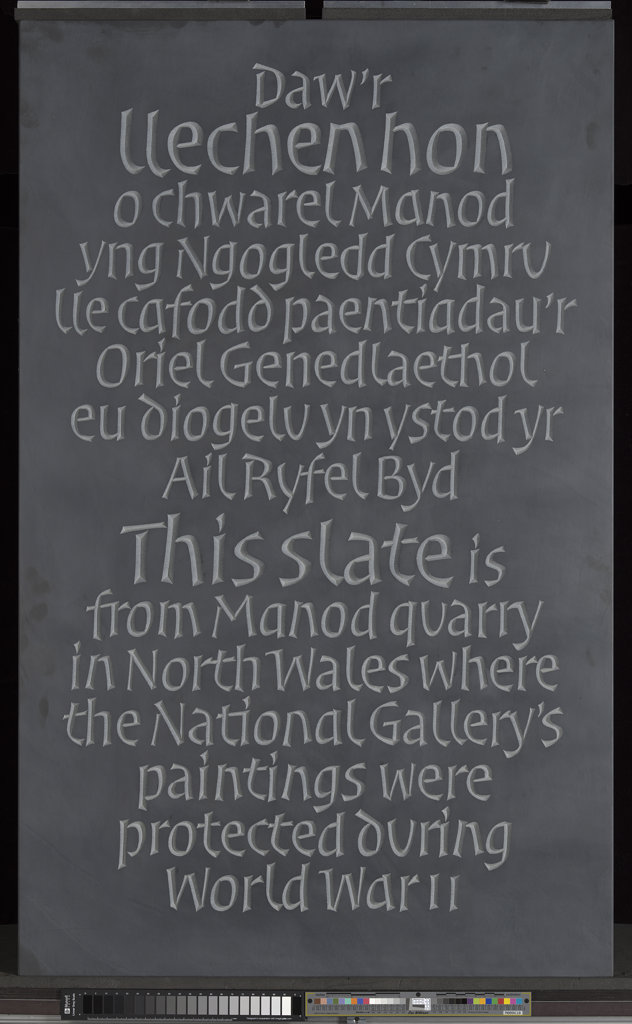
The work, entitled Manod Slate Tablet, was conceived by the artist Jeremy Deller and designed and engraved by the master stonemason John NeilsonCommissioned by Mostyn, Llandudno contemporary art centre, with the support of CELF, the national network for contemporary art in Wales, the tablet was donated to the National Gallery on the occasion of The Triumph of Art, a nationally distributed artistic project that concluded the celebrations for the National Gallery Bicentenary (2024–2025)The work is permanently exhibited in the Portico Vestibule of the National Gallery, not far from the famous floor mosaic of Boris Anrep depicting Winston Churchill in wartime, creating a powerful visual and symbolic dialogue between art, memory and history.
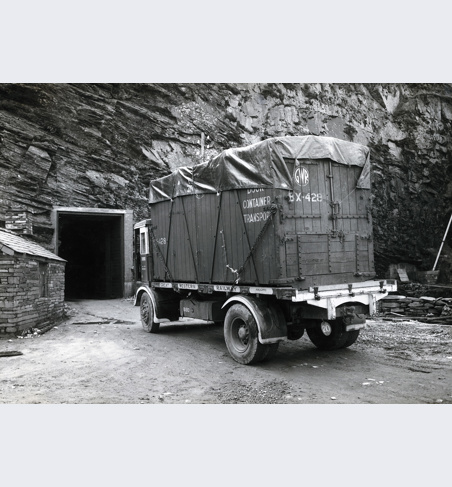
When art went underground
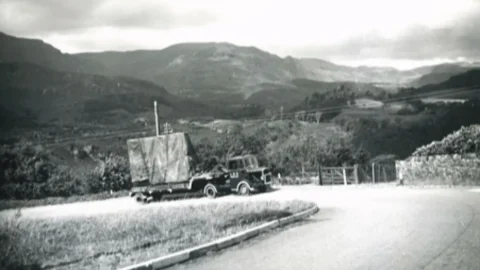
In May of 1940With Europe on the brink of collapse and the invasion of Britain believed imminent, a plan was needed to protect the national collection. One option was to evacuate the works to Canada, but the risk of German submarine attacks prompted the director of the National Gallery, Kenneth clark, to consult the Prime Minister Winston Churchill, who firmly rejected the idea. Manod slate mine proved to be the ideal solution. The entrance was widened to allow the passage of larger works, and protective structures were built inside the caves to ensure stable temperature and humidity conditions. In the summer of 1941, the entire collection was safely stored in its underground refuge, where it remained until 1945. That experience had a lasting impact: the observations conducted in the mine profoundly influenced the conservation criteria adopted in the post-war period, leading to the introduction of air conditioning and the strengthening of the National Gallery's scientific and conservation practices.
A contemporary legacy
La Manod Slate Tablet is one of the legacies of The Triumph of Art, a project that involved artists, institutions and young people, also through a collaboration with the Welsh theatre company Fran Wen, giving life to performances and narratives inspired by the places that had protected the paintings during the war. As he underlined Sir Gabriele Finaldi, director of the National Gallery, the tablet "commemorates the crucial moment during the conflict when the nation's works were hidden in caves in the slate hills of North Wales to be preserved for future generations." A small, understated and powerful object, it gives voice to an extraordinary episode of heritage protection and reaffirms a universal principle: Even in the darkest moments, art must be protected, because it preserves the memory and the future of a community..
“Hide them in caves and cellars, but not one picture shall leave this island”. (Winston Churchill, 1940)