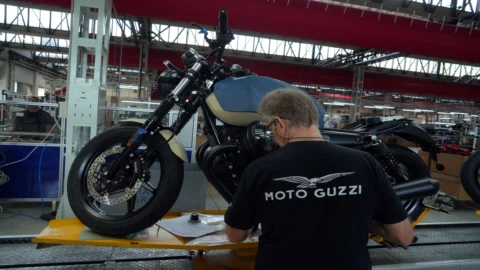
Mandello del Lario the house of remains Moto Guzzi, but behind the historic red gate of Via Parodi the future has already taken place. Piaggio has invested over 50 million euros to transform the factory where the brand was born in 1921, adding a deeply renovated factory, a museum, and new spaces for enthusiasts. The project, ccompleted after almost five years of work in the year of Moto Guzzi's 105th anniversary, strengthens the bond between the motorcycle manufacturer and Mandello del Lario. At the same time, it updates one of the symbolic places of Italian industry with automated lines, robotic systems and a production capacity that increases to over 30 thousand vehicles per year.
For the group, the project represents not only the relaunch of an industrial site, but the construction of a hub where manufacturing, technology, and brand memory coexist in the same space.
A larger, more automated factory
The new plant is located within the historic perimeter of Moto Guzzi and includes 5.500 square meters of new industrial buildings, in addition to 380 square meters of offices. The entire factory thus reaches a total surface area of 38 thousand square metersThe leap forward mainly concerns the productive processThe engine assembly lines have been built in a completely new building and employ state-of-the-art automated technology. The engine workshop is connected to the final assembly line via a robotic conveyor system, designed to streamline the transition between the various production phases. When the motorcycles reach the end of the line, the Kilo, the land drones developed in Boston by Piaggio Fast Forward. These devices take delivery of the vehicles and transport them to final testing, reducing the physical burden on workers and increasing the safety of operations.
The transformation also involved energy efficiency. The new plant was developed in Class A, makes extensive use of natural lighting and has 1.300 square meters of photovoltaic panelsThe goal is to combine increased production capacity with more careful use of resources.
Mandello remains at the centre of Piaggio's plans
Joined the Piaggio Group in 2004Moto Guzzi is therefore not abandoning the place where it has built over a century of history. The choice was to innovate the original site, preserving its symbolic and architectural value, rather than separating the brand's industrial future from its roots. The architectural direction was entrusted to the American Greg Lynn, winner of the Golden Lion at the Venice Architecture Biennale. His project reimagines the complex as a multifunctional hub, bringing together production, experimentation, culture, and design without erasing the identity of the factory built on the Lecco shores of Lake Como.
Piaggio strengthens one of its most recognizable brands, increases production potential and ties Moto Guzzi's image even more closely to the region where it was born.
The new museum celebrates 105 years of Moto Guzzi.
Next to the factory there is space for the new Moto Guzzi Museum, housed in a building of 3 thousand square metersThe architecture recalls the technical and metallic language of the motorcycles produced in Mandello, creating a visual continuity between the exhibition spaces and the lines of the brand's models.
The collection includes over 160 restored examples and spans more than a century of motorcycle evolution. The journey begins with the GP, the unique prototype that began the Moto Guzzi story, and reaches contemporary production. In between are models associated with travel, cinema, and the arts, vehicles built for military and law enforcement use, as well as the racing bikes that have won 14 world titles in the MotoGP.
The museum isn't designed as a space separate from the industrial activity. From the exhibition areas, visitors will be able to observe the new assembly lines and follow the birth of the motorcycles, directly connecting the historical heritage with today's production.
The new home of Moto Guzzi It also expands the part of the complex accessible to the publicThe project includes two tree-lined pedestrian plazas, a raised terrace overlooking the central square, and a large mosaic dedicated to the eagle, the brand's symbol. The historic Wind Tunnel has also been restored. The perimeter also houses the Motoplex Store, a café, spaces for workshops and events, and a new auditorium. The spaces dedicated to these activities total more than 4.200 square meters and were designed to welcome visitors all year round.
The factory and museum thus become parts of the same story. On one side are the engines, the robots, and a production destined to exceed 30 units annually; on the other, the motorcycles that have accompanied the evolution of Italian customs, technology, and design. In the middle remains Mandello del Lario, once again chosen as the starting point for Moto Guzzi's future.