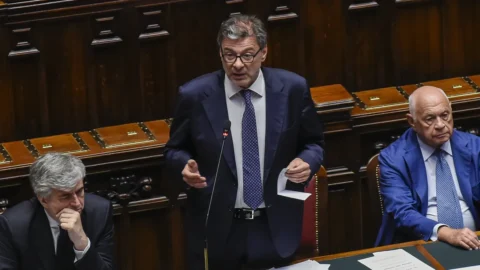
Italy aims to use all the flexibility European available for the energy security and a smaller share for the DEFENSEThis is the line indicated by the Minister of Economy. Giancarlo Giorgetti in communications to the Camera on national safeguard clause, the instrument provided for by the new EU rules that allows member states to obtain greater budgetary space for certain strategic expenditure.
"We will certainly request the full maximum for energy security, that is, 0,3% plus 0,3% equals 0,6%. On the defense side, however, we will not take the maximum and will limit ourselves to 0,9%," Giorgetti explained, outlining the government's position. The goal is therefore to request up to 0,6% of GDP for energy security-related interventions and use a 0,9% share for defense spending, without reaching the maximum limit theoretically envisaged by the clause.
The request to the European Union, however, does not yet represent a new budget varianceFirst, it will be necessary to consult with the European Commission, evaluate the Community institutions and go to Ecofin. after the European green light The government will return to Parliament to define the actual amounts of the deviation and how the resources will be used, also in view of the next budget law.
Energy: The government aims for maximum European flexibility.
La European safeguard clause It was initially created to allow for greater investment in the defense sector, but was later extended to include measures aimed at energy security. The new framework provides for an additional scope of up to 0,3% of GDP per year, for a maximum overall amount of 0,6% for the period 2026-2028.
The government intends to use entirely this possibility for finance structural interventions, with the aim of strengthening security of supply and reducing energy dependence on foreign countries. Giorgetti, however, clarified that temporary measures to combat energy costs will not be funded. "Measures intended to temporarily alleviate the current crisis, such as those on excise duties or direct and indirect subsidies to the private sector that do not lead to a structural improvement, are excluded," the minister explained to the Chamber of Deputies.
The resources of the clause, therefore, will be allocated exclusively to interventions capable of producing lasting effects on national energy security, while they will stay out emergency measures such as excise duty reductions o temporary supports to consumers.
Defense, Giorgetti: "When faced with duty, you don't kick, you don't run away, you don't desert."
On the front of the DEFENSE The government instead aims to use 0,9% of GDP, a lower share than the theoretical maximum allowed by the clause. Giorgetti acknowledged the political complexity of the choice: "It's a difficult choice" to come to Parliament and request a deviation for defense. The minister then invoked the constitutional principle: "I swore on the Constitution of the Republic, and Article 52 states: 'It is a sacred duty of the citizen to defend the homeland.'"
According to Giorgetti, politics must take responsibility for decisions even when they are unpopular: "politics also means taking responsibility" and "when faced with duty, one does not kick, one does not run away, one does not desert". The interventions for Defence will include both new investments is expense operating"Both capital and current account measures will be envisaged," the minister explained, opening the possibility of financing multi-year programs, new technological systems, strengthening operational capacity, and costs related to the operation of new facilities.
The Safe issue: Italy will evaluate the EU program "only if it's convenient."
The European programme is also at the centre of the debate Safe, the EU instrument created to promote common defense systems and support investments in the sector. "The SAFE initiative was created to promote common defense systems. Meanwhile, Italy has launched joint defense programs, and this has created a sort of obligation, more than a legal and moral one, to which each country must respond with great responsibility in order to be respected, as Italy is currently respected in Europe," Giorgetti explained to the Chamber of Deputies, emphasizing the connection between the use of the European instrument and the commitments already undertaken by Italy.
The use of Safe it will not be But Automatic: the majority he reformulated the resolution on the topic, foreseeing that the government evaluates "the use of different condizioni including where deemed advantageous those included in the Safe program", allocating any resources primarily to "national security and defense technological systems". The change came after the tensions emerged in the Chamber, with the suspension of work to allow for a discussion on the wording of the text and to overcome the discontent of the Alloy, which also called for a reference to internal security, while divisions also emerged within the centre-left.
Giorgetti also clarified that any use of the program will have to be compatible with European rules on defense funding and project implementation timelines. "Will there be rescheduling of the weapons system? It's possible," the minister explained, specifying that the European Commission provides specific criteria for planning, deployment, and accounting for expenses: "We need to understand—precisely because the timeframe is very tight—which ones can be included and which ones may require more time to define and then reflect in accounting terms."
The confrontation with Brussels and the deficit issue
The match remains tied to the sustainability of the public accountsGiorgetti explained that the final definition of the plan will arrive only after having evaluated the evolution of the European procedure on deficit"Any final articulation of the plan will have to be prepared with due consideration for compatibility" with public finance constraints, the minister said.
The key point is that the clause allows for greater flexibility, but the interventions will still have an impact on the accounts: “The interventions have a full impact on the deficit.” If the Italian deficit were to remain above 3% of GDP, the country could risk remaining in the European excessive deficit procedure even considering the increased expenses authorized through the clause.
The timetable: request to Brussels by August, decision in autumn
The process now involves several steps: Italy will submit its request to the European Commission by mid-August; Brussels will evaluate the proposal in September, and approval could come at the Ecofin meeting in October. Only after this step will the government return to Parliament to request approval. the authorization to deviate.
"The government felt it was necessary to appear before Parliament and request its authorization to begin this negotiation with the European Commission," Giorgetti concluded.
The final decision will therefore define the balance between new energy security needs and defense investments, while maintaining the constraint of public finance sustainability.