The number of raw material and will decide the international balance of power contains old acquaintances of geopolitics and almost unknown names. Permanent magnets at neodymium They are essential in high-efficiency electric motors, but are also used in wind turbines. praseodymium It is used in magnets and liquid crystal displays, the lanthanum Instead, it is essential in lithium-ion batteries and camera lenses. Not to mention all the rare minerals which are used for medical equipment. But it is above all the catalogue of precious metals which are used in the production of military equipment to grow year after year. Consequently, military dominance passes both through the technological frontier and through the raw materials needed for assemble satellites, drones, missiles and submarinesSpecial materials such as neodymium-iron-boron and samarium-cobalt.
It's a goldmine of information. new book by Maurizio Mazziero and Paolo Gila, "Rare Earth Geopolitics: The Strategic Challenge for the New Industrial Revolution: Key Players and Investments” (Hoepli), a sort of compass of elements capable of connecting the major questions of international politics and those connected to the industrial competition of the major manufacturing economies.
“Raw materials are a piece of the clash between the two great superpowers, the United States and China. The Americans must face a structural decline in their financial resources and at the same time must quickly respond to more than twenty years lost in the global game on rare earths,” explains the analyst. Maurizio MazzieroThe processes of strategic centralization of the rare earth supply chain, desired by the leadership of the Chinese Communist Party, began in the early 1990s, with specific programs to expand China's capacity to govern the production and refining of protected and strategic minerals.
China and the city of rare earths
"L 'rare earth extraction presents high refining difficultiesChemical-industrial processes are used that impact the environment, with environmental and social costs that Westerners would struggle to bear. Every year hundreds of thousands of quintals of ground earth, the result of iron mining and containing rare earths, are sent to China, even from the United States, to be refined and chemically processed." In China, in the western part of Inner Mongolia, there is the city of Bayan Obo, the "Rare Earth City”, on which a significant portion of the world's advanced technologies depends. Besides being a strategic city for Chinese industry, it is also one of the most polluted areas on the planet.
China considers rare earths a true heritage of the StateIt's the state that decides to whom to sell them and in what quantities; it's not a free negotiation available to private companies. "Retaliation on raw materials is one of the most powerful weapons in the battle between the Americans and the Chinese. During the first Trump administration, China blocked purchases of soybeans from the US in retaliation for tariffs, and has done so again in recent months. The backlash for the United States has been significant: it has had to subsidize Corn Belt farmers with billions of dollars."
The strategic repositioning of the United States
The intensity of the US strategic repositioning has undergone a change of pace with the “target Greenland”. The will of the President of the United States to to buy or invade a piece of a European region has triggered a deterioration of transatlantic relations at a level not seen since the Second World War. "It's not just a question of mineral reserves. Greenland is a small ice continent crucial for the passage of the Arctic routes, the famous Northwest Passage, the naval route connecting the Atlantic and the Pacific. The Tokyo-New York cargo route would save about 4.000 km, saving time and lower costs for shipping companies. The Americans would also be able to collect tariffs for the passage. It's not just a question of trade, but also of security. The Golden Dome is the missile shield which is supposed to protect Americans from Russian ballistic attacks: the so-called azimuth point of the missiles towards the United States is located right above Greenland”.
In recent months we have seen another issue emerge strategic repositioning of the United States, geographically located in Central America, in PanamaIn the American view, the ports of Balboa (Pacific side) and Cristobal/Colon (Atlantic side) were necessarily to return to US control. "The Strait is crucial because it allows the Atlantic fleets to reach the Pacific quickly. The future of the conflict between the Chinese and the Americans will be in the Pacific."
The Geopolitics of Oil
Still in the American garden, in Venezuela, another key country is placed in the new balance of power desired by the United States. On January 3, with Operation "Absolute Resolve", the Trump Administration has President Nicolás Maduro ousted taking him to prison in New York directly from Caracas. Beyond all the more or less shared considerations about the need to remove Maduro, the moves and countermoves, even in the new course of international relations, include the management of oil production and prices.Venezuela has the largest estimated crude oil reserves, about 17-18% of the world. At the current rate of extraction, the United States, through the fracking method, have reserves for 7-10 years. At current rates, Venezuela would have about 900 years of extraction horizons. Oil prices are low today, but in a couple of years they could be destined to rise. And, in fact, Donald Trump wants to "secure" Venezuelan oil production with the intervention of American corporations.
Il Petroleum and its geopolitics imbued with a super-realism, where what counts in the global balance of power are technology and the resources useful for governing industrial processes, is found in large quantities, for example, also in Nigeria, the target of US airstrikes late last year. The targets of the American attack: two military camps linked to terrorist groups in the Baunei forest, in the northwest of the country. "Nigeria is a country with extremely high oil value: the United States strikes with different objectives, but their strategy is clearly visible. When Trump posts the image of Canada, Cuba, and Greenland under the US flag, he's not just doing it for show. They're warnings for sailors."
La reorganization of US foreign policy, now oriented towards a frequency of interventions abroad which leave the idea of a return to isolationism intent on healing domestic economic and financial wounds, at the moment he sees the "almost" silence of the Chinese, the Russians and Europe. However, a de facto green light for Chinese intervention in Taiwan. On what grounds could the old Western world object to Beijing? "It's just a matter of defining when the Chinese will carry out 'their' operation. The island's fate is already sealed, because China must face its main geostrategic issue. That is, that sort of barrier to the exit to the Pacific represented by Japan to the north, Taiwan in the center, and further down the Philippines. The Chinese naval power if he wants to control the sea routes in that area of the ocean needs Taiwan".
The unstoppable rush of gold
The acceleration given by Trump's second mandate to the challenge between the various world blocs is producing a (geo)strategic uncertainty perfectly represented by the unstoppable rise in the price of gold: the yellow metal is breaking all records, month after month, dashing all analysts' forecasts. "China, in concert with the BRICS bloc, is attempting to organize a unit of account for trade and financial transactions independent of the dollar, linked to the major currencies of emerging countries and the renminbi. To do this, it needs to accumulate gold collateral: the results are evident in the price of the metal and could become equally evident in the price of Treasuries," continues Maurizio Mazziero.
The role of Africa
Another chessboard where China is playing its geopolitical game of raw materials, and of projection of its interests and connections outside Asia, is the African continent. Almost 70% of the global demand for cobalt, used in the cathodes of lithium-ion cells, is fulfilled by the Democratic Republic of Congo, according to ISPI analyses. China controls eight of the country's 14 most important mines, with the Russians responsible for mine security through specialized paramilitary contractors. China's advance in Africa has also seen the almost complete marginalization of the long-standing ties built over decades by European powers. France, especially, is in disarray, having been ousted as a colonial power from most of the countries where it maintained real influence. China has entered Africa without post-colonial constraints, but through loans and major infrastructure projects. Russia, which has had a longer presence in Africa, also presents itself as a force capable of providing stability and security. In Mali and Niger, Russian private troops perform "all kinds of services." Turkey, too, wants to transcend its garrison in Libya and aims to move beyond the desert, precisely to organize itself as a continental power. Africa possesses a wealth of raw materials that is unimaginable today.
Watch out for platinum and copper
Between old natural elements at the centre of twentieth-century international relations, such as oil, and new minerals that are crucial for the industries of the modern economy, we ask Maurizio Mazziero if there is a “Underdog” raw material, in the sense of a material that could become truly decisive in the large rare earth market and which has so far been little "courted". "I would say the Platinum, because it will not only be the catalyst needed for mufflers but will become crucial in other important chemical processes. Hydrogen could become crucial to produce energy in the most energy-intensive sectors, such as the steel industry, tile, and cement. Hydrogen is produced through electrolysis and requires platinum.
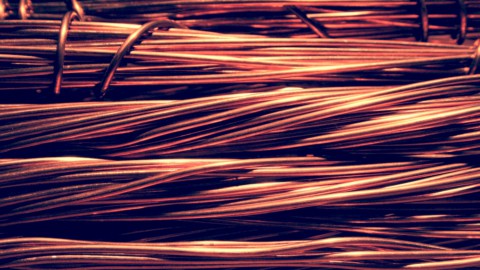
Between the “Underdog” platinum and the “evergreen” oil, another old acquaintance that could increase its ability to move the commodity market is undoubtedly the Copper. “Why is it fundamental in all modern infrastructures, from clouds to engine turbines. A gasoline-powered car requires about 27 kg, an electric one almost 60. To date, there are no new deposits in the world, and only two will come online by 2030. These are two mines in Indonesia, discovered about thirty years ago. There are also difficulties managing even the current large mines: the Escondida mine in Chile is a giant that's starting to run into trouble. For now, we're in balance: the same amount of copper is produced in the world, the same amount is consumed, but the situation could change quickly. Even if we were to find new mines, with current technology we wouldn't be able to bring them online for another 15-16 years.
And the European Union?
Where is it located? the European Union Within this raw materials game, which in turn is part of a centuries-old reorganization of international relations? For the European Union, intervening on issues of international strategy means touching on the sore points of foreign policy and common defense. "Not only that, but Europe must first rethink its energy policy, to avoid the collapse of its industries. The green transition is essentially still a work in progress, and before becoming autonomous, or almost so, Europeans too must seriously consider gas and oil."