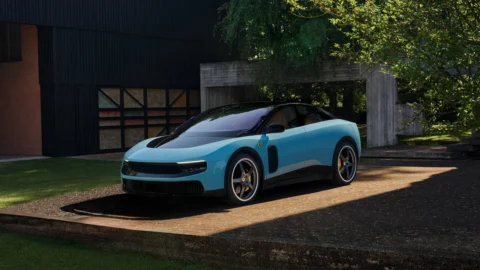
After so much waiting it has finally been revealed: the Ferrari Luce has arrivedIn Rome, in the setting of Calatrava's Vela at the Città dello Sport, the Cavallino presented the world premiere of the first full electric car from the Maranello-based company. Not just a simple battery-powered Ferrari, but a completely new model, developed on a dedicated platform and designed to expand the technical, stylistic and commercial perimeter of the brand. The design, together with the Ferrari Style Center led by Flavio Manzoni, is LoveFrom, the creative collective founded by Sir Jony Ive, a designer associated with some of the most recognizable icons of the Apple era, and Marc Newson. This collaboration was chosen to give Light a new, essential, and distinctive language, capable of interpreting the Prancing Horse's entry into the electric world without breaking ties with its tradition.
The date and city chosen for the presentation are also not accidental. The 25 May 1947, on the circuit of the Baths of Caracalla, the Ferrari 125 S won with Franco Cortese first official victory for the Prancing HorseSeventy-nine years later, still in Rome, Ferrari once again links its future to a place that is fundamental to its identity. That was when its sporting adventure began, The electric chapter opens today.
The Light comes with a ambitious promise: to demonstrate that electrification, extreme performance, luxury and driving involvement can coexist without distorting Ferrari's DNA. Confirmed the pre-sale price rumors and a the starting base indicated is 550 thousand euros, with first deliveries expected by the end of 2026.

Light: not just any electric car, but a new Ferrari
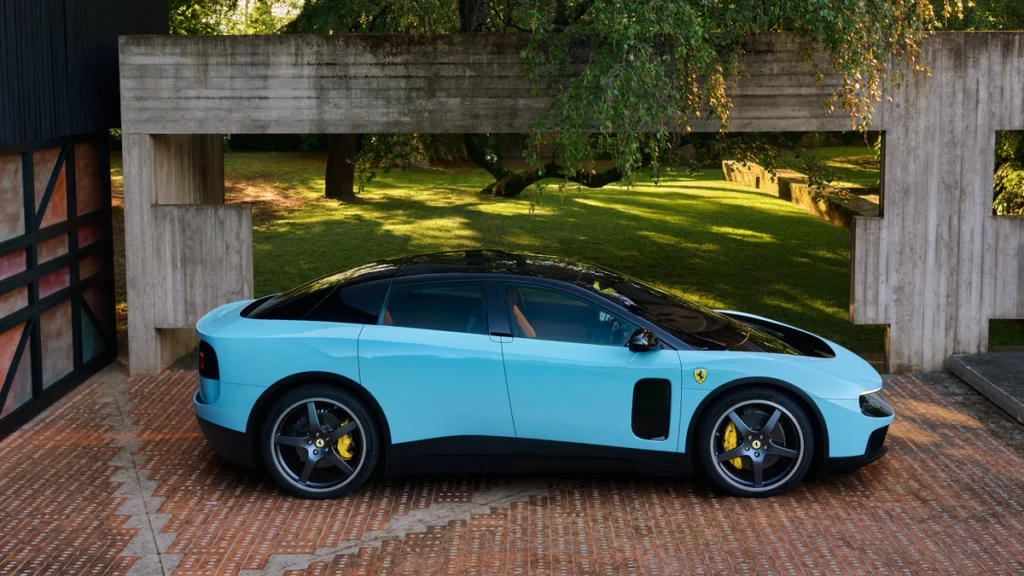
Ferrari Luce was not born as an electric variant of an existing model, but as acompletely new carIt's a four-door, offers five real seats, aims for a versatility never seen before in a road-going Ferrari and at the same time declares numbers of an absolute supercar.
They work under the bodywork four independent electric motors, one per wheel, designed and assembled internally. The overall power reaches 1.050 horses in Launch Control mode. Theacceleration 0 to 100 km/h takes 2,5 seconds, 0-200 km/h is done in 6,8 seconds and the top speed reaches 310 km/h. battery 122 kWh, with 800 Volt architecture, guarantees a declared range of up to 530 kilometers and supports fast charging up to 350 kW.
Curb weight is 2.260 kg, but Ferrari has worked on weight distribution, battery integration into the floorpan, and driving dynamics to turn the electric architecture into a design advantage. The battery pack helps lower the car's center of gravity, while the electric all-wheel drive allows for very precise management of torque to each wheel.

LoveFrom and Ferrari: Luxury Changes Its Language
One of the most significant elements of the project is the Design. For the Light, Ferrari worked with LoveFrom, the creative collective founded by Sir Jony Ive and Marc Newson, under the supervision of the Ferrari Style Centre, directed by Flavio Manzoni. The collaboration was born with the aim of bringing an external, more multidisciplinary perspective to the world of Ferrari, capable of blending luxury, technology, digital interfaces, and automotive architecture.
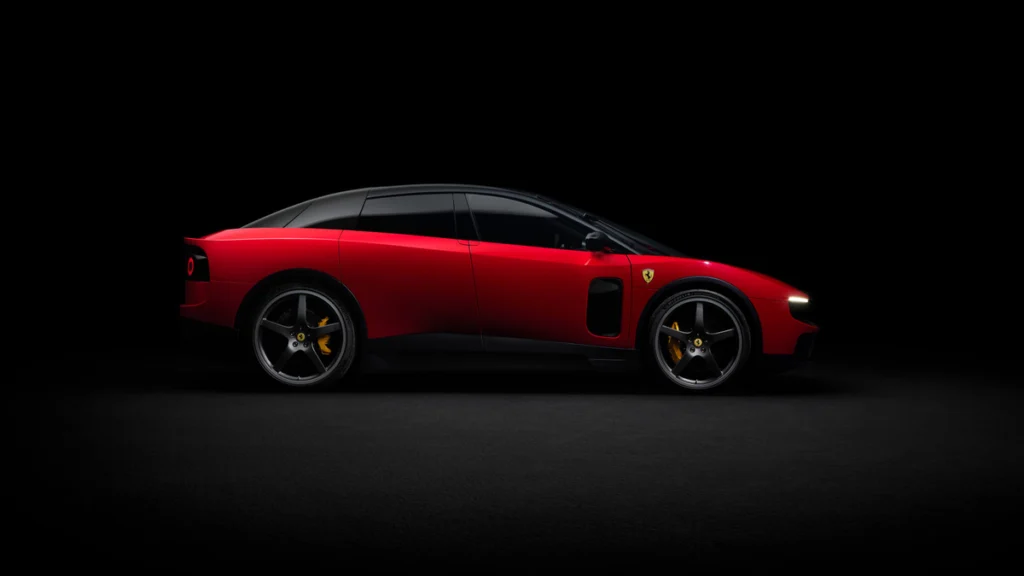
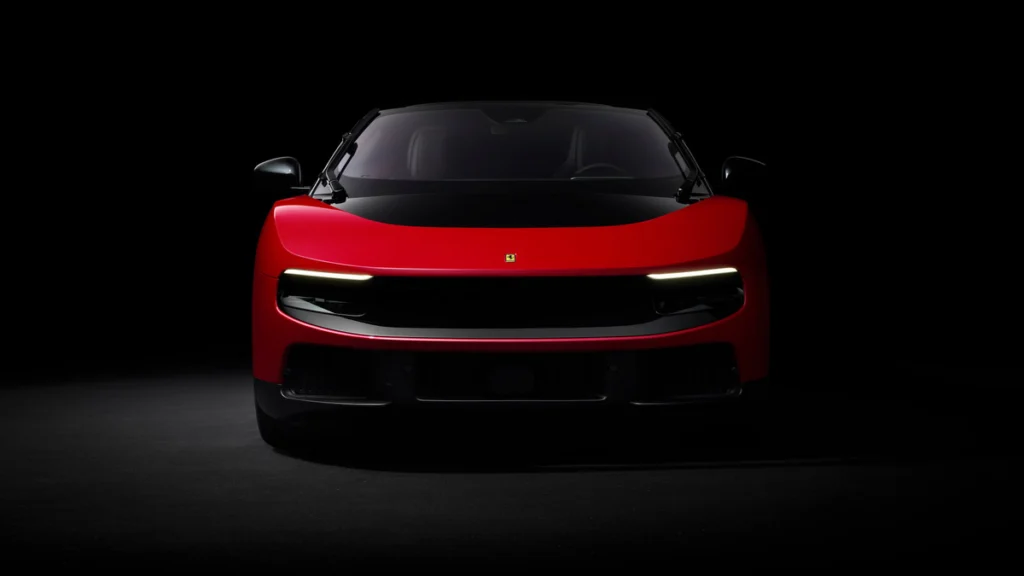
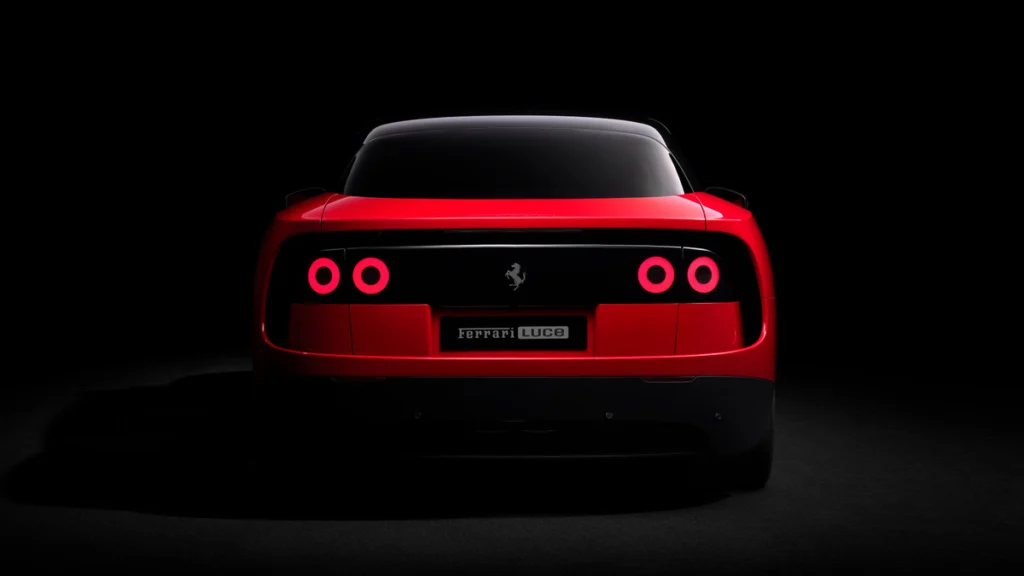
The result is a car different from any previous FerrariThe silhouette is dominated by a large glass surface, described as a sort of glass house, which helps give the body a clean, almost suspended presence. The surfaces are essential, continuous, and smooth. Aerodynamics do not appear as a technical addition, but as an integral part of the design. The front and rear appendages, the active grilles, the adjustable ride height, and the integration of the headlights work together to increase efficiency and stability. When the lights are off, the taillights almost seem to disappear into the bodywork. At the rear, the round headlights recall Ferrari tradition, referencing the formal purity of models like the 360 Modena and 458 Italia.
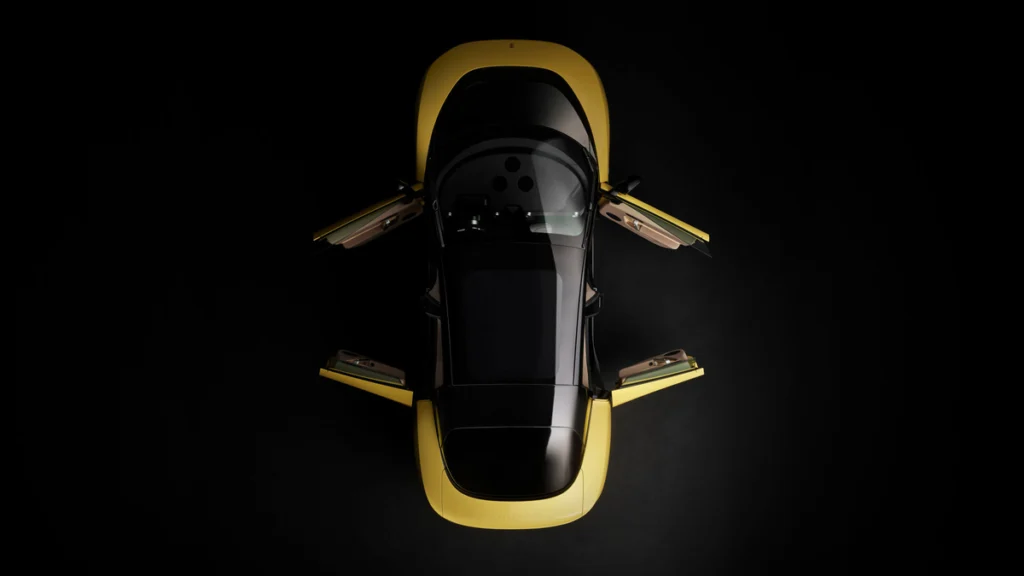
Even the proportions tell of the break with the past. Ferrari Luce is over five meters long, has four doors and a layout designed for five passengers. The rear doors that open counterclockwise enhance the feeling of accessibility and space, making the cabin brighter and more welcoming than the brand's usual standards.
Inside the Light, analog and digital meet
The the cockpit is one of the most radical points of the new FerrariThe philosophy isn't to overwhelm the driver with screens, but to strike a balance between physical controls, digital surfaces, and sophisticated materials. Ferrari focuses on mechanical buttons, tactile selectors, multifunctional displays, and a layout designed to minimize distractions.
Il steering wheel The three-spoke design integrates seamlessly with the instrumentation, creating a single control and readout element. In front of the rider, OLED displays with convex lenses are designed to improve clarity and visual depth. The instrumentation's color changes based on the selected mode, while some details, such as the backlit speedometer, combine aluminum and polycarbonate.
In the center of the dashboard there is a sadjustable screen, which can be rotated towards the driver or passenger thanks to a dedicated mechanism. The central tunnel makes extensive use of glass, a material also used in the key, made of Corning Gorilla Glass. The key integrates an e-ink display and participates in the welcome aboard ceremony, symbolically transferring the Ferrari yellow to the driving selector.
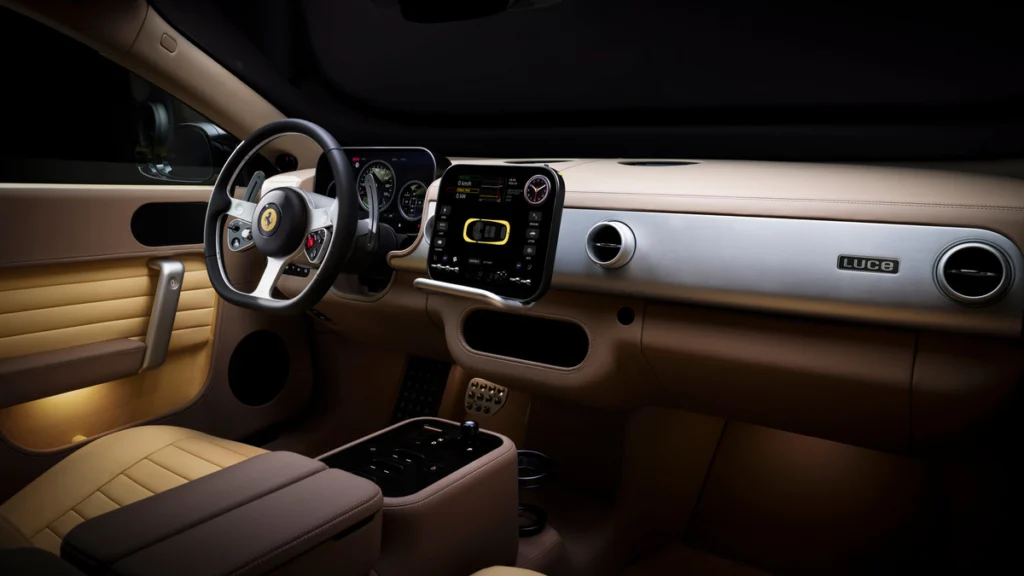
L'sound system It was developed in-house, features 21 speakers, and delivers a power output of 3.000 watts. The attention to detail extends to the door hinges, air vents, seat rails, and contact surfaces. The overall effect is that of an interior that strives to be technological without becoming cold, digital without sacrificing physicality.
The sound issue, an electric Ferrari must make itself heard
For Ferrari, the sound is not a detailIt's part of the experience, the memory, and the immersion. The challenge, with a fully electric car, was to avoid an artificial reproduction of the thermal roar. The solution chosen by Maranello is a system that captures the actual vibrations generated by the rotating parts of the electric axles, filters them, equalizes them, and amplifies them.
The principle is similar to that of a strumento musicale: the sound is not invented, but extracted from the car's mechanicsThe intensity varies according to the driving mode, with a more pronounced presence in Performance. In manual mode, the system works in conjunction with the steering wheel paddles and the torque converter, giving the driver perceptible progression in both acceleration and deceleration.
It's an important choice because it defines the difference between a silent electric car and an electric Ferrari. Luce isn't trying to imitate the past, but to build a new sound language consistent with its architecture.
Ferrari Luce: the electronic direction that combines power and control
The Ferrari Luce debuts extremely sophisticated dynamic management. The electric all-wheel drive system allows torque vectoring to distribute torque precisely between the four wheels. This is complemented by electrically actuated active suspension, independent four-wheel steering, and a new, dedicated evolution of Side Slip Control. The heart of the system is the Vehicle Control Unit, a control unit that networks the powertrain, chassis, and dynamics, updating parameters 200 times a second. The goal is to make the car precise, predictable, and readable even under extreme performance.
The e-Manettino, alongside the traditional Ferrari Manettino, manages power, torque curve, traction and powertrain behaviour through various modes. regenerative braking It was developed to work in continuity with the carbon-ceramic system, with 390 mm discs at the front and 372 mm at the rear, so as to maintain naturalness and progressiveness in the response.
The Light also introduces the Torque Shift Engagement, designed to modulate torque while driving and make progression more engaging, especially when cornering. In other words, Ferrari isn't just putting a lot of power to the ground: it's trying to transform the management of electric torque into a new form of driving pleasure.
Performance, comfort and space for a different Ferrari
Luce is probably the most versatile Ferrari ever madeIt offers four doors, five seats, a generous trunk, and an interior layout designed for long journeys. At the same time, it retains supercar figures and technical research consistent with the brand's positioning.
The combination of habitability, luxury and performance allows Ferrari to also address a new audienceFor some clients, it could be their first Ferrari, chosen not only for its power or prestige, but also for its zero-emissions, everyday usability, and a more contemporary form of luxury. The choice of materials reflects the same direction. Ferrari emphasizes the use of secondary aluminum alloys to reduce CO2 emissions during the production phase. The project is also supported by over 60 patents, a sign of a technological investment that goes beyond just the engine.
Elkann and Vigna's vision
The presentation of the Light was also an industrial manifesto. John Elkann he framed the model as a strategic step for the future identity of the brand: “with Ferrari Luce, Let's redefine the limits of what's possible once againToday we are not only presenting a new car, but we are opening a chapter that transforms our vision into reality, strengthening Ferrari's tradition of anticipating and shaping the future. Such a leap forward in product innovation could only arise from process innovation: this is why we have chosen to embark on new collaborations, such as the one with LoveFrom for design. And, as always, our research and engineering excellence have been put to the service of driving emotion, without compromise. Rome, the symbolic place of our first victory, becomes the starting point for a Ferrari that illuminates the future and opens new horizons.”
“We are convinced that a company demonstrates its leadership when it has the courage to dare and face the challenge of new technologies – declared the CEO Benedict Vigna – “Ferrari Luce was born from this very challenge, offering our unprecedented vision of electrificationNever before have we offered our customers greater freedom of choice: in line with our belief in technological neutrality, we are the first in the world to combine full-electric architecture with hybrid and internal combustion engines for sports cars. We have not limited ourselves to innovating in the engine, but with Luce we have inaugurated a true range segment. This model is the result of more than 60 of our new patents and is at the heart of an ecosystem of collaborations with leading technology partners. We have created a car that combines unique driving emotions with extraordinary performance, driving pleasure and comfort for the Ferrari enthusiasts of today and tomorrow.”
Words that clarify Ferrari's position: Electric does not replace thermal and hybrid vehicles, but is added to them. Light thus becomes the third pillar of a multi-energy strategy which aims to offer customers more choices without sacrificing the centrality of the driving experience.
Maranello enters the electric world without denying itself
Ferrari Luce is a declaration of intentIt doesn't erase the Prancing Horse's thermal history, it doesn't question the hybrid, it doesn't try to disguise the electric as a combustion engine. Rather, it uses the new architecture to explore territory that previously didn't exist in the range.
The real stake is to demonstrate that a Ferrari can change its energy source without losing emotional centralityLuce was created to be efficient, spacious, and technologically advanced, but above all it must remain desirable. It must convince Ferrari fans of today and attract those of tomorrow. The electric Ferrari has arrived. And Maranello wants to present it not as a deviation, but as a new way of being a Prancing Horse.