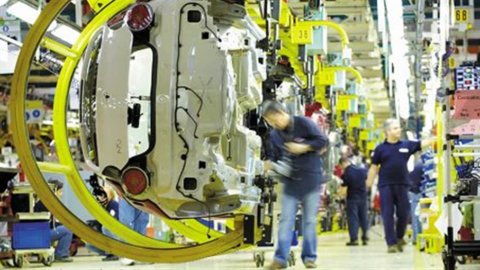
“The Fiat of Melfi? More than a factory, it is an experimental university. Here we study “Work and management” like nowhere else in Italy”. The copyright of this summary belongs to a tall, blond, smiling boy. A Yankee, you'd say, and instead he's from Palermo. He's an engineer, his name is Bartolomeo Càllari and he's the head of the bodywork, i.e. he oversees the dance of the 680 robots who here weld the sheet metal of around 1500 Jeep Renegade, Fiat 500X and Fiat Punto per day, more than one car per minute, per day and night, and – as is not the case in Germany either – 7 days a week, including Sunday.
Melfi is the first continuous-cycle European car factory, something that even the BMW managers came to observe closely in June. And not just because this beautiful corner of the South is by now among the top industrial centers in Italy given that, with the 1.500 hirings of young people scheduled between January and April and the other 500 in June, 8.000 people work here, which becomes 11.000 with the 16 plant of suppliers located since 93 (does anyone remember the “integrated factory” of Romitian memory?) in front of the Fiat factory.
AN EXPERIMENTAL LABORATORY
OF WORK AND MANAGEMENT
The interest of the Germans concerns above all the quality of Italian work. You understand this when Càllari, before illustrating the technological marvels of the system, takes you in front of a gigantic 15X3 board full of drawings similar to those seen in schools. "These are the factory improvement proposals formulated in recent months by the study groups of workers - explains Càllari - Behind the robots there is a great deal of human work".
Already. Because going beyond the gates of Melfi you enter a factory model where, contrary to what has happened in many Italian companies, the evolution of the product is assigning greater value to work and is changing it, for the better, with a depth that you expect. In this "laboratory" Fiat is moving from the production of "simple" cars to more complex and expensive cars, destined not only for Europe but for export all over the world. So Sergio Marchionne in this corner of the South has asked for and planned more qualified work, very well organized and less tiring. Here the product gives the future and imposes a working model built with a rare commodity in Italy: motivation.
For this reason, the Lucanian plant is the first large Italian factory whose production lines - with a work that lasted 18 months - were designed together by engineers and groups of workers in a special shed called Workplace Integration, "Pilotino" for the Italians . Here, and this too is a novelty, a first, large crack is opening in the old wall between blue-collar work and clerical tasks: in fact, in Melfi - as we will see better - the workers do not only carry out manual operations but "sign" their operations on computers present in each of the 400 workstations. Again: here it is possible to see psychologists circulating in the plant intent on studying what human resources employees call "the chemistry of the factory", that set of human relationships which in the past, in the "barrack factory" model, the company did not even include on his radars.
Finally, in peripheral Basilicata, we can glimpse a new chapter in the history of the Italian trade union which is faced with problems outside the box of the crisis. If only because of night shifts, overtime and Sundays, salaries are high: they travel between 1.500 and 2.000 euros net per month in an area where a rent costs a maximum of 300 euros per month.
GOODBYE FACTORY-BARSAM
CHANGE THE BUSINESS MODEL
But be careful, let's immediately set aside Adriano Olivetti and his "human-scale" factory utopia. The strength of the Melfi model, a giant son of the experiment begun in 2010 in Pomigliano and even earlier on the Mito line at Mirafiori, lies in the fact that we are in the presence of a precise business model: everything you read serves to produce profits. Indeed: many useful. Necessary to repay and increase the one billion euros invested.
To understand this, you have to visit the assembly department, the realm of the engineer Ennio Meccia, a thoroughbred from Molise who speaks excellent English. Here, behind a simple glass that separates them from the assembly line, the employees and managers of the factory work. No pro-ambush walls. Differences with the workers reduced to a minimum: the employees work at a desk, but in overalls. And Meccia (as well as Càllari) as well as the director of the factory, Nicola Intrevedo, wear the same white and gray overalls as the other 8.000 workers. Accompanying Meccia along the lines, one perceives that for the workers the "boss" is not an unknown (feared/hated) mega-manager, as happened in the old factory where the separation between workers and managers was symbolized by the "jacket and tie" of the seconds .
EXECUTIVE SUITS
AND TEAM WORK
And in fact the Càllari and the Meccia, wandering around the factory, ended up informally collecting information and judgments from the workers on the small imperfections encountered day by day in the functioning of machinery and online computers. Yes, computers. Because in Melfi even the workers work on computers. They carry out simple tasks because, if all the new recruits have diplomas and degrees, as many as 4.000 Melfi workers have the eighth grade, but now they are no longer "imprisoned" in manual skills alone. In each of the assembly stations there is a computer screen on which the workers write down the most delicate operations they carry out. “It's a system that only the Fiat of Melfi has in all of Europe – explains Meccia – It allows us to follow each car step by step, which by now has an enormous number of variants, to intervene immediately when problems arise, to memorize an immense quantity of data".
And who warns you of problems? “A new worker figure: the team leader”, replies Meccia. The team leader is a worker who doesn't work with his hands. In Melfi there are about 400 who coordinate their "domain" (that's exactly what it's called) made up of six of their colleagues from their team. They are to all intents and purposes micromanagers who verify product quality, untie the thousand little knots that mark each working day, manage permits and above all never make the workers feel "lonely and abandoned". “Since I've been a team leader, I'm getting pissed a lot more but I don't feel like a number and pride for my factory was born inside me,” explains Luciana Mecca, a veteran of the Melfi factory.
Of course, not all that glitters is gold. A research conducted by the Fim and the Milan Polytechnic has highlighted that in some Fiat factories the team leaders behave like "leaders" rather than being the "engine of collaboration" as envisaged by the new work model. In Melfi, on this front, a new fact is noted: some newly hired engineers have been employed as team leaders. It's a bit like Fiat saying to them: do you want to have a career? Prove your worth from the bottom up. Also because the collective watchword is clear: team up. Everyone. Both the old "barracks factory" was vertical by photocopying the most classic military scheme, so the 4.0 factory is horizontal, with a very low hierarchy. It is no coincidence that in the new Fiat contract, freshly signed, only three hierarchical levels are envisaged for new hires - workers, middle managers and managers - against the current eight. A semi-flat system specifically designed to crown the new religion of the new Fiat factories: "team building".
THE ROLE OF THE TRADE UNIONS DECLINES
THE BOARD OF DELEGATES GROWS
"All positive, but the Fiat executives seem undecided about the team leaders between the nostalgics of the barracks factory who consider them small hierarchs and those who want a real involvement of the workers", underlines Donato Rosa, Uilm union delegate, the most voted in Melfi. Already. And the union? It is the great "black hole" of this story. It is not clear how the union is gearing up for the reshuffling of the cards between blue-collar and white-collar work. The contract provides for a system of factory bonuses which increase as the costs of the plant decrease. So the workers are encouraged to make proposals in exchange for a nice nest egg of pennies: between 7 and 10 thousand euros over the next four years. The same workers can then contact the team leader to get permission or propose/request small improvements. It is clear that the company now has a direct and capillary channel of communication with its employees. And it is no coincidence that corporate hegemony in Melfi has never been so profound: absenteeism is 3%; shifts, even if uncomfortable, were accepted at the very small price of a few shouts in an assembly; the latest strike by Fiom brought together 29 workers out of the 1.500 at work.
So one of the basic questions that hangs over this "University of work" is very heavy: in the factory of collaboration, what is the use of the union? In the recent elections for delegates, the five unions that signed the Fiat contract (Cisl, Uil, Fismic, Ugl and Quadri, with the exception of Fiom) obtained the vote of 93% of the workers. Data to be taken with a grain of salt: in the countries of the South friends vote for friends and compatriots who then have to return the favor. But this time it won't be easy for the elected delegates. With the new contract - on the model of the analogous German structure - the council of delegates has the power (previously reserved only for the unions) to call strikes by majority vote and has the mission of dealing with the factory management to solve together the thousand problems of the management of the immense Lucanian industrial beast. Yet another wide-ranging experiment. There's no denying: with Melfi the factory is back on the stage of Italian work in a big way.