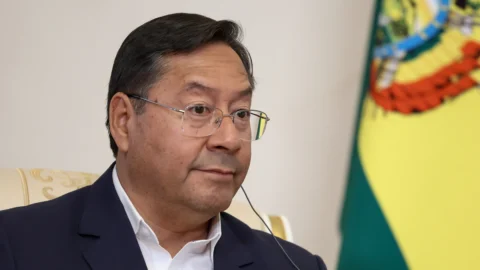
Another bastion falls in South American politics: even in Bolivia, where he has been governing for twenty consecutive years, the left is defeated from the presidential elections. A total defeat in the first round on August 17, which does not even give any chance in view of the run-off in mid-October, given that those who have accessed the second round are two candidates, both right-wing, or in any case in opposition to the outgoing majority and to the president Luis Arce: the senator Rodrigo Paz Pereira and the former president, but of a lifetime ago, Jorge “Tuto” QuirogaThe first is a younger and more moderate figure: 57, an economist, a member of the Christian Democrat center, and a champion of the fight against corruption. Quiroga, on the other hand, is now 65 and has had many ups and downs, including the "stain" of having been former dictator Hugo Banzer's deputy and then his successor. He is decidedly more conservative and pro-American: he studied in Texas and was an engineer at IBM.
Another epochal defeat for South American socialism
For South American socialism, this is therefore an epochal defeat, in line with what has been happening for some time: after the "red wave" of the 2000sWhen virtually all countries in the region were governed by left-wing or center-left parties, today this applies only to Brazil, under the resurgent Lula, Chile, under Gabriel Boric, and Colombia, under Gustavo Petro, with Nicolas Maduro's Venezuela a completely different matter. Instead, Argentina, Uruguay (where, however, Pepe Mujica's party, led by Yamandú Orsi, has recently returned to power), Paraguay, Peru, Ecuador, and now Bolivia have all veered to the right, and in some cases to the far right.
In La Paz, for twenty years, the left had always governed, even if not in a homogeneous way: first with the most radical Evo Morales, the first indigenous president who had brought the country into the economic boom, then with the reformist Luis Arce, Morales's former party colleague in the Movement for Socialism, the designated heir but then the sworn enemy of his predecessor and a secessionist. And it is precisely this split that has cost the left dearly. Moreover, Arce did not run again, and the candidate he nominated was a flop, while Evo wanted to but was prevented from doing so: he is ineligible for having already served three consecutive terms as president, in violation of the Constitution (he won the third term but was forced to resign, and a hasty attempt to "fix" the Constitution was rejected), and he is also implicated in a disturbing case of sexual abuse of minors.
What remains of Morales' economic miracle and what happens now in the race for lithium?
Very little remains of the economic miracle of the Morales era, and now that progressive framework risks being overwhelmed by the liberal proposals of the two contenders in the runoff election. Quiroga, for example, is eager to privatize everything, while Pereira—who was the real surprise of the first round—is focusing on reindustrialization, but always with an eye on foreign capital. Indeed, Bolivia, like all of South America, is heavily de-industrialized, having focused everything on the export of raw materials, in particular those critical minerals that are now coveted by the whole world, starting from Lithium of which he holds one of the world's largest reserves, for an estimated 23 million tons. However, it currently produces very little, less than 1% of the global total, and precisely for this reason the new presidency will be crucial in defining strategies.
So far, first with Morales but then also with Arce, the Andean country has in fact handed over its resources to Russia and the ChinaNow, there's a distinct possibility of a pro-US shift, or at least less ideological trade relations, so to speak. Indeed, it's conceivable that once peace is secured in Ukraine, Donald Trump might turn his attention there too and seize the opportunity, perhaps through one of his vociferous endorsements ahead of the October 18th runoff elections. Meanwhile, there's a crisis to address: dollars are no longer available in La Paz and the surrounding area, meaning fuel and some basic products are going at unsustainable prices. Inflation has skyrocketed to 25%, the highest in 17 years and now the highest in South America excluding Venezuela and considering that Argentina has embarked on a virtuous path in this sense.