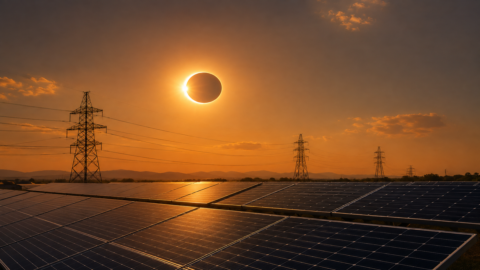
The Solar eclissi of August 12, 2026 It will not only be one of the most anticipated astronomical events of the year. While millions of Europeans will be looking up at the sky, in control rooms of electricity grid operators attention will be paid to energy flowsThe passage of the Moon in front of the Sun will in fact cause a rapid decrease in photovoltaic production, followed shortly thereafter by an equally rapid recovery. According to estimates by Entso-E, the association that brings together the operators of European transmission networks, in clear sky conditions the Solar production decline could reach 9,7 gigawatts in Europe between 19:15 PM and 21:30 PM. This is a significant change, but one that was anticipated well in advance and for which operators have already put specific measures in place.
This phenomenon occurs in a profoundly different energy system than it was just a few years ago. In 2025, solar energy accounted for approximately 13% of the European Union's electricity generation, and the increase in photovoltaic capacity makes natural events like an eclipse increasingly relevant for those who must constantly maintain a balance between energy production and consumption.
Why the eclipse is a stress test for the European network
The problem is not so much the overall amount of energy that will be lost, how fast solar production will drop and will subsequently grow again. Unlike clouds, which are difficult to predict with absolute precision and are often geographically limited, the shadow cast by the Moon crosses vast areas of the continent according to a trajectory known in advance. Managers can therefore prepare, but must still compensate for the temporary loss of production in real time through other sources, reserves, storage systems, and electricity exchanges between countries.
For this reason Entso-E has activated a dedicated task force and coordinated a series of measures between European Transmission System OperatorsControl room operators were informed in advance, market participants received indications of the expected reduction in PV production, and local managers will be able to rely on updated forecasts provided by meteorological services.
Furthermore, during the hours affected by the eclipse, scheduled grid interventions will be avoided where possible to maintain maximum operating margin. ENTSO-E assures that, thanks to existing coordination mechanisms and the preparations made, European operators are ready to ensure the safe and stable operation of the electricity system.
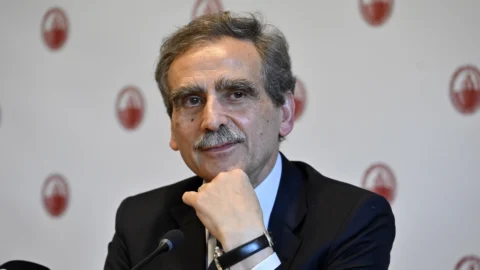
Davide Tabarelli, president of Nomisma Energia, defined the eclipse as a real “stress test” for the European electricity system, today much more exposed to variations in solar production due to the strong growth of photovoltaic.There will be a decline, because there will be a blackout,” he explained, underlining however that in Italy a substantially stable electricity demand helps to better manage the phenomenon. Tabarelli nevertheless said he was confident in the stability of the grid and does not foresee a crisis.
Spain and Germany are the most exposed, while a drop of around 70 MW is expected in Italy.
The impact will not be the same across Europe. Spain e Germany are indicated by Entso-E as the countries in which the greater reduction of photovoltaic production. In Spain, where the eclipse will be total in part of the country, Red Eléctrica estimates a maximum reduction of close to 5 GW. This is just over half the entire reduction expected at the European level and equivalent to about 13% of the peak demand typically recorded in the country on a Wednesday in August. For Germany, the estimated reduction is around 2,5 GW. Great Britain too could experience a significant decline. The grid operator's estimates indicate a drop of around 700 MW, which, based on some models, could reach up to 1,3 GW. In France, photovoltaic production could decline by around 1,8 GW.
The expected effect in Italy appears much more limitedTerna's analyses indicate a maximum decrease in photovoltaic power input to the grid of approximately 70 MW, expected around 19:45 PM. Therefore, no significant repercussions on the national electricity system are expected. The timetable will contribute most to reducing the impactThe eclipse will indeed cross Western Europe when the sun is already low on the horizon and photovoltaic production has begun its natural decline towards sunset. And with the August bank holiday approaching, electricity demand tends to decline due to the closure of many production facilities.
However, the estimates remain linked to weather conditions.The 9,7 GW represents the clear-sky scenario: in the presence of clouds, photovoltaic production would already be lower and, consequently, the loss directly attributable to the eclipse would also be lower.
The 2022 precedent and a European network already under pressure from the heat
Eclipses are nothing new to electricity providers. On October 25, 2022, another solar dimming affected much of continental Europe., including Italy. On that occasion A total of approximately 13 GW were involved of European photovoltaic production, but the Italian system went through the event without consequences for businesses and citizens. Terna It then implemented specific dispatching measures and continuous monitoring from its operations rooms, in coordination with other European operators. The company emphasized that the rapid decline in solar production during an eclipse requires different preparation than the normal variation between sunrise and sunset.
Even more significant was theeclipse of March 2015, when the reduction in European solar production reached around 35 GW. Even then, the system passed the test without interruption, despite the phenomenon occurring during a time of day much more favorable for photovoltaic production than this year.
This time, though, to the test of the eclipse is added that of the heat affecting several areas of Europe. According to the European Commission, some power plants in Hungary, Romania, Slovenia, France, Italy, and Poland have been shut down or had to reduce production due to low river levels or high cooling water temperatures. In France, three nuclear reactors were taken offline due to water availability issues, while in Poland, two large coal-fired power plants temporarily reduced production, resulting in a loss of approximately 1,3 GW. Water reservoirs in Norway, a major energy exporter to the rest of the continent, have also fallen to particularly low levels.
From Brussels, however, No immediate safety concerns are reported at this time. of supplies. Trade between countries can help offset any shortfalls, and the European network will continue to be monitored throughout the eclipse.
For the Old Continent's electricity system, therefore, the Moon's passage in front of the Sun will primarily test its ability to manage an energy production increasingly dependent on renewable sources. This is a significant but perfectly predictable variation, which for a few hours will test the coordination built up over the years between European grids.