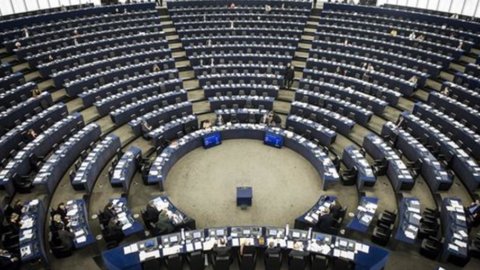
It will be a week of passion that the new European Commissioners appointed by the Member States of the Union are preparing to spend. A week marked by the severe scrutiny to which they will be subjected one by one by the parliamentary commissions in view of the vote that the Strasbourg Assembly will cast on the new European executive as a whole at the next plenary session scheduled for the end of October. A vote that will have to be validated immediately afterwards by the seal of the European Council by qualified majority.
A week – this one which opens on Monday 29 September and which will have a short queue on the afternoon of Monday 6 October and on the morning of Tuesday 7 – which will certainly be demanding for all 27 commissioners under examination. Test to which the Christian Democrat Jean-Claude Juncker, ex-premier of Luxembourg, who had already passed it on July 15, when during the plenary session of the European Parliament in Strasbourg, was elected president of the Brussels Executive, will not have to undergo by secret ballot.
These other 27 commissioners, on the other hand, starting next Monday, will have to pass the gauntlet of the hearing in the parliamentary commission responsible for the matter. Commission which, in terms of the regulation, is called to evaluate the general competences of the designated commissioner (or of the commissioner, one of the nine called to join the new Commission), his European commitment, his personal independence, knowledge of the portfolio assigned to him and his communication skills.
The members of the parliamentary commission (or of the commissions in cases where the competence of the commissioner under examination extends to more than one sector), a few days before the date set for the hearing, send five written questions to the candidate. Of these, two are common to all: the first on general competence, European commitment and personal independence; the other on portfolio management and cooperation with Parliament. To these two questions, the members of the commission in question add three more. Preliminarily, the commissioner-designate has 15 minutes for a short introductory report, then he will answer the questions. And finally he will be able to make a short closing statement.
In total, each audition must last 3 hours. For this reason, there will be a maximum of six auditions in the space of a day: two commissions will work in parallel from 9 to 12, two more from 13,30 to 16,30, and another two from 18 to 21. The auditions will be all public, at the end of each the deputies of each parliamentary commission will meet, in this case behind closed doors, to draw up an evaluation of the test for each commissioner-designate. These evaluations will be sent to the president of the European Parliament and to the presidents of the parliamentary commissions who will transfer them to the conference of presidents of the parliamentary groups.
Once this phase of the procedure is concluded, it will be Parliament's turn in plenary, on 22 October, to vote by roll call to accept or reject the Commission as a whole. If the total of "yes" exceeds that of "no", it will be up to the Council (and therefore the Member States) to decree the formal approval of the Commission which will take office on November XNUMXst.
A complex procedure, this one just illustrated; and obviously demanding both for the designated commissioners and for the members of the parliamentary commissions called to judge them. On the names of the new commissioners a solid majority has coagulated both among the parliamentary groups (and here the agreement appears armored) and among the member states (and also in this regard the agreement found by that old fox of the art of mediation who è Jean-Claude Juncker should ensure a smooth conclusion).
And yet… In reality, today no one can guarantee that everything will go smoothly. And that improbable but not impossible unforeseen events can call into question an already completely defined scenario. As in any self-respecting negotiation, even in this one which gave birth to the list of commissioners-designate and the assignment of tasks it was inevitable (for Juncker, of course) to put together positions, needs and requests that at first sight were irreconcilable. With the consequence that a commissioner (or a commissioner) could receive a less than enthusiastic evaluation by the parliamentary commission. For his own objective incapacity in relation to the portfolio that he should manage; or more simply, for example, due to the difficulty of answering embarrassing questions from a "peon" deputy not linked to any consortium.
Difficult? Perhaps. Impossible? Nobody can rule it out. Not even the Strasbourg Parliament itself. Who cares to remind us (thank you!) what happened in February 2010, when the Commission was elected five months after the expiry of the previous one following the delay in approving the Lisbon Treaty. On that occasion, after a very weak hearing by the Bulgarian candidate Rumiana Jeleva, President Barroso invited her to step aside and asked for an alternative candidate for the government in Sofia. That you hastened to recall the economist Kristalina Georgieva from Washington, where she held the position of vice president of the World Bank, to hastily send her to Brussels; where, moreover, in recent years you have made yourself appreciated and now you are confirmed, moving to vice president, in Juncker's team.
It went even worse five years earlier, even then President Barroso. Which led to the withdrawal of our Rocco Buttiglione, penalized by a sincere answer (even too much, and therefore perhaps naive, to a provocative question) and the Latvian Ingrida Udre, replaced respectively by Franco Frattini and Andris Piebalgs, and changed portfolio at Hungarian Laszlo Kovacs.
Returning to today, some commissioner-designate could encounter obstacles for reasons of incompatibility or opportunity, in part amplified by journalistic indiscretions. On the subject of possible incompatibility, there is the Englishman Jonathan Hill, a former lobbyist from the City of London who has been assigned the portfolio of Financial Stability, Financial Services and Capital Markets Union.: “I hope that British friends will now understand the European logic of financial services is a little better if they explain it to him in Shakespeare's language”, was Juncker's explanation. Someone else said that giving Hill the job was a bit like putting a fox on guard at a chicken coop…
Then there is the Spaniard Miguel Arias Canete, commissioner designated for climate action and energy, president of two oil companies, not at all pleasing to environmentalists. There is the Maltese Karmenu Vella, commissioner for the environment and maritime policies, former director of a large betting company. And there is the Hungarian Tibor Navracsics, Prime Minister Viktor Orban's Foreign Minister and author of the law that brought down freedom of the press in Hungary.
Finally two commissioners. One is the Romanian Corina Cretu, commissioner for regional policy, a beautiful lady accused of having been used by Ceausescu's secret services to seduce Western politicians and thus be able to become aware of highly confidential information. Circumstances that she has always denied very firmly. The other is Slovenian Alenka Bratusek, the first female prime minister in her country until last spring, a brunette so charming that Google has dedicated a sort of book full of photos and videos to her with the unequivocal title "Bratusek legs".
Resigned as prime minister after her party lost the elections, she had remained in office for ordinary administration pending a replacement. Brief wait during which Bratusek, in the exercise of her role as prime minister, gave him her own in response to Juncker's request to suggest a name to candidate for the new Commission. Now, barring surprises at the hearing, he is now Vice-President of the Commission for the Energy Union.
No surprises on the horizon instead for Federica Mogherini, whom Juncker defined as "ultra-competent". Our current foreign minister has let it be known that you will remain at the Farnesina until the end of October. He will obviously go to Brussels for the hearing set for the evening of 8 October. Then, on November XNUMX, he will take up his new office in Berlaymont as other representative for EU foreign affairs and security policy and as vice-president of the European Commission.