It is almost time to present the proposals to the EU on climate and energy. The days go fast towards December 31st, the last useful date and it is not yet defined what Italy will say to the commissioners in charge of drawing up the lines of the new climate governance. Home businesses insist on the government to make it clear that the game is serious. Eyes wide open for the choices that will be made in the first months of 2019, which will condition investments, employment, commercial strategies, international agreements for many years. A panel with renewables, fossils, circular economy, energy efficiency.
When the center-left was ousted from leading the country, the National Energy Strategy it was one of the best things he left behind. Elaborated and discussed over a long period of time with valuable economic and environmental balance points. A wide-ranging, recognized job with companies, associations, territories, which it would be harmful to deny today. Anev, the association of wind companies, is the latest in chronological order to move towards politics to explain the role of its companies and get concrete proposals to Brussels.
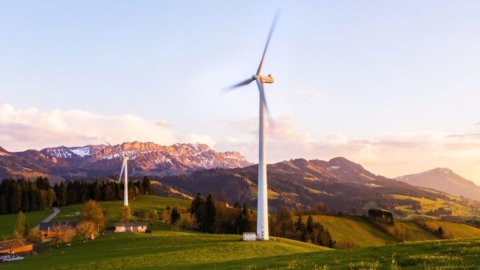
There are also others, in energy sectors other than renewables, but wind power is the second form of electricity production at European level. With 18% of total domestic and industrial consumption, it wants to grow further. Investments reached 22 billion euros, despite the drop in 2016. Money invested inOnshore and in 'offshore accountsrespectively with 7,5 and 14,8 billion. Germany has invested the most, followed by the United Kingdom and Italy. The fact is that in view of the end of the year, the Italian wind industry has launched an information campaign on social media to make itself heard. A strategy that (could it be a coincidence?) coincides with the communication methods of the yellow-green government.
The decision to broaden the audience of supporters of this form of energy is not only linked to the European context but also to production costs and the imbalance between distributed and produced energy. On the decisions of the Italian Energy Authority – Arera – the wind farms complain about the penalization of costs between 3 and 7 Euros per Megawatt. Wind power, explained the President of Anev Simone Togni, is penalized by bureaucratic costs, lengthy authorizations and lack of tools to be able to build new plants. If we add to this the rising costs established by the regulator, the system suffers and any idea of new investments becomes precarious. There is also a hand in hand the latest report of wind Europe, according to which focusing on this energy source also means thinking about transmission system operators. In a less disturbed environment, they can plan and build new infrastructures.
If the wind energy association launches an information campaign, however, it should be kept in mind that the energy source that precedes it in global consumption – natural gas – maintains its primacy. Yes, the match on climate and energy should (?) end in 2030 with the reduction of CO2 quotas. But gas and oil together total 67,9% of global consumption, almost two-thirds of the energy universe. Eurostat certifies that for companies this source is still irreplaceable (22%) together with other fossil fuels and despite the growing expenditure for systems greens. In the last year, Italy has spent 14 million euros on gas imports from Russia, Algeria, Libya, the Netherlands distributed from North to South. The 2017 SEN considered this combination, which is not short, of energy sources. A transitory combination certainly, but well organized to keep industry, investments, consumption and climate together. We'll see what eventually leaves Rome for the heart of Europe.