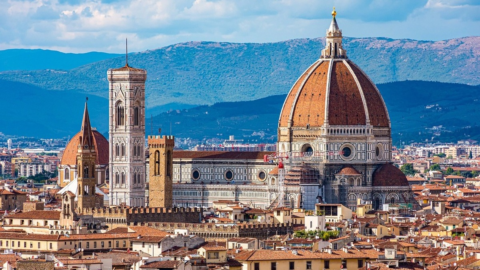
On August 7th of 1420, exactly 601 years ago, the construction of the dome of Santa Maria del Fiore, the Duomo of Florence, better known as Brunelleschi's Dome. Finished in 1436 (the addition of the lantern dates back to 1470), it was at the time the largest dome in the world, with an internal diameter of 45 and a half meters (55 meters on the outside). Today there are larger domes (San Pietro, Santa Sofia), but the Florentine masterpiece remains the largest masonry dome on the planet.
Beyond the size, what matters most is the visionary genius of Filippo Brunelleschi, who with the dome of the Florentine cathedral wrote a fundamental page in the history of architecture, destined to influence the art of building for centuries.
Actually, Brunelleschi's dome it is not a real domebecause it is not hemispherical in shape. It is quite a octagonal vault, formed by eight sails that fit on an imperfect drum with eight corners.
A structure of this type is very complicated to build, because – unlike a normal hemispherical dome – it is not self-supporting. Meaning what it doesn't stand on its own: not exactly a minimal problem.
Brunelleschi solves it with a series of inventions that make history. He calculates every detail with precision, from the angle of the walls to the herringbone pattern of the bricks. And especially, it lightens the building by emptying it: the sails are organized on two shells separated by an empty space. In this way the dome is able to support itself, without resting on the traditional wooden scaffolding.
Popular legend has it that Michelangelo Buonarroti - in a letter sent to his father shortly before leaving for Rome, where he would have designed the dome of St. Peter's - wrote two verses in rhyming couplets referring to the dome of Santa Maria del Fiore: "I'm going to Rome to be your sister; bigger yes, but not prettier".