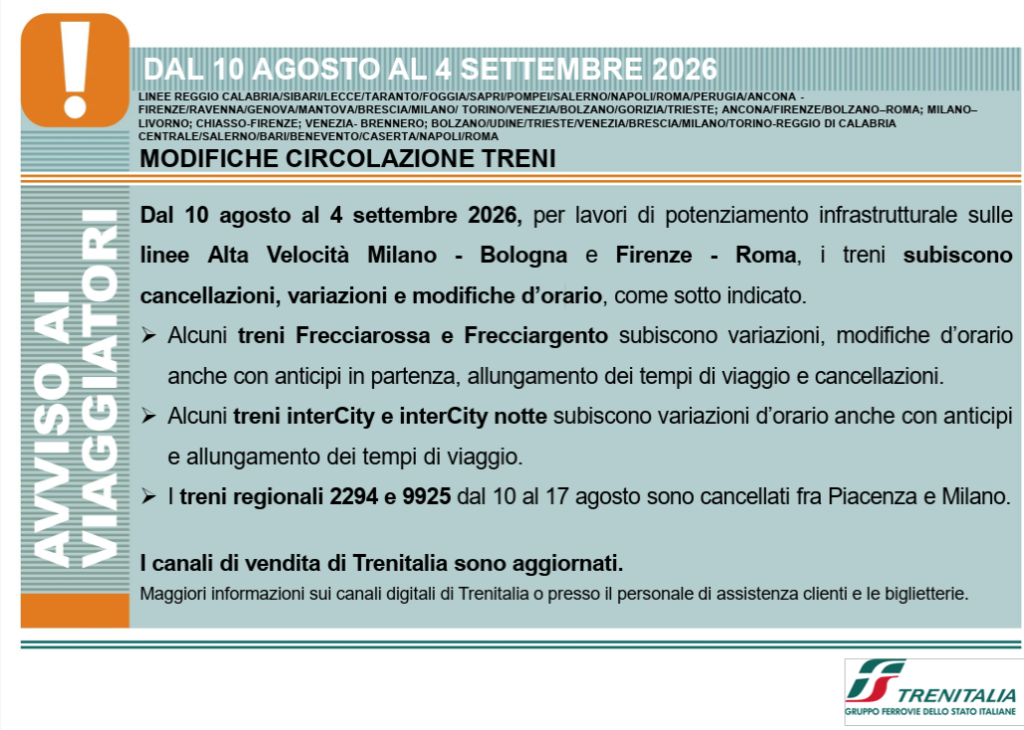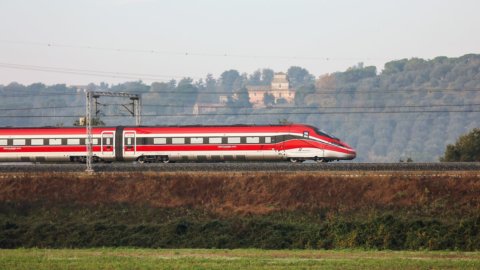
After the interventions that have already affected the railway network in recent weeks, The last major summer work on the Rome-Florence route beginsFrom Monday 10 August until 28 August Rfi will be involved in a series of yards on the Direttissima and conventional Florence-Rome lines, with interventions concentrated above all between Chiusi and OrvietoThe program, which is worth approximately 6 million euro, will impact rail services right in the heart of the mid-August exodus. High-speed, intercity, and regional trains will be affected, with schedule changes, rescheduled connections, and longer travel times. The changes have already been implemented in the railway companies' sales systems.
RFI has concentrated its activities during the summer period with the aim of limiting the impact, especially on commuter traffic, and, at the same time, improving the reliability of one of Italy's main railway lines.
Rome-Florence trains: Schedules and travel times will change from August 10th to 28th.
The most significant phase of the works will concern the Direct Florence-Rome, where construction work will be concentrated on the section between Chiusi and Orvieto. Work will particularly affect the Fabro tunnel and the Paglia viaduct, near Orvieto. RFI has allocated approximately €5 million for this portion of the program. Over 80 technicians from the company and contractors will be working on the construction sites every day, supported by construction trains and other vehicles used for infrastructure work.
The works will inevitably have effects on circulationThe service will be rescheduled and travellers will therefore be able to find different timetables, longer travel times and a different organisation of connections along the axis between Florence and Rome. The changes will affect both the High Speed and Intercity and Regional services. RFI explains that the interventions have been "scheduled for the summer period to minimize the impact on mobility” and will serve to improve “the reliability of the infrastructure and the regularity of rail traffic”.
Construction sites also on the conventional line, total investment of 6 million
In parallel with the interventions on the Direttissima, the works will concern also the conventional Florence-Rome lineIn this case, an investment of approximately one million euros is planned for a series of extraordinary maintenance activities. The main construction site will concern the Riomaggiore railway bridge, on the stretch between Chiusi and Panicale. Work is also planned on the second shelter at the Chiusi-Chianciano Terme station.
More than 30 technicians will be working on this front daily, again with the support of construction vehicles and trains. Adding together the work on the Direttissima and that on the traditional line, the plan implemented by RFI therefore reaches a value of approximately €6 million.
The Rome-Florence line will not be the only high-speed line affected by the construction work in August. Between 10 and 17 August, interventions are also planned on the Milan-Bologna motorway., with further changes to circulation on the high-speed network.
Work will end on August 28th, but delays are possible until the 31st.
Il August 28th will mark the conclusion of the main construction sites, but for a complete return to normal circulation we will have to wait a few more days.
The restoration phase will start between August 29th and 31st of the expected operation after the infrastructure renovation. During this period, trains will begin traveling along the affected sections at reduced speeds. The speed limits will then be gradually removed once the technical checks are completed.
For passengers, this means that, even after August 28th, travel times may still be extended by 5 to 10 minutes. Full service will therefore return only after the inspection procedures are completed.
In view of the August departures and the counter-exodus at the end of the month, the advice for those travelling on the Rome-Florence route remains therefore to check your connection time before departure. All construction-related changes have already been incorporated into the railway companies' sales systems.