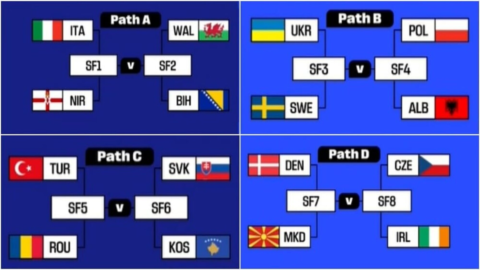
Northern Ireland to start with, then one between Wales and Bosnia. This is the path that separates Italy from the 2026 World Cup, the obstacle to overcome to avoid a third, catastrophic absence in a row. The Zurich draw didn't offer any shocks, but not even a shred of serenity. The only certainty is the first stage: the On March 26, the Azzurri will play a one-off semi-final against Northern Ireland.A challenge that on paper seems manageable, but that precisely because of this amplifies the pressure. Because this time, mistakes are out of the question.
The draw then defined also the intersection of the other semi-finalBosnia and Wales will compete to qualify for the final against Italy on March 31. And this is where the hardest blow comes.. The final will not be played at home, but in Cardiff or Sarajevo (most likely in Zenica). A detail that weighs heavily, especially given the Azzurri's recent history of being away from home in the playoffs.
Northern Ireland, a match worth much more than ninety minutes
Gennaro Gattuso has been repeating it for days: no calculations and no alibisNow that the draw has spoken, the path is clear. Italy, placed in Pot 1, knew they would draw one of the teams from Pot 4. The verdict chose Northern Ireland, a team coming from the Nations League path and ready to present herself with the profile of the “underdog” A team that thrives on focus, order, and opportunism. It's a team that gives nothing away and, in one-off matches, can create more dangers than expected. Predictions don't protect against anything.
A qualification worth billions
Behind the sporting tension lies a huge economic stake. Failure to qualify for the 2026 World Cup would not only be a technical failure, but it would open a financial holeThe FIFA prize money for the tournament, according to estimates circulating in the Anglo-Saxon press, is expected to reach 780 million dollars. Staying out would mean forfeit the participation fee and any potential future earnings.
The FIGC's sponsorships, already hit by its elimination from the 2022 World Cup with approximately €5 million in commercial adjustments, would suffer a further blow. TV rights, particularly for RAI, would see their value drastically reduced: fewer matches, lower audiences, less advertising. Merchandising would also be affected, with an immediate collapse in sales of official jerseys and products.
Added to this are the macroeconomic effectsStudies show that a global victory could boost GDP by up to 0,7%, or between 5 and 10 billion euros in economic benefits. Without Italy, this potential stimulus evaporates. The risk, in short, is systemic.
What happens now
The Italy-Northern Ireland semi-final will be played on March 26, 2026 probably in Bergamo. Only afterward, and only if successful, will the Azzurri fly to Cardiff or Sarajevo for the final on March 31st. In between, five days that will decide not only the sporting fate of the national team, but also a piece of the country's reputation and economy.
2026 World Cup: the other play-offs
Europe has also discovered other paths. Path B is probably the hardest, with Ukraine–Sweden on one side and Poland–Albania on the other. In Path C the Vincenzo Montella's Türkiye will face Romania, while Slovakia and Kosovo will play the other semi-final. Path D, instead, offers Denmark-North Macedonia and Czech Republic-Ireland, physical, tense challenges with a very “British” pace.
And it's not just Europe. Even before UEFA opened its polls, the FIFA draw had already the intercontinental playoffs outlinedThe winner of the New Caledonia-Jamaica match will face the Democratic Republic of Congo, while the winner of the Bolivia-Suriname clash will play Iraq for a spot in the World Cup. These matches were played at very different footballing latitudes, but all carry the same weight:last ticket for 2026.