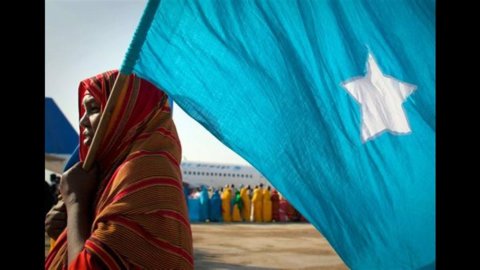
La Somalia? An opportunity to invest. To be encouraged and promoted in the long run. At present, in fact, there are no conditions for doing business in the Horn of Africa. But there is a strategy for the stability and development of the country.
Confirmation comes from the conference “Somalia: current scenarios and development prospects”, organized by the Be (Italian Society for International Organization) and from Cir (Italian Council for Refugees). An appeal to the international community that also sounds like an alarm bell.
According to a report published by Oxfam, Somalia is the fourth state in the world more dependent on remittances from migrants. Approximately $1991 billion has been transferred since the outbreak of the Civil War in 11. Diaspora Somalis transfer between 1 and 2 million dollars annually. Figures that make 40% of the country's families totally dependent on remittances. This is why it is necessary to restore the security conditions and give new connotations to the Mogadishu economy.
"Unfortunately, the political framework is still unstable and the Somali economy is vulnerable - explains the Director General for Development Cooperation of the Ministry of Foreign Affairs, Giampaolo Cantini -. Industry represents only 7% of the GDP and agriculture is essentially based on breeding. The financial system remains weak and dependent on the informal sector, where remittances dominate. Resources are needed for development: Somalia receives about 1 billion dollars a year in aid, but they are needed for reconstruction and development. The country would have so much to offer, in terms of mineral and agricultural resources, fish fauna, natural gas and oil. The reconstruction of the economic and social bases is one of the objectives and the European Union has drawn up a Joint Program for Somalia, between the Commission and the Member States”.
Mario Beccia, of the Institute for Industrial Promotion of the Ministry of Economic Development ensures “the involvement of Italian entrepreneurs in international organizations, in this case in the African Development Bank. We strive to promote our businesses, even if the conditions in Somalia do not currently exist to engage. If they change, the hope is to make a contribution to getting Italian companies to invest in Somalia”.
"Today the exchange activity between Italy and Somalia is limited to just over 10 million euros - says Maria Concetta Giorgi, of the General Directorate for Internationalization of Trade and Development Policies – and is unbalanced on Italian exports, above all of agricultural machinery and construction materials. Instead, trade can increase. While waiting for the conditions to become more favourable, the Ministry of Economic Development has taken an important step by setting up a table for female entrepreneurship about 2 years ago”.