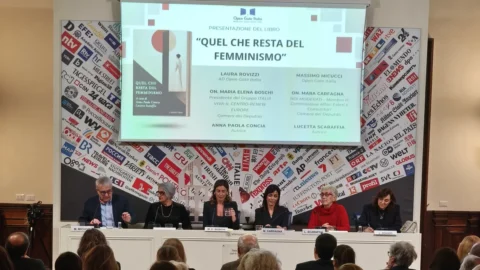
That What remains of feminism today? and what space does comparison have in contemporary public debate? The debate has developed around these questions presentation of the volume "What remains of feminism", edited by Anna Paola Concia e Lucetta Scaraffia, hosted in Grazioli Palace in the conference room of the Foreign Press Association.
The initiative, promoted by Open Gate Italy, brought together different political and cultural voices for a discussion on the state of the feminist thought, in a context marked by growing polarization and an increasingly conflictual use of public language.
The works were introduced by Laura Rovizzi, CEO of Open Gate Italia. The debate, moderated by Massimo Micucci, saw the participation of Mara Carfagna, member of the III Commission for Foreign and Community Affairs of the Chamber of Deputies, of Mary Helen Woods, president of the Italia Viva – Il Centro – Renew Europe group in the Chamber, and the editors of the volume.
Feminism Today: Between Polarization and a Crisis of Confrontation
During the meeting, the need to question the current state of feminism emerged, at a time when debate between different positions appears increasingly difficult, partly due to the impact of social networks and the radicalization of political conflict. The volume was created with the aim of reopening dialogue on key issues such as patriarchy, identity, language, right e freedom, in light of the most recent cultural and social changes.
At the opening Rovizzi She emphasized the importance of creating spaces for discussion that can overcome simplifications and ideological conflicts. "Open Gate Italia," she explained, "has decided, once a year, to spark a reflection on issues that, while not central to our work, are at the forefront of political and institutional debate. This creates an opportunity for a calm, bipartisan, and open discussion. The issue of how gender equality is still ensured in our society is close to my heart, and I believe we must not let our guard down."
Rights, consent and gender equality
On the topic of rights, she intervened Mary Helen Woods, who criticized the majority's approach to the proposal amendment of the consent lawAccording to Boschi, this is an "error of method and substance" that breaks "a political and institutional pact and risks a step backward on rights. Amending a law approved unanimously without consensus is a mistake that risks undermining the work begun with the approval of the Istanbul Convention. Furthermore, the new draft even retreats from the judges' interpretation: dissent must remain presumed, and we will not backtrack on this."
Mara Carfagna instead drew attention to the persistent inequalities in the world of work"Women's work is still too often precarious and underpaid, and there's a persistent wage gap that translates into a pension gap. Today's girls risk earning truly paltry pensions in the future. Therefore, we need an even greater commitment to supporting female employment, a major pact with businesses to ensure effective pay equality."
The cultural debate and the contribution of the book
Among the topics addressed, ample space was dedicated to the relationship between feminism e “woke” culture and a reflection on patriarchy as a complex phenomenon, not reducible to an abstract category. Also central is the theme of law and the boundaries between freedom and unfreedom, with a critical analysis of issues such as abortion and surrogacy.
The volume includes contributions from Luca Ricolfi, Claudia Mancina, Fabrizia Giuliani, Silvia Niccolai e Aldo Schiavone, which offer diverse and sometimes non-aligned perspectives, united by the desire to discuss the legacy and contradictions of contemporary feminism without dogmatic approaches.
During the comparison, Anna Paola Concia, one of the authors, explained that “What Remains of Feminism” was born from the need to reopen “a great debate on feminism, since, in recent years, there has certainly been a lack of public debate, mainly due to this neo-feminism that preached no debate, that is, you can't debate”.
The presentation concluded with a awareness shared: feminism immense it's a question that it only concerns women, but society as a whole. Restoring complexity and depth to public debate is now a pressing need that can no longer be postponed.