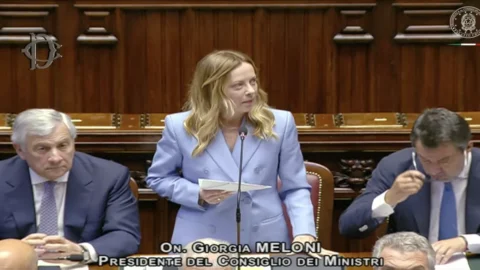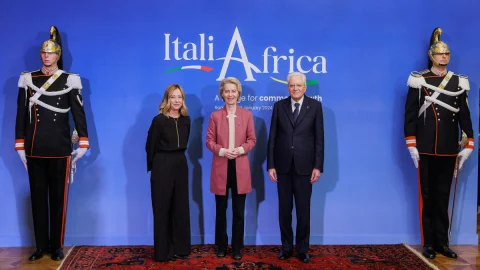
First of all, let's start by saying what the so-called "Mattei plan” of the centre-right Italian government. The prime minister repeats it until exhaustion Giorgia Meloni before the Heads of State and Government of 46 African countries received on Sunday evening at the Quirinale for a dinner by President Sergio Mattarella and yesterday at the Senate. And therefore: "it will not be a predatory plan". It will not be "a project dropped from above". It won't be an empty box." It will not be “a well-intentioned plan”. Instead it will be – states Meloni – a new way of interfacing with the southern shore of the Mediterranean as equals. In the background there is always the firm will of the Government forces to "help them at home" to discourage or rather prevent those "journeys of hope" of young Africans who almost always end up on the Italian coast and who above all worry the centre-right electorate.
The President of the African Union: “We were not consulted”
But, despite everything, the Chairman of the African Union Commission, Moussa Faki, he hoped that the Italian presidency of the G7 can amplify this approach to the partnership with Africa. “Madam Prime Minister – said Faki – on the Mattei Plan that you propose we would have liked to be consulted. However, Africa is ready to discuss the contours and methods of implementing the Plan. I insist here on the need to move from words to deeds, you will understand well that we can no longer be satisfied with simple promises, which are often not kept".
Meloni responds to all the criticisms (especially from the opposition) by speaking of new financial instruments "to support shared development and growth initiatives". Therefore, not only “good intentions but concrete and achievable objectives”. A timetable will set the stages of the various projects which will be developed together with the recipient countries after operational missions are launched in the coming weeks. And above all, the prime minister insists "Africa will continue to be one of the strategic priorities of Italian foreign policy and will therefore be central during the Italian presidency of the G7".
Mattei Plan: 5,5 billion resources in 4 years
Yesterday the Senate analyzed the five priorities on which to focus action: education and training, healthcare, agriculture, water and energy. Not a plan lowered from above but which will be based on a "shared programmatic platform, outside of a predatory or charitable approach". And that will have to see Italy's commitment to "the entire country system, starting from development cooperation and the private sector".
You can count on one initial endowment of over 5,5 billion euros in four years: 3 billion are allocated from the Italian climate fund and the rest from the cooperation and development fund. With the intention of involving "international financial institutions, multilateral development banks, the European Union and other donor states" and creating "within the year a new financial instrument to facilitate investments in the sector together with Cassa Depositi e Prestiti private".
In more detail, on the one hand the bilateral relations with African countriesi, as a follow-up to the conference last July (a new conference is already expected in Tunis in the autumn). On the other hand, the creation of a Multilateral Fund at the African Development Bank with founding partners Italy and the United Arab Emirates, who will subscribe 100 million euros each but funds from Saudi Arabia (perhaps 200), other Gulf countries and European ones such as France and Germany are not excluded.
A plan supported by ours large public companies, primarily Eni and Enel but which focuses heavily on relations with the EU (yesterday in the Senate alongside Meloni were the President of the Commission Ursula von der Leyen and the President of the EU Council Charles Michel). A bet that relies on the possibility of using at least part of the EU Global Gatway funds destined largely for Africa for a total of 300 billion euros in 7 years.
The 5 priorities of the Mattei Plan
Yesterday in the Senate I structured the 5 priorities:
Education and training. A decisive chapter for Meloni who recalled how "any investment to bring wealth requires adequate education and training to build bridges, railways and photovoltaic systems, roads, schools, hospitals". The Prime Minister cited a project in Morocco "where we aim to organize a center of excellence for professional training on the topic of renewables". The Plan will promote the exchange, training and updating of teachers, new professional courses, the adaptation of curricula inspired by the Italian 'model' of SMEs. A project in Tunisia for the "infrastructural redevelopment of schools in 2024".
Health. We want to strengthen health systems. In this context, the first nation that will be involved is Ivory Coast, "where our objective is to improve the accessibility and quality of primary services with attention to the little ones, their mothers, the most fragile people". Among the initiatives that will be put in place, according to reports, is the development of strategies and systems for the prevention and containment of health threats, in particular pandemics and natural disasters.
Agriculture. “We are not only committed to food security” says Meloni. The challenge is not only to guarantee food for all but quality food for all. And the role of research is fundamental in this, which must not be used to produce food in the laboratory and move towards a world in which those who are rich eat natural food and those who are poor eat synthetic food. The world we want is "a world in which the age-old bond between man and earth is maintained and research guarantees that bond" observed Meloni, who highlighted the importance of grasping the possibilities offered by technologies "in terms of earth observation and data collection to obtain information on phenomena such as deforestation, water waste and the state of health of agriculture".
Water. Italy wants to offer its contribution to improve the management and access to water, which is "increasingly scarce" and the lack of which is one of the main factors of food insecurity, conflicts and immigration". Among the projects, one in Tunisia, "where we are working to strengthen the non-conventional water purification stations to irrigate an area of 8 thousand hectares and create a training center dedicated to the agri-food sector", in Congo where "we intend to engage in wells and water distribution networks especially for agricultural purposes powered by renewable energy" and in Ethiopia with the "environmental recovery of some areas and carry out water restoration interventions also through training and technical support to local universities".
Energy. The "climate-energy nexus" will be central. Meloni reiterated that Italy has "what it takes to become the natural energy supply hub for the whole of Europe". With the on-site development of technologies applied to energy through the establishment of centers where Italian companies will be able to select local start-ups and thus support employment and the valorisation of human capital. “This exchange works if there are large connection infrastructures between the two continents and we work on this together with the EU”, observed the prime minister, citing the Elmed electrical interconnection between Italy and Tunisia and the new H2South corridor for the transport of hydrogen from North Africa to Central Europe passing through Italy.
“There is no objective of going and getting something – explains Eni's CEO Claudio Descalzi - But say go and give something. By giving to them we also receive, then it is clear that there are complementarities; Africa has a lot of energy, it has a lot of territory, we have a lot to give and when Africa grows we grow too."