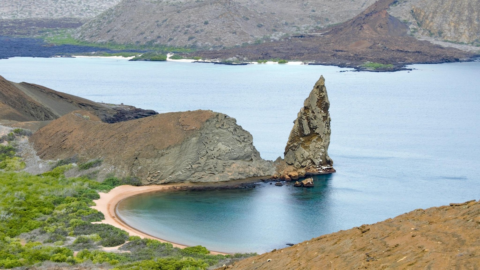
Nowadays, to find a place in the world unreachable by travelers, and especially untouched by overtourism, you really have to venture to remote and probably inhospitable places. Like perhaps the poles, or some small island lost in the oceans. Although, in truth, if those islands are minimally known and relatively close to continental shores, like the Galapagos, the game is already lost. This is reported by an investigation by the New York Times according to which even in thearchipelago off the coast of (and under the jurisdiction of) Ecuador, in the Pacific Ocean, the alarm is going off due to overtourism. The latest data shows that there has been an explosion in tourism even during the low season and that this is putting pressure on the delicate environmental ecosystem of the Galapagos.
A protected reserve that is very important for the economy: tourism, but not only
The archipelago, which has been a UNESCO World Heritage Site since 1959, is known for its invaluable biodiversity: 97% of its territory, made up of 19 islands, is a protected nature reserve, established as a National Park. It was while visiting these places, a couple of centuries ago, that the British biologist Charles Darwin developed the theory of evolution of plant and animal species by natural selection, a cornerstone of humankind's scientific progress. But above all, nature in the Galapagos contributes significantly to the economy: in addition to tourism (provided it is controlled), which alone is worth $275 million a year, there are also fishing ($110 million) and the carbon dioxide captured by plants, which is worth $36 million in green finance, provided the ecosystem remains intact.
To protect all this, the annual limit of tourists had been set by the Ecuadorian government at 12 thousand visitors, but this year according to estimates by the Tourism Observatory 300 thousand will arrive, practically double compared to 2007. The reason for this crisis is easily explained: the new forms of tourism, represented above all by Airbnb, which allow anyone to host people outside the traditional hotel circuit, increasing the availability of beds and simultaneously driving down prices. And with this type of dynamic, tourists obviously rejoice: more options and rock-bottom prices. According to the New York Times, since the pandemic, Galapagos residents have started renting their rooms for as little as $8 a night, or entire apartments for just over $100.
The Airbnb model is creaking, but what are the alternatives?
Decidedly low-cost prices, with the noble result of making tourism more accessible even to the less wealthy. But can it really work like this, even in high-risk environmental areas? "The promise of Airbnb, founded in 2007, has always been this," writes the New York Times. "But around the world, Its success has sometimes led to unwanted hordes of touristsTensions between Airbnb and local communities have become common in recent years, from Barcelona to Beverly Hills, with criticism over rising rents for residents and environmental damage caused by crowds.
In short, the Airbnb model is creaking, but the solutions aren't easy, nor are they unambiguous. The Ecuadorian government itself isn't sure where to start, because it also has its counterpart, the local Galapagos community, for whom this type of tourism is more of an opportunity, if not a necessity, than a risk. It's a fight "for the people," one Airbnb host went so far as to tell the New York Times. "The locals just want to work legally without destroying the environment. In any case, the number of tourists will increase, with or without Airbnb. But Airbnb generates revenue for the Galapagueños, without building new facilities.”