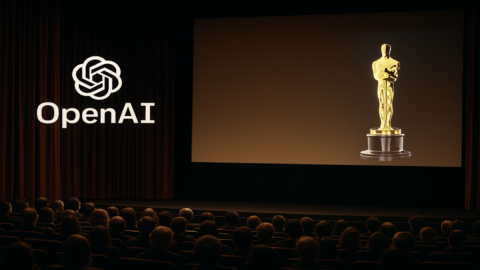
“And the winner is… an algorithm?” It might sound like a comedian's sketch, but it's not. In a couple of years, when the most anticipated envelope in cinema opens in Los Angeles to award the most coveted golden statuette, the name that bounces around might not be that of a director, but of a piece of software. OpenAI, Sam Altman's creature that has already revolutionized communication with ChatGPT, now wants to compete with HollywoodThe intention, in fact, is to bring to the room critter ore, an animated feature film entirely created with artificial intelligence. Release expected in 2026.
Critterz, the first all-AI film: the plot and the concept
The title It reminds me of a 90's cartoon, but the story moves forward. A village populated by fantastical creatures is turned upside down by a mysterious villain, prompting the protagonists to embark on an epic journey. The plot is classic, but the novelty is the method. Behind the direction there is not a visionary like Spielberg, but a GPT-5-driven algorithm battery.
Il creative seed but remains humanThe film's concept was born in 2023 from Chad Nelson, a designer at OpenAI, who attempted to make a short film with Dall-E, the then-newly launched image generator. Three years later, that experiment became a film with global ambitions.
Low budget, record time
While Hollywood burns hundreds of millions and at least three years to make an animated film, Critterz promises to reach the finish line with “only” 30 million dollars it has just nine months of work.
The production is being handled by two experienced studios: Native Foreign of Los Angeles and Vertigo Films of London. A transatlantic alliance that marks the first real "joint venture" between Silicon Valley and the movie camera, with the aim of demonstrating that AI can reduce times and costs without sacrificing quality.
The road to the Oscar is not smooth. There is a significant obstacle. In the United States, content is entirely generated by AI it is not copyrighted. To prevent that critter ore ends up in the cauldron of the public domain, OpenAI has decided to involve real voice actors and graphic artistsAround thirty people will work on the sketches and voices, enough to claim human authorship of the work and divide the rights.
Hollywood trembles (or applauds?)
The case critter ore explodes in a moment of tension between industry and AINetflix has already used it to reduce the cost of special effects, Disney and Universal have sued Midjourney for alleged plagiarism, and the 2023 writers' and actors' strikes have had artificial intelligence among the hot topics.
What's certain is that with this film, OpenAI isn't just experimenting; it's also putting together a film that aims to be the definitive proof of concept. If it works, it'll be hard for Hollywood to back out.
Se critter ore will be successful, the model risks becoming a standardReduced costs, compressed timelines, and potentially infinite content—a huge temptation for the major studios. But the trade-off is quickly apparent: less work for traditional screenwriters, animators, and artists, with the risk of an increasingly uniform cinema, "trained" to please algorithms.
For supporters, AI can democratize manufacturing and open up new creative avenues. For the critics, is the beginning of a soulless cinema, more similar to an advertising rendering than a work of art.
What if the future Oscar belongs to AI?
The question is less absurd than it seems. Or at least it's no longer science fiction. OpenAI wants to debut the film at the Cannes Film Festival to then launch it in theaters around the world in the second half of 2026. If the film convinces audiences and critics, the the Oscar race would no longer be a joke.
And so, yes, at the Dolby Theatre in Los Angeles, we might actually hear the historic announcement: "And the Oscar goes to… GPT-5." With all due respect to the screenwriters, directors, and actors, who will have to learn to live with colleagues who don't forget their lines and don't demand stellar fees.