The Olympic effect doesn't end with a temporary spike in visibility or consumption, but acts as an accelerator of processes already underway, pushing the Italian system, and Milan in particular, toward a new configuration in which city, housing, and material culture become parts of a single symbolic and economic infrastructure.
Luxury is no longer exclusivity
The luxury market, in this context, is progressively moving away from the idea of exclusivity From purely ostentatious to take the form of a complex experience, intertwined with locations, architecture, and design, where value is no longer merely embedded in the product but in the narrative surrounding it, the context in which it is enjoyed, and the quality of the relationships it fosters between public and private spaces. The Olympics help strengthen this dynamic by attracting a highly targeted global audience, making Milan and Cortina showcases of an Italy that presents itself as a laboratory of contemporary living, where sport, culture, fashion, and design converge in a coherent aesthetic of excellence.
Milan, the most sought-after city
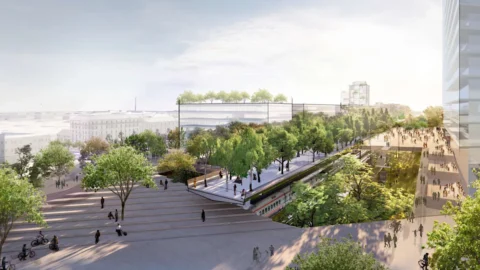
At the same time, the luxury real estate market is being restructured not only in terms of prices, but also in terms of valuation criteria: location remains central, but is increasingly influenced by architectural quality, sustainability, the presence of integrated services, and the buildings' ability to offer a living experience that engages with the city. The areas involved in the Olympic projects, particularly in Milan, are becoming case studies of a new urbanity in which residences, public spaces, and infrastructure intertwine, generating a legacy effect that favors selective investment and a more sophisticated demand, interested in both yield and cultural and design prestige. The Olympic Village, destined to be transformed into a large student housing complex, emblematically represents this trend: not an isolated intervention, but a development model that combines density, design quality and functional mix, prefiguring a future in which luxury does not necessarily coincide with the rarefaction of space, but with its care and articulation.
Luxury, real estate and hospitality
In this scenario the luxury market tends to integrate more and more with real estate and hospitality, giving life to branded residences, projects signed by renowned architects and living spaces that take on characteristics typical of high-end hotels, dissolving the boundaries between home, service and representation. Furniture and design, seen through the lens of the next Salone del Mobile in Milan, in turn become strategic nodes of this transformation., because they don't just decorate spaces, but contribute to defining their economic and symbolic identity. Luxury design is shifting toward greater attention to materials, contemporary craftsmanship, and sustainability, replacing visual excess with a more subtle and enduring refinement. Meanwhile, a growing collectible design market is emerging, featuring limited editions, collaborations between fashion brands and furniture companies, and pieces that function as true cultural as well as commercial assets. The Salone del Mobile, in this sense, becomes a barometer of the transformations taking place, showing how the market is polarizing between an increasingly sophisticated high-end segment and a widespread quality offering that continues to represent the productive strength of Italian design.
Growing interest in real estate and high-end furniture
The Olympic Games, By amplifying Milan's international exposure, they also strengthen the export dimension of the sector, encouraging greater demand in the Middle East, Asia and the United States. and consolidating Italy's image as a global benchmark for design and living. Economically, the overall effect tends to produce selective growth: real estate values are rising especially in areas with genuine urban quality, while luxury is stabilizing at higher levels than in the pre-Olympic period, with a growing focus on experiences and iconic products rather than purely status-driven consumption. High-end furnishings are benefiting from this reconfiguration, seeing both average prices and the value attributed to designer pieces and exclusive collaborations rise, while real estate developers are increasingly seeking partnerships with design brands to create distinctive and coherent residential projects. Thus, the 2026 Olympics are not an isolated incident, but a moment of structural reorientation in which the luxury market, real estate, and design are intertwined in a new balance founded on quality, the integration of architecture and furnishings, and a concept of luxury that prioritizes experience, culture, and design over the simple accumulation of goods.