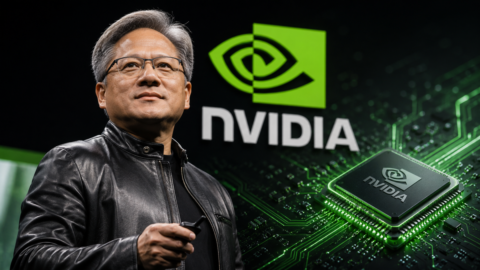
Even if the quotations of the securities related to theartificial intelligence are taking a break after the powerful rallies, the industries in the sector they continue to march undaunted trying to respond to a explosive demand for chips, while the queen of artificial intelligence, Nvidia, shows plans that are expanding to robotics, personal computers, and supercomputers. This morning Jensen Huang, CEO of Nvidia, at the end of tour in South Korea started Friday, announced a set of chords with tech giants of the country to secure crucial memory chips to fuel its ambitions and attract new customers.
Huang signs multi-year agreement with SK Hynix for advanced memory chips
The agreements involve companies such as the giant SK Hynix, Besides Lg group, SK Telecom, Naver, Doosan Group, Hyundai Motor Group. SK Group, the country's second-largest conglomerate, confirmed that its divisions SK Hynix and SK Telecom have reached agreements with Nvidia, adding that they have signed a multi-year technological partnership to develop advanced memory chips for global AI data centers. “SK Hynix has been Nvidia's primary partner in the memory business and will continue to be so,” Huang said after meeting with SK Group Chairman Chey Tae-won. The agreement with SK Hynix, which is a competitor of Samsung Electronics and of the American company micron Technology, will help keep the offering up to date with theNvidia expansion in the sector of robotics, personal computers, and AI supercomputers. “We already purchase billions and billions of dollars worth of products from SK Hynix every year, and that figure is destined to grow considerably“, Huang said.
The other South Korean companies involved
Among the other agreements signed is the one with Sk Telecom who announced the construction of a cloud for gigawatt-scale AI in South Korea, using Nvidia technology, with the first dedicated AI data center coming online in 2027. Nvidia also said that the internet giant Naver and the conglomerate Doosan They will use its technology to help build AI data centers. Doosan, a company that develops robots and produces materials used in Nvidia's most powerful Blackwell chips, said it expects its energy solution to be used in Nvidia's data center platforms and will also leverage the U.S. company's physical AI technology.
In particular regarding the robotics, Nvidia has also accelerated collaboration with the LG Group, Huang said this morning: “We are collaborating with them both in the field of motor technology and in that of mechanical systems, so that we can combine the humanoid robotics to the future of robotics,” he told reporters after a meeting with LG Group Chairman Koo Kwang-mo in Seoul. “We are also collaborating with LG in the design of the future data centers“, including cooling, power supply, and the entire design and construction of data centers.
Huang, after also meeting Euisun Chung, executive chairman of Hyundai Motor Group, said Nvidia will deepen its partnership with Hyundai in a series of artificial intelligence initiatives, including autonomous mobility, la robotics and AI-based manufacturing. He also highlighted opportunities to accelerate the development of industrial robotics, stating that Nvidia and Hyundai will collaborate to bring artificial intelligence to “all forms of mobility” and to deepen collaboration in the field of robotics for practical industrial applications. Huang described the AI data center that Hyundai Motor Group intends to build in Saemangeum an “AI valley”, similar to California's Silicon Valley, and said he was “very happy to build Nvidia’s headquarters in Saemangeum.” Huang is also expected to meet with heads of Samsung.
Despite the agreements, Kospi collapses, but Huang confirms that the future of artificial intelligence is very promising.
Despite the agreements, the desire to achieve worldwide starting from Wall Street after the powerful rallies, together with the fears of a interest rate hike of the Fed have triggered heavy sales of the KospiSouth Korea's benchmark stock index plunged 8,3% today, its biggest daily decline since March 4, which also triggered circuit breakers, the electronic system that automatically suspends trading in the event of excessive fluctuations. Closing at 7.484,41 points, it is now 15% below the peak of 8.801,49 reached on June 2. Despite today's losses, the Kospi is up 78% year-to-date. It has posted a 76% gain in 2025, its biggest gain since 1999 and the best performance among major global markets last year. "Theincreased volatility It is inevitable, but the collapse is unlikely to last for several days, given that the pressure on Kospi valuations has been eased by the recent correction and earnings momentum remains robust for semiconductor stocks,” he said. Reuters Han Ji-young, analyst at Kiwoom Securities.
Asked about the global collapse of semiconductor stocks, Huang downplayed the concerns. “Everyone should be enthusiastic; now they can buy shares at a lower price, and it is absolutely true that the future of artificial intelligence is very promising." he said.
Samsung Electronics fell by 10,2%, and the competitor SK Hynix The two South Korean chipmakers were the driving force behind the index's record surge, buoyed by record profits. This year alone, their market capitalizations have increased by more than 150% and 200%, respectively, now representing more than half of the benchmark index and propelling them into the club of companies with a market capitalization above $1 trillion. The e-commerce company Naver was the exception among the index's major stocks, rising 9,2% thanks to a deal with Nvidia, while Hyundai Motor fell by 8,7% despite an agreement with the US manufacturer to expand their collaboration.