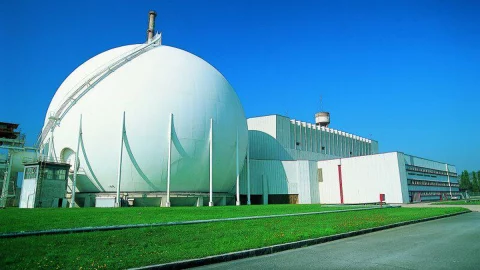
Concerns arising from the Russian attacks on Ukrainian nuclear power plants for three years they have been constant and affect thousands of people. All those who live near the plants, even more so since the beginning of the war, aspire to greater security. The Russian attacks have devastated hectares of land that will hardly return to the state before. It may also be for these reasons that Ukraine is joining the European Assas project of 4 million euros to prevent "severe" incidents in the nuclear reactors. The project is coordinated by the French company Asnr and has the participation of 14 partners from EU countries. Representing Italy is theAeneas.
Nuclear: A Model of Artificial Intelligence
The project adopts a model of Artificial intelligence to improve accident simulation calculations. This is clearly true for the hundreds of plants around the world. “Assas aims to create a prototype simulator based on a code to model, calculate and visualize in real time the main phenomena of an accident through an interactive graphical interface,” he says Fulvio Mascari Enea responsible for the project. The code that will be used is known by the acronym Astec, it was prepared specifically for emergency management.
The scientific model that researchers are engaging in will have to combine temporal analysis with site relationships to optimize the calculations. nuclear accidents are still the strongest deterrent against the construction of new sites. The widespread fears that new technologies are breaking down, concern above all the release of pollutants and dust outside. Suggestive to experiment with the application of AI in laboratory simulations.
Nuclear: Safety and Response Strategies
The ultimate goal – say the researchers – is to improve safety when accidents occur by adopting ready and tested response strategies. Only a few simulators in the world today model severe accidents that can lead to nuclear core meltdown. The time factor is certainly fundamental and for this reason the European project has among its objectives a calculation speed such as to offer those who work on the simulator a realistic training experience. For Enea the next steps include the validation of the models to increase the accuracy of the simulations. Hoping that they will remain in the laboratories forever.