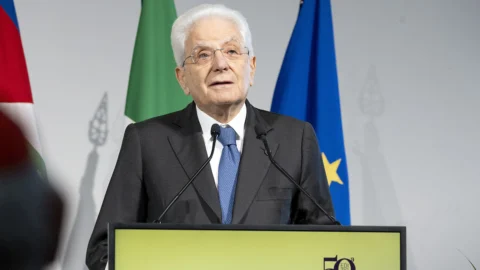
Sergio Mattarella returns to the crosshairs of RussiaThe President of the Republic was added of new section of the Russian Foreign Ministry's website, titled “Examples of manifestations of Russophobia”. The portal collects statements, names and quotes of Western and Ukrainian leaders, accused by Moscow of spread hate against Russia. But no response came from the Quirinale: the head of state chose to remain silent and focus his attention on far more serious issues, starting with the tragedy in Gaza. A gesture that confirms the profile of a head of state with sober tone and firm principles.
The Foreign Minister was also present with the Head of State Antonio Tajani and the Minister of Defense Guido Crosetto end up on the list. A move that provoked an immediate reaction from the Ministry of Foreign Affairs, which announced the summoning of the Russian ambassador a Roma.
The Russian page isn't strictly speaking a "blacklist," but presents itself as an ideological archive: it collects textual statements, dates, and contexts attributed to international public figures, with the intent of labeling anyone who criticizes Moscow as Russophobic. According to the Kremlin, many of the collected statements violate a UN resolution on promoting intercultural dialogue and tolerance. But in reality, the section seems to respond more to the needs of propaganda than diplomatic logic, designed to convey an image of the world through the distorting lens of Russian rhetoric.
Why Mattarella ended up in Moscow's crosshairs: the disputed passages
The first Italian name appears almost immediately: Sergio MattarellaThe President of the Republic is cited for two public speeches, reported in full in the new Russian section. The first dates back to February 2025, during one lecture at the University of Marseille, in which the Italian president declared: “The principle of dominance prevailed, not cooperation. And these were wars of conquest. This was the Third Reich's plan in Europe. The current Russian aggression against Ukraine is of this nature.”
The second incriminating passage dates back to May 2024, during the ceremony for the80th anniversary of the Battle of Monte Cassino“The tragedy of the Ukrainian people reminds us of the destruction that has struck European countries and invites us to renew our commitment to defending peace, freedom, and the rule of law from dictatorial regimes.”
For Moscow, these words constitute "incitement to hatred." For the rest of the world, they seem like ordinary declarations condemning a war.
And it's not the first time that Moscow has taken it out on the Italian president: Maria Zakharova, spokesman for the Russian Foreign Ministry, had already accused him of “blasphemy”, even going so far as to launch a online petition A farcical petition against him, signed by supposed citizens with unlikely names. Not content with that, Zakharova herself also proposed establishing an "International Day Against Russophobia" and released a digital sticker with the Russian word "ukokoshit," a colloquial term that can mean "to eliminate" or "to send to the other world."
Mattarella ignores the list and raises his voice against Moscow and Israel: "Stubbornness to kill."
During the Fan ceremony at the Quirinale, in front of parliamentary journalists, Mattarella spoke for 25 minutes without May quote the Kremlin listA decision that's worth more than just a controversy. No comment, no changes to the speech: "because we don't consider it a serious matter," they said from the Quirinal.
The president instead focused attention on other dramas, in particular Gaza, defined as "day by day, dramatically, more serious and intolerable." He accused the Israeli government of systematic destruction: "It is difficult, in such a chain, to see an involuntary repetition of errors and not recognize a determination to kill indiscriminately." Then the Latin comment: "Errare humanum est, perseverare diabolicum".
Also clear is the condemnation of the invasion of Ukraine"Russia's aggression against Ukraine has changed the history of Europe," declared Mattarella. "That great country, which remains so despite the grave responsibilities its current leadership has assumed before history, has increasingly taken on a disconcerting configuration geared toward a clash of military power."
Finally, a warning about the Italian government's withdrawal from the Global Pandemic Agreement. For Mattarella, the WHO remains a "fundamental point of reference for everyone's safety."
Moscow: Tajani and Crosetto also on the list
Two interviews with the... also end up in the cauldron. Messenger, both released in 2024: The words of Tajani, in particular, linked the Ukrainian resistance to the Italian partisan struggle: “I would like to see blue and yellow flags at the march on April 25. Ukrainian fighters, like the partisans and soldiers of the 1945 liberation army, are fighting for freedom.” Crosetto, for his part, had declared: “Putin wants all of Ukraine, and no one guarantees that he will stop there.”
These phrases, in any other context, would fall within the scope of normal geopolitical debate. But according to the Russian Foreign Ministry, they constitute "incitement to hatred." Surprisingly, a phrase by French Minister Stéphane Séjourné also appears, perhaps by mistake, in the Italian paragraph.
Who else is on the “Russophobe” list?
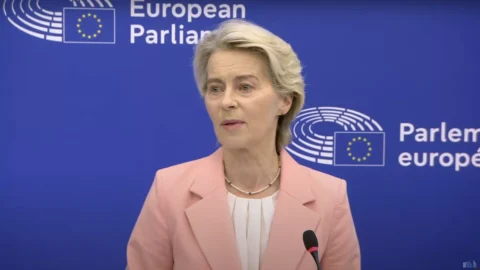
Italy isn't the only country in Moscow's sights. The new digital "blacklist" includes prominent figures in European and international politics. From the German Chancellor Friedrich Merz to the French President Emmanuel Macron, passing through the Dutch Prime Minister Mark Rutte, who is being challenged for three statements. The EU High Representative for Foreign Policy is also present, Kaja Kallas, protagonist with seven incriminating citations. On the other side of the Atlantic, the only American reported is Senator Lindsay Graham, known for having speculated, in a rather explosive manner, that the United States might bomb Russia if Moscow did not respect an ultimatum imposed by US President Donald Trump to resolve the Ukrainian crisis.