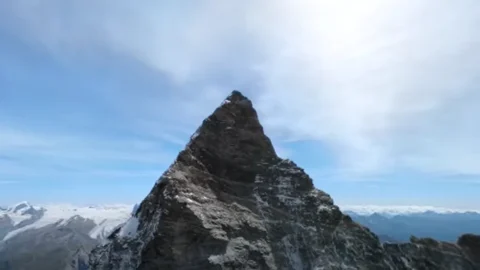
In addition to bringing waves of earthquakes and cloudbursts, the climate change He also began to remodel the borders between the states. Switzerland e Italy are witnesses of this phenomenon: due to the melting glaciers, the two nations have agreed to review the border route under the Monte Cervino, one of the most iconic peaks in Europe, which separates the Swiss region of Zermatt laid down by the Valle d'Aosta in Italy.
In mountainous regions, the borders between Italy and Switzerland have historically been defined by the ridges of glaciers and perennial snow. However, with the continuous melting of these glaciers, the Swiss government has stated that “these natural elements evolve and redefine the national border when this is determined dynamically”. Among the glaciers more at risk, the one that stands out is the Marmolada, which is losing about 7 cm a day and could disappear by 2040. Unfortunately, it is not the only one: the Mer de Glace, on the French side of Mont Blanc, and the glaciers of the valpelline in Valle d'Aosta they are undergoing a drastic thinning.
The new border agreement between Italy and Switzerland
The famous Zermatt ski resort is directly involved in this change. Italy and Switzerland have agreed to change the border around landmarks such as Testa Grigia, Plateau Rosa, Rifugio Carrel and Gobba di Rollin, all for economic reasons. A joint commission agreed on the changes in May 2023, and while Switzerland has already approved the agreement, it waits still there company final of theItaly. The redrawing of the border should clarify responsibilities for the maintenance of specific natural areas, but also put an end to long-standing territorial disputes.
Glaciers at risk: a race against time
In 2023, Swiss glaciers took a major hit, losing 4% of their volume, the second largest annual decline on record, following a 6% decline in 2022. Swiss Glacier Monitoring Network (Glamos) attributed this reduction to particularly hot summers and insufficient snowfall, launching thealarm: Some glaciers are melting at such a rate that, even with global temperatures kept within the 1,5°C increase of the Paris Agreement, they may not survive.
But the decline of glaciers does not only concern Switzerland and Italy, but the entire Alpine arc. According to Legambiente's "Glacier Caravan 2024", an international monitoring campaign carried out in collaboration with the Italian Glaciological Committee, 12 glaciers between Italy, France e Slovenia have been studied to understand the impressive speed of their retreat. Among these, the Valpelline glaciers, increasingly injured, and those adjacent to the Flua on Monte Rosa, extinct since 2017, are worth mentioning. The Piode and Sesia-Vigna glaciers are also disappearing rapidly, confirming a worrying picture: Italy and Europe risk being left without glaciers in a few decades.
Marmolada could disappear by 2040
The glacier of the Marmolada, the largest in the Dolomites, is one of the most evident symbols of this phenomenon. After the collapse of a part of the glacier that caused the death of 2022 people in 11, experts warn that the Marmolada it could disappear completely within the 2040. Monitored since 1902, it is a true “natural thermometer” of climate change.