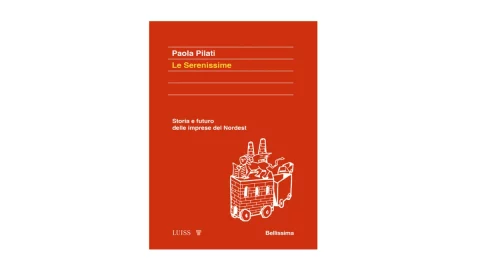
“Tell the story of the changing Northeast. Remove the dust from the image of the territory that remained crystallized from the boom years, verify what is left alive of the business model that spontaneously sprouted, between the seventies and eighties, from a peasant culture and which multiplied in an extraordinary imitative effect, giving life to a globally successful production fabric, rooted and organized in the districts. Telling the story of the new Northeast, sometimes caught in full transition, sometimes decisively shaped by new connotations. This is the mission with which this book was born” by Paola Pilati “Le Serenissime. History and future of companies in the Northeast”, published by Luiss University Press.
History and future of Northeastern businesses: the generational transition
“Il generational change – Pilati writes in one of the central chapters of her new book – coincides with a new culture of doing business. It will make us evolve." TOAntonella Candiotto, managing director of Galdi, second generation is optimistic about one of the most complex transitions in the Northeast, due to its socio-economic fabric much more divisive and pervasive than any other transition, whether energy or environmental. The passing of the baton from the founder to the heirs is always delicate, in this territory, where the fathers' generation often had a lot of talent in their hands but little schooling, that of the children moves between masters, international milieu, consultants. It means a very radical change of values, of vision, even of relationships with employees. Two different worlds. But the signs often remain of that transition, the idea of a crossroads between freedom and destiny, the sense of a responsibility that cannot be betrayed.
“I grew up with the company name tattooed on my heart,” he admits Mario Roberto Carraro, the managing director of Mecc Alte, who left his university career because of that familiar call, and one guesses a vein of regret. Tattoos that date back to childhood, stories of children brought to the shop with an indelible imprint: "The company has been part of our lives since we were children", he says Mirco Male, heir with his brother Andrea of the agricultural machinery company founded by his father Egidio: “When he finished school my father took me with him: I had my overalls, I stamped the time card and tightened bolts. For me it was a game, but it served to convey to me the value of work and the love for that place".
The magnetism of family business
Not all stories start out the same as, when questioned by students, there are few sons of entrepreneurs who see their fate already sealed. Yet the magnetism of the family business wins in the end, permeated as it is not only by head decisions, but above all by gut decisions.
The arrival of the new generations he has certainly brought a broader and more sophisticated vision of the business world into the command rooms, he has opened the door to external consultants, once seen as intruders from the world of the fathers, he has been able to elaborate plural governance and no longer centered on a single man guide.
The boundaries
The passing of the baton is also an opportunity to clarify the boundaries between company and family. The enlargement of the clans and the management of the possible internal conflicts have led to the definition of family pacts for the entry of the new generations, because not all children necessarily have to inherit the cloche, but if they want it they must certainly demonstrate that they know create value. Agreements therefore that provide for drastic blocks for home broods: a degree is essential, as well as a period of experience abroad, possibly abroad, and even the demonstration of knowing how to found your own business becomes the test for admission to the upper floors of the company.
The adulthood of northeastern capitalism
Taking responsibility by forty/fifty-year-olds it has already begun to change the face of the Northeast. It has given them a ruling class that comes from the provinces, which feels on a par with companies that already have five generations behind them, those in Lombardy or Piedmont, from which here in the Northeast they felt looked upon with a certain superiority. Above all, this new generation is giving very good proof. And it stimulates emulation: "In Confindustria, 60% of young entrepreneurs are first generation", he points out Giordano Riello, grandson of the founder of Aermec of the same name. To say that the desire to do business hasn't stopped, that the genius loci of the Northeast in giving space to individual initiative remains alive. The fact that companies remain familiar in terms of control, but they are less and less "of the family" as a style of command, where the cash register is no longer held by the former banker who has retired, the balance sheet is no longer written by the accountant at home, paves the way foradulthood of northeastern capitalism. What can truly ensure the life of the company over time is its durability amidst the dangers of the future.
Paola Pilati
Paola Pilati, journalist, worked for the weekly L'Espresso, where she was in charge of the Economy pages for over 15 years. You have dealt with the various aspects of the sector, from construction to transport, from energy to finance, from trade unions to social security and macroeconomics.